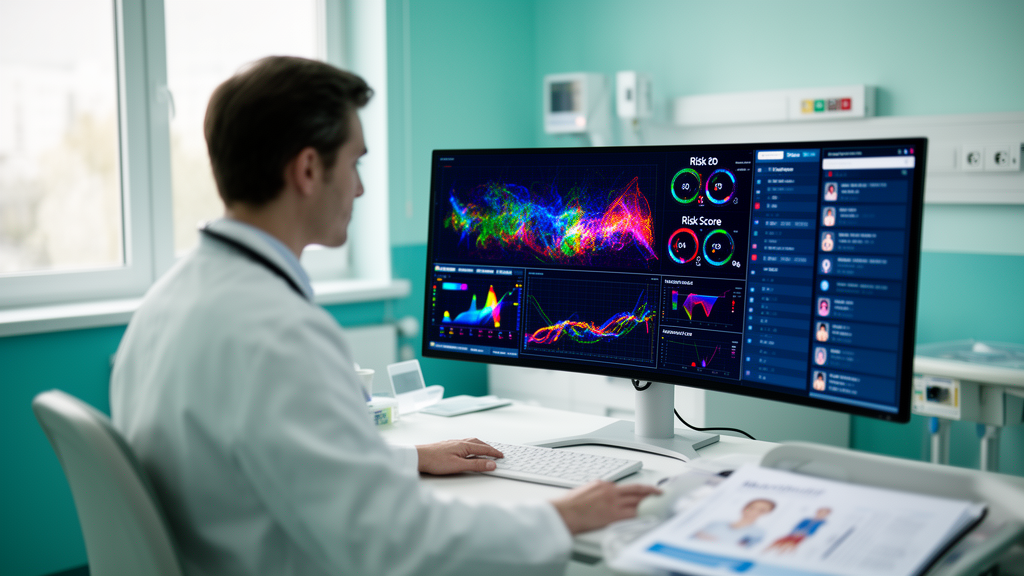
Machine learning models built on routinely collected health information could help identify people at higher risk of several common cancers, according to an international study presented at the ESMO Congress 2026. The research, led by investigators at the Else Kröner Fresenius Center for Digital Health at TU Dresden, Germany, used data already gathered in everyday care, including blood tests, medical history and lifestyle factors, to predict individual cancer risk across 20 cancer types.
The team developed approximately 500 machine learning models and trained and evaluated them using data from 463,620 UK Biobank participants followed for approximately 18 years, during which 57,055 participants developed cancer. The models drew on medical history, lifestyle factors, blood tests, and genetic and metabolomic data. To test how well the models generalised beyond the original cohort, the researchers evaluated them in participants from Scotland and Wales, in 42,036 people from the US All of Us research programme, and in more than 3 million individuals from Japan’s JMDC database. Cancers diagnosed within the first year were excluded from the relevant models to reduce the influence of disease that was already present but undiagnosed.
The models outperformed traditional statistical approaches, although predictive performance varied considerably across cancer types. For a combined cancer outcome covering cancers that could be predicted from routine clinical data, the models achieved an area under the curve (AUROC) of 0.83 at 15 years, where 0.5 represents prediction no better than chance and 1.0 represents perfect prediction. Performance was particularly strong for lung, oesophageal and liver cancers, but more limited for ovarian, breast and cervical cancers. For acute myeloid leukaemia and multiple myeloma, performance declined when predictions were made further ahead, suggesting that some short-term predictions may partly reflect early signs of cancer that was already present but not yet diagnosed.
Much of the predictive information came from routine blood tests and clinical history. Blood tests continued to add predictive value for cancers diagnosed more than five years later, while genetic and metabolomic data contributed only a small further improvement. The researchers also developed PRE-Screen, a toolbox that enables artificial intelligence agents based on large language models (LLMs) to run the risk models consistently. In their tests, agents using the toolbox performed substantially better than LLMs attempting to make predictions unaided.
“For selected cancers, these models could serve as a low-cost pre-screening step using data already available in routine care,” said lead author Dr Paul-Henry Koop of the Else Kröner Fresenius Center for Digital Health, TU Dresden. “Existing screening programmes cover only certain cancers and often use broad eligibility criteria, rather than assessing each person’s individual risk.” In the European Union, screening recommendations have traditionally focused on breast, cervical and colorectal cancer, with the Council of the EU also recommending exploration of screening for other cancers.
Koop explained that cancer types differ substantially in their carcinogenic mechanisms and in how strongly their risk factors and precursor conditions are captured in routine data, which helps account for the uneven performance across tumour types. He noted that the models could help target screening or interventions aimed at reducing cancer risk, but cautioned that many people flagged as higher risk would never develop cancer. “A positive flag should therefore trigger minimally invasive testing first,” he said. Because the study analysed existing data retrospectively, further research is needed to establish whether the approach actually leads to earlier diagnosis or better patient outcomes.
Independent experts emphasised the need for broader validation. “What is needed is a comprehensive assessment of the proposed protocol in various kinds of populations and settings, external to the UK Biobank cohort,” said Dr Marco Lorenzi, Research Director at Inria Sophia Antipolis, Université Côte d’Azur, France, who was not involved in the study. He stressed that further validation was required to assess the reliability and generalisability of the findings and to identify potential biases before the models could be relied upon in clinical practice.
Nevertheless, Lorenzi saw promise in the approach. “The automated analysis protocol proposed in this work may represent a valuable instrument for patient prioritisation, early detection and risk assessment,” he suggested. “The benefit would be alleviating the burden of care on society and the healthcare system.” If prospective studies confirm that risk-targeted follow-up improves early detection, models of this kind could complement existing population screening programmes by concentrating resources on individuals whose routine data indicate elevated risk.
Subject of Research: Machine learning prediction of cancer risk from routinely collected health data
Article Title: Machine learning could help identify people at higher risk of common cancers using routine health data
Article References: Machine learning could help identify people at higher risk of common cancers using routine health data. Original publication (Bibliographic details unavailable.)
Image Credits: AI Generated
DOI: Not provided
Keywords: machine learning, cancer risk prediction, ESMO Congress 2026, UK Biobank, routine health data, AUROC, screening, PRE-Screen, large language models, blood tests, early detection, prospective validation
News Source: Nathaniel Bowman. (October 27, 2026). Machine learning models flag higher cancer risk from routine health data. Scienmag.