


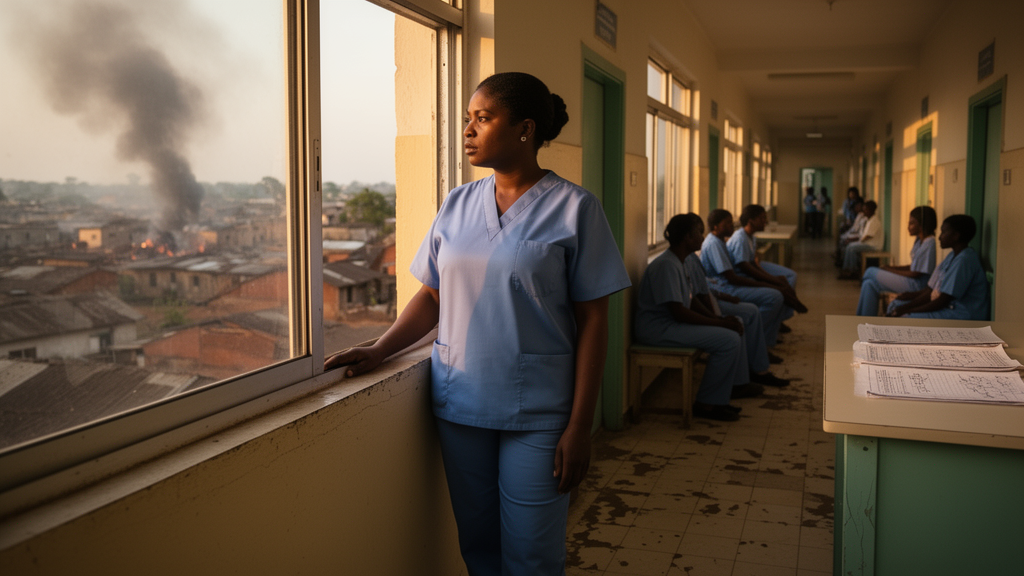
Healthcare workers who believe their health system is resilient are markedly more likely to be personally resilient themselves, according to a cross-sectional study conducted at Tibebe-Ghion Teaching Referral Hospital in Northwest Ethiopia. Demographic data were collected alongside these measures, and the analysis was carried out in SPSS version 27. Statistically, the researchers summarized categorical variables as frequencies and percentages and discrete variables as means.
They then applied binary logistic regression with 95% confidence intervals, treating results as significant when the P value fell below 0.05. This approach allowed them to estimate how demographic characteristics and perceived system resilience related to the odds of high personal resilience, while adjusting for other factors in the model. Education emerged as a clear dividing line in how providers judged their system.
Compared with workers holding short-cycle tertiary education, classified as ISCED level 5, those with second-degree qualifications were substantially more likely to perceive the health system as resilient, with an adjusted odds ratio of 4.753 (95% confidence interval 1.237 to 18.263). Providers with third-degree education showed an even stronger association, at an adjusted odds ratio of 8.968 (95% confidence interval 1.990 to 40.418). The central finding concerned the link between the two forms of resilience.
Healthcare providers with higher perceived health system resilience reported higher personal resilience, with an adjusted odds ratio of 2.165 (95% confidence interval 1.506 to 3.113). In practical terms, workers who trusted their institution's capacity to endure shocks were more than twice as likely to show strong personal coping, a relationship that held after statistical adjustment. The authors interpret this pattern as a challenge to the idea that resilience is purely an individual trait that employees must summon on their own.
Their conclusion states that recovery from adversity is related to how robust a provider perceives the health system to be, highlighting that adaptive coping is deeply tied to workplace trust rather than expecting individual employees to single-handedly bounce back from stress. The setting gives the finding particular weight. Tibebe-Ghion Teaching Referral Hospital operates in a low- and middle-income country context where civil unrest has strained health services, making the workforce's perceptions of institutional support a matter of both staff welfare and service continuity.
As with all cross-sectional designs, the study captures a single point in time, so it can establish associations but not prove that perceived system resilience causes personal resilience. The confidence intervals for the education-related odds ratios are wide, reflecting uncertainty in those estimates, and the results describe one hospital's workforce rather than the entire Ethiopian health sector. Even so, the data suggest that in crisis-affected settings, strengthening the visible resilience of the health system itself may be inseparable from supporting the psychological endurance of the people who staff it.
Subject of Research: Personal resilience and perceived health system resilience among healthcare workers in Northwest Ethiopia
Article Title: Healthcare workforce resilience amidst civil unrest: a cross-sectional study on personal coping and health system resilience knowledge in a low-and-middle-income-country setting
Article References: Gelaw, T. T., Tilahun, S. F., & Getahun, M. A. (2026). Healthcare workforce resilience amidst civil unrest: a cross-sectional study on personal coping and health system resilience knowledge in a low-and-middle-income-country setting. BMC Health Services Research. https://doi.org/10.1186/s12913-026-15477-z
Image Credits: AI Generated
DOI: 10.1186/s12913-026-15477-z
Keywords: healthcare workforce, resilience, health system resilience, Ethiopia, cross-sectional study, civil unrest, Connor-Davidson Resilience Scale, logistic regression, low- and middle-income countries, occupational health, Healthcare, workforce
News Source: Ophelia Keating. (October 27, 2026). Research report: Healthcare workforce resilience amidst civil unrest: a cross-sectional study on personal coping and health system resilience knowledge in a low-and-middle-income-country setting. Scienmag.



