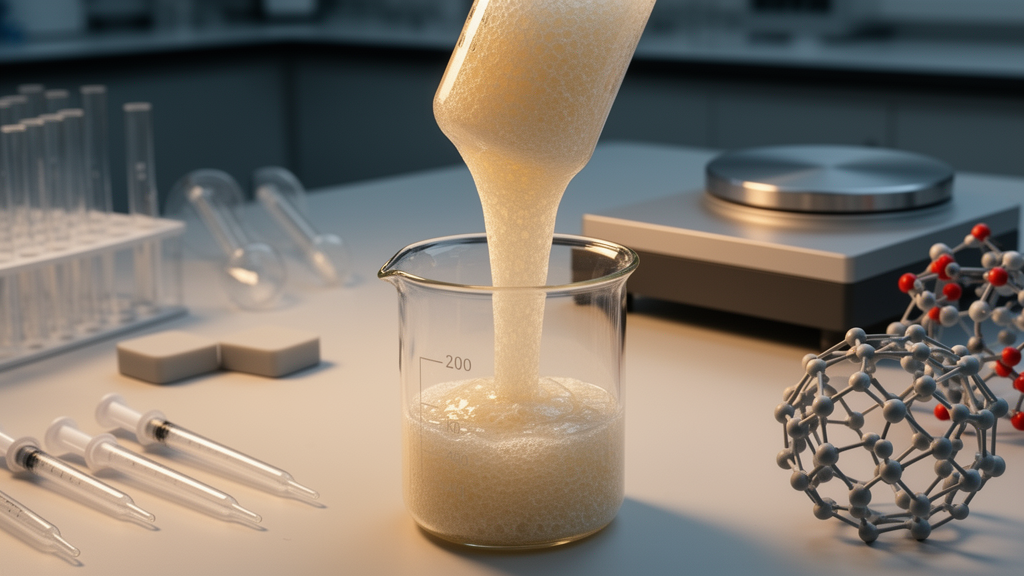
A solvent-free liquid whose flow behaviour can be dialed across a factor of roughly 170 million—without touching its pore volume—has been reported by a Kyoto University-led team. The strategy, published in the Journal of the American Chemical Society on August 4, 2026, rests on a deceptively small change: swapping the chemical groups displayed on the surface of porous cage molecules. Those surface groups dictate how the polymer chains surrounding each cage fold or stretch, and that conformational switch alone transforms the liquid from something that pours like warm honey into a material that behaves like a solid over short timescales yet still flows when given hours.
The fluids in question belong to a rare class known as type I porous liquids, in which the cavities themselves are the molecular constituents rather than being dissolved in a solvent. The researchers built theirs from cuboctahedral rhodium-based metal-organic polyhedra (MOPs), cage-shaped hosts with permanent internal porosity. Twelve flexible polyethylene glycol (PEG) chains were grafted onto each MOP core, producing star-shaped molecules that pack together into a fluid with no diluting solvent at all. Four different surface functional groups and two PEG chain lengths yielded eight distinct liquids. Crucially, within each chain-length series the cavity size, the number of chains, and the chain length were held constant—only the surface chemistry changed.
Synchrotron X-ray scattering and molecular dynamics simulations revealed why such a small modification has such enormous consequences. Dodecyloxy surface groups attract the hydrophobic ends of the PEG chains, prompting them to fold back and hug the MOP surface. The resulting compact polymer shells interpenetrate little and slide past one another readily, so the liquid flows easily. Hydroxy groups, by contrast, leave the chains free to extend outward into neighbouring MOPs, weaving a transient interpenetrating network that strongly resists deformation. The macroscopic consequence is a zero-shear viscosity—at 60 °C—ranging from 18 Pa·s in the most fluid formulation to 3.0 billion Pa·s in the most viscous one, a span of about 170 million. The most viscous samples showed solid-like responses over short times but flowed over longer times, confirming their viscoelastic character.
“We were able to modulate the macroscopic flow behavior without changing the polymer length or the porous volume,” said Xiang Xiang, a doctoral student at Kyoto University’s Graduate School of Engineering. “A change confined to the MOP surface reorganized the conformation of surrounding chains, resulting in a 170-million-fold change in viscosity.” The team included Dr Zaoming Wang, Professor Kenji Urayama, and Professor Shuhei Furukawa of the Institute for Integrated Cell-Material Sciences (WPI-iCeMS), working with collaborators in Japan and Taiwan.
The same surface-controlled polymer shell also acts as a temperature-sensitive gate for gas molecules. Carbon dioxide adsorption measurements at 30 °C confirmed that all eight liquids retained accessible MOP cavities. In the long-chain series, however, accessibility depended strongly on temperature. For the dodecyloxy-functionalized liquid, CO2 uptake rose from 0.29 mol per mol of porous liquid at 0 °C to 1.25 mol per mol at 30 °C—the opposite of the usual temperature dependence in porous solids, where adsorption typically falls as temperature rises. At low temperatures the polymer chains move less and block the cavity entrances; heating mobilizes the chains and opens the way in. Replacing the dodecyloxy groups with hydroxy groups held the chains in a more extended configuration, keeping the gas pathways open even at low temperature.
“This work decouples two properties that have previously been difficult to tune independently: pore volume and liquid viscosity,” said Furukawa. “Relatively low-viscosity liquids could be circulated through gas-processing systems, while high-viscosity liquids may be advantageous for membrane-based separations. The surrounding polymer layer can also act as a gate that regulates molecular access to the pores.”
The decoupling addresses a long-standing trade-off in porous liquid design. Diluting solvent-containing porous liquids lowers viscosity but also dilutes the porous components, reducing the density of available cavities. In solvent-free type I systems, adjusting the length of the attached polymer chains changes the ratio of nonporous material and can inadvertently seal off the pores altogether. By fixing the chain architecture and varying only the surface functionality, the new approach sidesteps both problems: the porosity per molecule stays intact while flow properties swing across eight orders of magnitude.
The practical implications follow directly from that tunability. Low-viscosity formulations are easier to pump and circulate and support faster heat and mass transfer, which matters for carbon dioxide capture and gas separation loops. High-viscosity formulations offer greater structural stability during membrane formation, where a fluid must hold its shape long enough to be processed into a solid film. The temperature-gated CO2 uptake adds a further control dimension, potentially allowing capture performance to be switched with modest heating.
The authors caution that several hurdles remain before such materials reach industrial use. Future work will evaluate mixed-gas selectivity, membrane permeation, long-term durability under repeated cycling, low-temperature flow behaviour, production cost, and scalability—none of which are established by the present study, which characterized single-gas CO2 adsorption and rheology under laboratory conditions.
More broadly, the study demonstrates that the three architectural elements of a porous liquid—the MOP cavity, the surface chemistry, and the surrounding polymer shell—can be designed independently. That modularity offers a general recipe for matching porous liquids to specific chemical processes, from gas capture columns to membrane fabrication, by choosing surface groups that deliver the viscosity and gating behaviour an application demands.
Subject of Research: Surface-group control of polymer conformation to tune viscosity and gas access in solvent-free porous liquids
Article Title: Molecular surface design achieves over 100 millionfold tuning of porous liquid viscosity
Article References: Molecular surface design achieves over 100 millionfold tuning of porous liquid viscosity. Original publication (Bibliographic details unavailable.)
Image Credits: AI Generated
DOI: Not provided
Keywords: porous liquids, metal-organic polyhedra, viscosity, polymer conformation, carbon dioxide capture, gas separation, surface chemistry, molecular dynamics, synchrotron X-ray scattering, membranes, Kyoto University, viscoelasticity
News Source: Bethany Barker. (October 27, 2026). Surface chemistry alone tunes porous liquid viscosity by 170 millionfold. Scienmag.