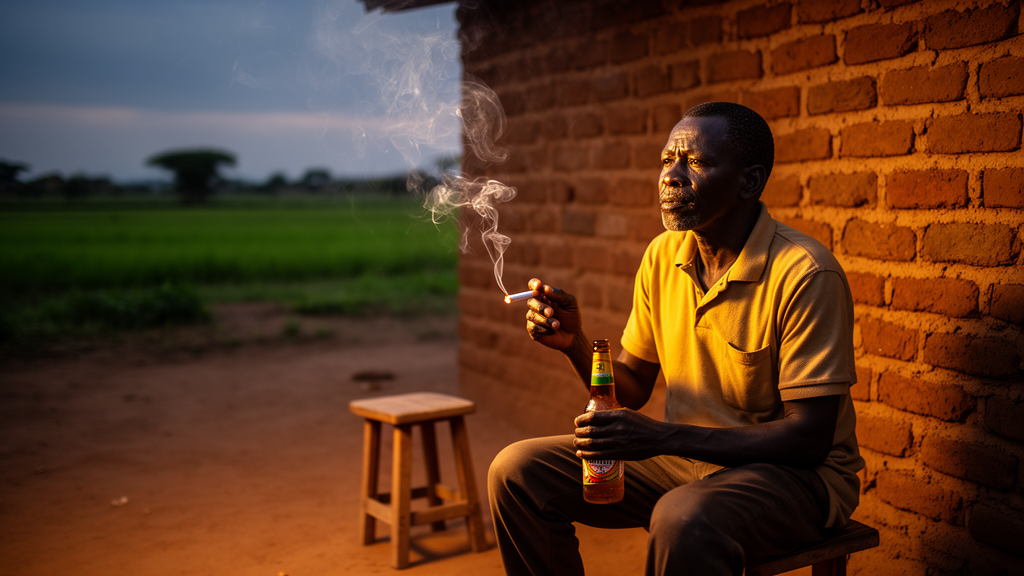
Roughly one in 13 Malawian men smokes tobacco and drinks alcohol at the same time, according to a cross-sectional secondary analysis of the 2024 Malawi Demographic and Health Survey published in BMC Public Health. The study, led by Chimwemwe Ngoma, examined men aged 15 to 54 years across the national survey domains, analysing data from 8,583 respondents after excluding 330 men interviewed in the Dzaleka refugee camp sample from the 8,913 men surveyed, with no missing data. Dual use was defined as current tobacco smoking together with current alcohol consumption, and the analysis applied survey-weighted logistic, modified Poisson and multinomial regression to estimate prevalence and identify associated factors.
The headline numbers show that 12.1 percent of Malawian men currently smoke tobacco (95 percent CI: 11.2 to 12.9), 22.7 percent currently consume alcohol (21.4 to 24.0), and 7.3 percent do both (6.6 to 8.1). That dual-use figure is about 2.7 times the 2.7 percent that would be expected if the two behaviours occurred independently, indicating that smoking and drinking cluster together far more than chance alone would predict. Tobacco smoking and alcohol consumption are major behavioural risk factors for non-communicable diseases that frequently co-occur, yet in Malawi they have typically been studied separately, which is the gap this analysis set out to close.
Dual use rose steadily and reached a plateau around ages 40 to 44 years, where adjusted odds were 15.78 times those of men aged 15 to 19 (95 percent CI: 8.13 to 30.62), and the adjusted prevalence ratio was 12.68 (6.90 to 23.30). Socioeconomic position also mattered in a mutually adjusted model in which education and household wealth were adjusted for each other, employment and the other covariates. Men in the richest households had lower odds of dual use than men in the poorest households (adjusted odds ratio 0.42, 0.27 to 0.65), and men with higher education had lower odds than men with no education (0.40, 0.20 to 0.78).
Employed men, by contrast, had higher odds than unemployed men (1.63, 1.19 to 2.23). Marital status showed a more complicated pattern. Currently married or cohabiting men had higher crude odds of dual use than never-married men, but after adjustment their odds were lower (0.53, 0.35 to 0.78).
When the marital association was stratified by age, it was higher at ages 15 to 24 years but lower from age 25 years. Men who were previously married or separated had higher adjusted odds than never-married men (2.04, 1.23 to 3.37). In a further technical detail, the wealth and education gradients for dual use resembled those for smoking only rather than for alcohol consumption only, implying that the socioeconomic patterning of concurrent use tracks the smoking component more closely than the drinking component.
The authors stress that these are adjusted associations from cross-sectional data, so the analysis cannot establish whether the observed factors cause dual use or merely mark groups at higher prevalence. Sensitivity analyses using continuous covariates, heavier drinking and any tobacco use were conducted to test the robustness of the findings. The study concludes that dual use is unevenly distributed: it is more common among older and employed men and men in the poorest households, and less common among men with higher education.
Because tobacco smoking and alcohol consumption have typically been studied separately in Malawi, the authors suggest that integrating tobacco and alcohol screening and cessation support within existing primary healthcare and non-communicable disease platforms may help address co-occurring use among the groups with a higher prevalence.
Subject of Research: Socioeconomic and demographic patterning of concurrent tobacco smoking and alcohol consumption among men in Malawi: evidence from the 2024 Malawi demographic and health survey
Article Title: Socioeconomic and demographic patterning of concurrent tobacco smoking and alcohol consumption among men in Malawi: evidence from the 2024 Malawi demographic and health survey
Article References: Ngoma, C. (2026). Socioeconomic and demographic patterning of concurrent tobacco smoking and alcohol consumption among men in Malawi: evidence from the 2024 Malawi demographic and health survey. BMC Public Health. https://doi.org/10.1186/s12889-026-30131-3
Image Credits: AI Generated
DOI: 10.1186/s12889-026-30131-3
Keywords: public health, tobacco, alcohol, Malawi, epidemiology, non-communicable diseases, demographic and health survey, concurrent use, smoking, socioeconomic factors, Socioeconomic, demographic
News Source: Phoebe Ingram. (October 27, 2026). Dual smoking and drinking affects one in 13 Malawian men, survey finds. Scienmag.