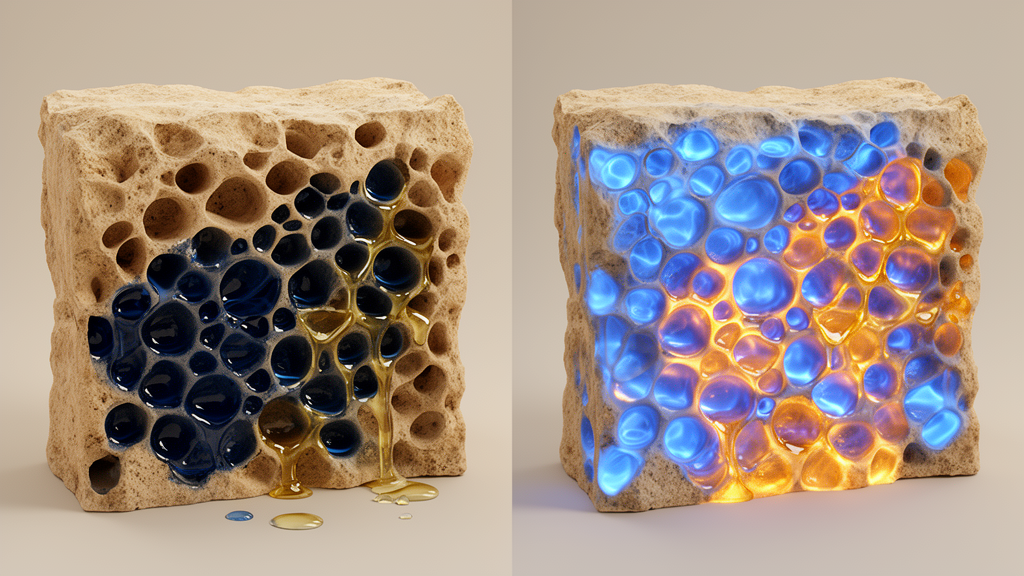
Researchers have simulated how oil invades a water-filled sandstone core plug at the scale of individual pores and compared the results directly with experimental measurements from the same rock sample. The study, published in Discover Fluid Mechanics, applies an enhanced color-gradient lattice Boltzmann model to a three-dimensional geometry extracted from micro-CT imaging of Gildehauser sandstone from the Bentheimer formation. Across four different boundary condition configurations, the simulated final oil saturations ranged from 0.714 to 0.796, bracketing both the published experimental value of 0.78 and the value of 0.7947 reported in an earlier modeling study on the same image dataset.
The work is a second-stage validation of the model. In previous research, the team had verified the enhanced color-gradient lattice Boltzmann method against the analytical Washburn equation for two-fluid displacement in a single straight capillary tube, a controlled benchmark with simple geometry. The new study moves to a considerably more complicated and practical case: a realistic pore geometry obtained from micro-CT scanning, with results compared against physical experimental measurements rather than an analytical solution.
The experimental reference data came from a fast synchrotron-based micro-CT flow experiment on a cylindrical Gildehauser sandstone sample with an average porosity of 20 percent and a permeability of 1.5 plus or minus 0.3 darcies. The rock was described as strongly water wet, and the primary drainage experiment injected a non-wetting phase at a constant rate of 1000 microliters per minute until a final non-wetting phase saturation of 78 percent was reached. The researchers verified the published saturation value by computing the average oil saturation over the full image dataset and obtained 77.5 percent, confirming the reference figure.
For the simulation domain, the team extracted the maximum inscribed rectangular prism from the original cylindrical image, following the approach of an earlier validation study that used the same dataset. The extracted sub-volume measured 566 by 550 by 552 voxels, equivalent to 2.49 by 2.42 by 2.43 millimeters, at a voxel resolution of 4.4 micrometers, with an average porosity of about 19 percent. Fluid buffers of 16 lattice units were attached to the inlet and outlet boundaries, and the domain was initially fully saturated with water except for the inlet buffer, which was filled with oil.
A central contribution of the study is a complete mapping between the experimental parameters and the lattice Boltzmann parameters. The authors note that in previous pore-scale simulation studies that compared against experimental data, the mapping between available experimental data and lattice Boltzmann parameters was either absent or only partially reported, making the simulations impossible for others to reproduce or extend. In the present work, the simulation parameters match all available experimental values, including image resolution, fluid viscosities and viscosity ratio, interfacial tension, and injection rate, together with the derived length, mass, and time units and the relaxation times of both fluids. This mapping allowed the drainage displacement to be simulated at the experimental injection rate itself rather than at numerically convenient conditions. Earlier studies had run simulations at capillary numbers two orders of magnitude above experimental values, or more than forty times the experimental value, and relied on constant inlet velocity boundary conditions rather than mimicking the constant flow rate delivered by injection pumps.
Four boundary condition configurations were tested on the same digital rock with the same fluid parameters. The first combined a constant inlet volumetric flow rate of 1000 microliters per minute with a fixed outlet pressure of 0 kilopascals, the configuration closest to realistic special core analysis experimental setups. The second used a fixed inlet velocity of 2.856 times 10 to the minus 3 meters per second with a convective outflow boundary. The third and fourth used fixed inlet pressures of 12 and 25 kilopascals respectively, with the outlet held at 0 kilopascals. In all four cases, oil saturation followed a linear increase during the early stage of pore invasion until oil reached the outlet boundary and breakthrough occurred, after which the saturation change was no longer linear.
The choice of boundary conditions shifted the predicted final oil saturation, and the analysis showed that the sign and magnitude of the local error along the saturation profile were governed by the inlet pressure each case developed rather than by the type of boundary condition imposed. The constant velocity and constant flow rate cases settled at inlet pressures of 8.6 and 9.2 kilopascals respectively, and most simulated saturation values along the profiles fell below the measured values. The trend reversed for the 25 kilopascal case, while the 12 kilopascal case lay between the two. Median local relative errors ranged from minus 8.7 percent for the constant velocity case to plus 2.2 percent for the 25 kilopascal case against the full imaged plug. Against the published endpoint saturation of 0.78, the most realistic configuration gave an error of approximately 7 percent, and approximately 4 percent against the value measured over the extracted sub-domain. Against the sub-domain measurement, however, the highest inlet pressure case showed the largest deviation at plus 5.8 percent while the 12 kilopascal case gave the smallest at minus 0.9 percent, so closer agreement of the highest-pressure case against the published value is not by itself evidence of a better physical representation.
One systematic artifact appeared in all four simulations: water accumulated near the outlet boundary, producing very high water saturation there that was absent from the experimental data. The authors attribute this to the imposed zero pressure at the outlet, which left capillary pressure values too low for oil to displace water in that region. The phenomenon decreased as the pressure in the domain was increased. They also note that in real special core analysis experiments, a semi-permeable porous plate is often installed at the outlet of the core plug, elevating pressure along the core and allowing oil to invade more pores, but no porous plate was reported for the referenced drainage experiment and none was implemented in the simulations. Because the experimental contact angle was not reported, the team assumed a base value of 40 degrees based on the strongly water-wet character of the rock, and a sensitivity analysis over 30 to 50 degrees showed that decreasing the contact angle raised the final oil saturation by 0.021 at 30 degrees and lowered it by 0.015 at 50 degrees for the constant flow rate configuration.
The study also quantified computational performance, an aspect the authors say is rarely reported in pore-scale simulation studies even though it determines which rock samples a research group can simulate with available hardware. The simulations ran in single precision on a single Nvidia RTX 3090 consumer-grade GPU with 24 gigabytes of memory, using an optimized solver with the A-A streaming technique, Structure of Array memory layout, memory tiling for porous media, and indirect memory addressing for wetting boundary conditions. These optimizations reduced the GPU memory requirement from 60 gigabytes to 20.55 gigabytes and achieved a computational speed of 3700 million lattice updates per second. Without the memory reduction techniques, the required memory would have exceeded the capacity of the RTX 3090 and all currently available consumer-grade GPUs, forcing the use of higher-grade or multiple GPUs.
The authors identify several limitations. The two fluids were treated as fully immiscible, so interphase mass transfer and component solubility are not represented, restricting the model to displacements in which compositional exchange between phases is negligible. The extracted sub-domain covers about half the sample cross-sectional area, and in the two flow-controlled configurations the superficial capillary number was about twice the experimental value because the experimental injection rate was preserved through a smaller inlet face, while the fixed-pressure groups fell between three and nine times the experimental value. Missing experimental data on contact angle, pressure distribution, and confining pressure limited the comparison to qualitative agreement in displacement trends with two quantitative parameters, final oil saturation and the oil saturation profile. Future work, the authors write, should implement a semi-permeable outlet condition imposing a finite capillary entry pressure, extend validation to datasets with measured contact angles and pressure drops, and validate additional displacement processes such as imbibition, secondary drainage, and secondary imbibition so the model can cover a wider range of special core analysis experiments.
Subject of Research: Pore-scale lattice Boltzmann simulation of primary drainage in sandstone validated against micro-CT experimental measurements
Article Title: Pore scale simulation of primary drainage in sandstone using a color gradient lattice Boltzmann model
Article References: Sedahmed, M., El-Banbi, A., Coelho, R. C. V., & Haddara, S. (2026). Pore scale simulation of primary drainage in sandstone using a color gradient lattice Boltzmann model. Discover Fluid Mechanics, 2(1), Article 16. https://doi.org/10.1007/s44369-026-00021-7
Image Credits: AI Generated
DOI: 10.1007/s44369-026-00021-7
Keywords: lattice Boltzmann method, primary drainage, sandstone, pore-scale simulation, digital rock, micro-CT, capillary pressure, multiphase flow, special core analysis, oil saturation, GPU computing, reservoir characterization
News Source: Denise Maddox. (October 27, 2026). Lattice Boltzmann Simulation Matches Sandstone Drainage Experiment at Pore Scale. Scienmag.