• HOME
  • NEWS
  • EXPLORE
    • CAREER
      • Companies
      • Jobs
    • EVENTS
    • iGEM
      • News
      • Team
    • PHOTOS
    • VIDEO
    • WIKI
  • BLOG
  • COMMUNITY
    • FACEBOOK
    • INSTAGRAM
    • TWITTER
Sunday, August 30, 2026
BIOENGINEER.ORG
No Result
View All Result
  • Login
  • HOME
  • NEWS
  • EXPLORE
    • CAREER
      • Companies
      • Jobs
        • Lecturer
        • PhD Studentship
        • Postdoc
        • Research Assistant
    • EVENTS
    • iGEM
      • News
      • Team
    • PHOTOS
    • VIDEO
    • WIKI
  • BLOG
  • COMMUNITY
    • FACEBOOK
    • INSTAGRAM
    • TWITTER
  • HOME
  • NEWS
  • EXPLORE
    • CAREER
      • Companies
      • Jobs
        • Lecturer
        • PhD Studentship
        • Postdoc
        • Research Assistant
    • EVENTS
    • iGEM
      • News
      • Team
    • PHOTOS
    • VIDEO
    • WIKI
  • BLOG
  • COMMUNITY
    • FACEBOOK
    • INSTAGRAM
    • TWITTER
No Result
View All Result
Bioengineer.org
No Result
View All Result
Home NEWS Science News Biology

Statement on the Nobel Prize in Physiology or Medicine 2017

Bioengineer by Bioengineer
October 2, 2017
in Biology
Reading Time: 2 mins read
0
Share on FacebookShare on TwitterShare on LinkedinShare on RedditShare on Telegram
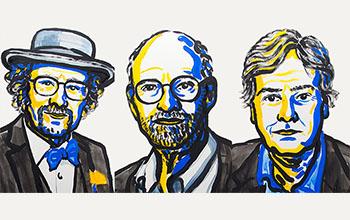
IMAGE

Credit: Nobel Media. Ill. N. Elmehed

The Nobel Assembly has awarded the 2017 Nobel Prize in Physiology or Medicine jointly to Jeffrey C. Hall and Michael Rosbash of Brandeis University and Michael W. Young of Rockefeller University in New York for "their discoveries of molecular mechanisms controlling the circadian rhythm." The National Science Foundation (NSF) has provided support to the research of these three researchers, including grants from the Office of International Science and Engineering for Hall and Robash and funding from the Biological Sciences Directorate for Robash. Young served as head of the Rockefeller University unit of the Science and Technology Center for Biological Timing, funded by NSF's Office of Integrative Activities.

NSF Director France Córdova issued the following statement on the Nobel announcement.

By building a body of research over decades using a model organism — fruit flies — these three researchers have given us a clearer understanding about human physiology. The findings of Jeffrey C. Hall, Michael Rosbash and Michael W. Young have significant implications for health and wellness, and connect with our daily lives every time we go to sleep or wake up. Their discoveries shed light on a fundamental physiological mechanism, helping to advance and accelerate the field of circadian biology, which continues to produce new breakthroughs. NSF is proud to be associated with the work of these Nobel laureates. It demonstrates yet again that investing in basic research in the life processes of a wide variety of organisms and incorporating knowledge and techniques from across scientific disciplines yields results that benefit society.

###

Media Contact

Robert Margetta
[email protected]
@NSF

http://www.nsf.gov
Share12Tweet8Share2ShareShareShare2

Related Posts

Fertility benefits may explain why harmful disease genes persist in humans

Fertility benefits may explain why harmful disease genes persist in humans

August 30, 2026
New atlas reveals mesenchymal diversity in human gut and organoids

New atlas reveals mesenchymal diversity in human gut and organoids

August 30, 2026

New spatial transcriptomics method maps RNA isoforms across primate brain cells

August 30, 2026

Transcription factors steer distinct pancreatic cancer cell states and drug dependencies

August 30, 2026
Please login to join discussion

POPULAR NEWS

  • Waldenström’s macroglobulinemia in siblings: 25 years of institutional cases reviewed

    29 shares
    Share 12 Tweet 7
  • Disrupting CDK4/6–RARα–NF-κB axis eases senescence inflammation, improving aging and chemotherapy recovery

    29 shares
    Share 12 Tweet 7
  • NPTN gene variants linked to autism through disrupted brain cell signaling

    29 shares
    Share 12 Tweet 7
  • BEGONIA trial: durvalumab plus trastuzumab deruxtecan for HER2-low metastatic breast cancer

    29 shares
    Share 12 Tweet 7

About

We bring you the latest biotechnology news from best research centers and universities around the world. Check our website.

Follow us

Recent News

Waldenström’s macroglobulinemia in siblings: 25 years of institutional cases reviewed

Disrupting CDK4/6–RARα–NF-κB axis eases senescence inflammation, improving aging and chemotherapy recovery

NPTN gene variants linked to autism through disrupted brain cell signaling

Subscribe to Blog via Email

Enter your email address to subscribe to this blog and receive notifications of new posts by email.

Join 85 other subscribers
  • Contact Us

Bioengineer.org © Copyright 2023 All Rights Reserved.

Welcome Back!

Login to your account below

Forgotten Password?

Retrieve your password

Please enter your username or email address to reset your password.

Log In
No Result
View All Result
  • Homepages
    • Home Page 1
    • Home Page 2
  • News
  • National
  • Business
  • Health
  • Lifestyle
  • Science

Bioengineer.org © Copyright 2023 All Rights Reserved.