In the built-up center of Näfels, a small town of about 4,000 people in the canton of Glarus in northern Alpine Switzerland, researchers have documented something no one had recorded before: a colony of the ant Formica fuscocinerea invaded and apparently taken over by Formica truncorum, a notorious temporary social parasite. The observation, published in the journal Alpine Entomology, is remarkable because F. fuscocinerea belongs to a small group of ants considered largely resistant to social parasitism, and because no previous case of social parasitism in this species had ever been reported.
The discovery came during an inventory of ants in selected reserves of the canton of Glarus. The team, which included Rainer Neumeyer, also searched built-up areas outside the reserves for species of the Formica cinerea group that were still missing from their records. On 25 May 2020, at 6:30 p.m., they found a small colony in sandy soil between cobblestones at the foot of the south-facing wall of a school building. At the nest entrance they saw workers of F. fuscocinerea, but also somewhat more numerous ants of the parasitic species F. truncorum. Four days later they returned to photograph and film the colony and collected two voucher specimens of each species from the nest entrance. The specimens were identified by Rainer Neumeyer using a stereo microscope and the identification key in Bernhard Seifert’s 2018 work, and the identification was later confirmed by Seifert himself. The voucher specimens are now deposited in the entomological collection of the Senckenberg Museum in Görlitz, Germany.
The site itself is telling. The schoolhouse at Im Dorf 14b stands at 440 meters above sea level, and its colony was found along a cobbled wall erected in 1877. The surroundings are largely urban, although the edge of the built-up area lies only about 200 meters to the northwest, and a steep forest with interspersed rock faces begins roughly 400 meters to the west. This mix of habitats matters because the two ant species involved normally occupy very different environments, a fact that lies at the heart of the researchers’ interpretation of what they observed.
To understand why the finding is so unusual, some background on temporary social parasitism is needed. In this mode of life, found in certain ants, bees and wasps, a parasite species depends on a host species only during its colony-founding phase. A freshly mated parasite female invades a host colony, replaces the host queen, and begins laying her own eggs. The host workers nurse the parasite’s brood until they gradually die off, and by the time the last host worker is gone, a large workforce of the parasite’s own offspring is running the nest. About half of all animal species can be considered parasites under a broad definition, but this particular strategy is a highly specialized variant confined to social insects.
Within the genus Formica, 24 species are recorded from Switzerland, divided among four subgenera. Two of these subgenera are relevant here. The ten Swiss species of the subgenus Serviformica can all establish colonies independently, with inseminated females founding nests on their own. The species of the other subgenus, Formica, are incapable of independent colony foundation; their females need existing colonies, either of their own species or of a Serviformica species. Formica truncorum is one of these dependent species. Its females normally invade Serviformica colonies such as those of Formica fusca and probably Formica lemani, though they may occasionally also parasitize colonies of Formica polyctena, which belongs to their own subgenus.
Most Serviformica species are monodomous, meaning an entire colony lives in a single nest, and such species are generally vulnerable to social parasites. The great exception is the Formica cinerea group, which includes just three representatives: Formica cinerea, F. fuscocinerea and F. selysi. These are known for forming polydomous supercolonies, with a colony’s population spread across several spatially distributed nests. That architecture makes them hard targets for a parasitic queen, and they are hardly ever invaded. While F. cinerea has been reported as a host of socially parasitic ants, no case of social parasitism had previously been documented in either F. selysi or F. fuscocinerea, which is precisely what makes the Näfels colony a first.
The researchers considered and rejected an alternative explanation before concluding that a takeover had occurred. In theory, the F. truncorum workers at the nest entrance could have been behaving in a dulotic manner, that is, raiding the F. fuscocinerea colony for slaves to carry back to an existing F. truncorum nest elsewhere. But within the genus Formica in Europe, only Formica sanguinea is known to behave this way. The habitat evidence also pointed strongly toward usurpation. The built-up environment is typical only for F. fuscocinerea, a species that originally inhabited alluvial sand and gravel banks and now also thrives in anthropogenic habitats such as gravel pits, industrial wastelands and the interiors of settlements. F. truncorum, by contrast, typically lives at the edges of forests or in clearings, and also in bogs developing into heathland and in bushy xerothermic grassland. A daughter colony of F. truncorum establishing itself in the town center and subsequently enslaving neighbors was therefore ruled out, and the researchers concluded that a F. truncorum female had usurped a nest of F. fuscocinerea after her nuptial flight.
How could a parasite breach a species famous for its vigorous supercolonies? Seifert’s 2018 work had noted that F. fuscocinerea appears to have retained the potential for single-queen colony foundation, at least in certain regions. The researchers therefore conclude that the nest entrance they observed belonged to a small monogynous, or single-queen, or possibly even queenless colony of F. fuscocinerea when the parasitic female took it over. Supporting this interpretation, they were unable to find another colony of F. fuscocinerea in the immediate area around the schoolhouse. Given the relatively few host workers remaining, the takeover most likely happened in 2019, if not already in 2018.
A curious detail strengthened the picture of a colony under stress. All of the F. truncorum workers observed were below average in size, hardly larger than the host species’ workers, and at first glance resembled small workers of Formica rufa in their dark pigmentation, especially on the head. In medium and large F. truncorum workers, the whole head is uniformly light reddish brown in the vast majority of cases, so the dark head marking is typical only of nanitic, or dwarfed, workers. Nanitic workers are characteristic of the initial phase of a colony founded claustrally, that is, by a single recently mated female in a closed founding chamber, and they appear when food is scarce and must be conserved. They are perhaps best understood as starvation forms. Crucially, nanitics are less likely to occur after a social parasitic takeover, because food-supplying host workers are available from the start. The fact that only dwarf workers of F. truncorum were seen therefore suggests the colony is starving, probably because the urban nest site is far from ideal for a forest-edge species.
During a fifteen-minute observation of the nest entrance in sunny, windless conditions at 21 degrees Celsius, the researchers counted a total of five workers returning to the colony, one F. fuscocinerea and four F. truncorum, and eleven workers emerging, four F. fuscocinerea and seven F. truncorum. Three additional ant species shared the schoolhouse wall: Lasius emarginatus, Myrmica sabuleti and Tetramorium impurum. When the team returned on 17 September 2020, the nest entrance had apparently shifted almost a meter to the west, though this does not necessarily mean the colony had moved its underground nest chambers.
The colony’s future looks uncertain. As Bernhard Seifert suggested in personal communication to the authors, it will probably need to relocate to more favorable habitat to avoid perishing. The nearest suitable environments lie at least 400 meters to the west, in the forest and scree of steep mountain slopes that rise to more than 1,000 meters above sea level within about 1,200 meters. Several hundred meters is likely an insurmountable distance for a relocating colony, and at best it could be covered stepwise over several years. Observations of a migrating F. truncorum population in Finland suggest relocation distances of at most 95 meters per year. Such a stepwise migration would depend on suitable stepping-stone habitats such as gardens and meadows with trees. For now, the tiny colony of dwarfed parasites survives at the foot of a schoolhouse wall, a rare and documented example of a supposedly well-defended host species falling to one of its genus’s most committed social parasites.
Subject of Research: First recorded takeover of a Formica fuscocinerea ant colony by the temporary social parasite Formica truncorum in Switzerland
Article Title: First observation of an ant colony of Formica fuscocinerea Forel, 1874 invaded by the social parasite F. truncorum Fabricius, 1804 ( Hymenoptera , Formicidae )
Article References: Neumeyer, R., Sommerhalder, J., & Ungricht, S. (2021). First observation of an ant colony of Formica fuscocinerea Forel, 1874 invaded by the social parasite F. truncorum Fabricius, 1804 (Hymenoptera, Formicidae). Alpine Entomology, 5, 23-26. https://doi.org/10.3897/alpento.5.67037
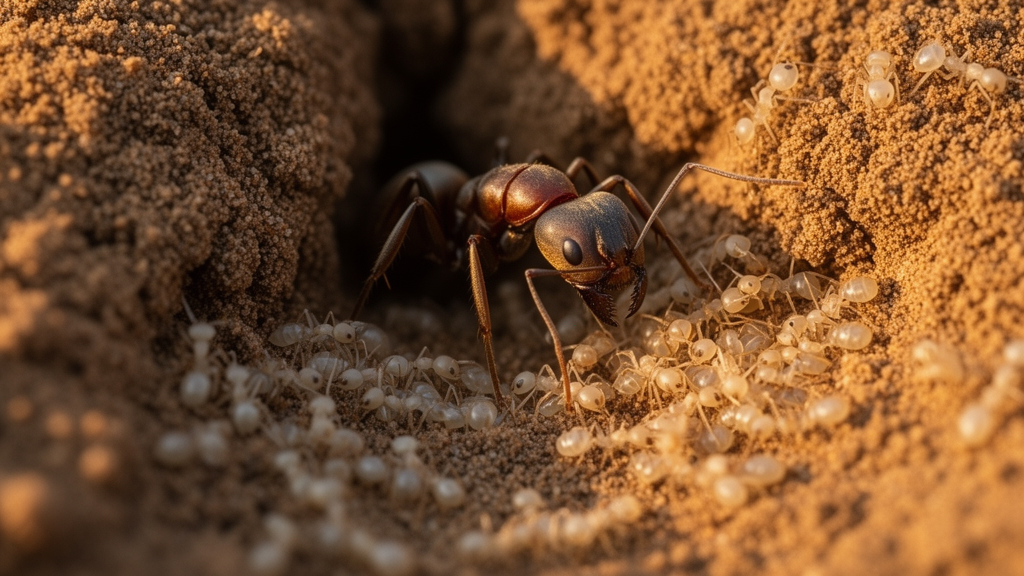
Image Credits: AI Generated
Keywords: ants, social parasitism, Formica truncorum, Formica fuscocinerea, Switzerland, Alpine Entomology, nanitic workers, urban habitat, colony takeover, entomology, Formica cinerea group, temporary parasitism
News Source: Drew Townsend. (October 27, 2026). Social parasite ant invades a host colony thought nearly immune to takeover. Scienmag.