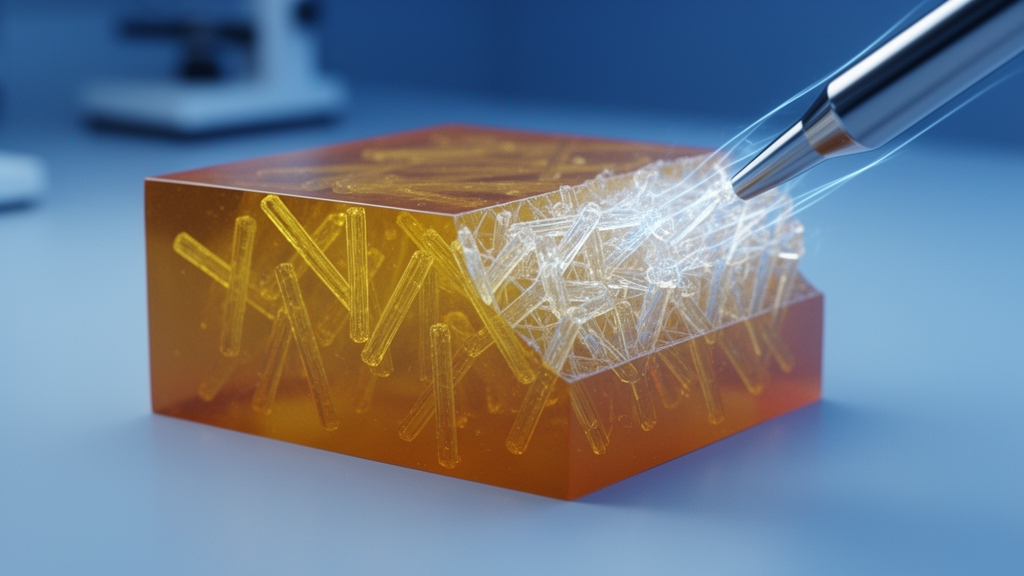
Researchers have synthesized dual-phase, lead-free perovskite nanocrystals of Cs3BiBr6@Cs3Bi2Br9 (CBB) and embedded them in a poly(vinylidene fluoride-co-hexafluoropropylene) (PVDF-HFP) polymer matrix at concentrations of 0.0, 0.5, 1.0, 2.0, and 4.0 wt/wt%, reporting an enhancement of the polymer’s electroactive β-phase and improved local piezoelectric response. The work, published in the Journal of Materials Science, addresses a long-standing limitation of lead halide perovskites, whose toxicity, environmental hazards, and human health effects have inhibited their commercialization.
The dual-phase character of the synthesized CBB material was confirmed by powder X-ray diffraction (PXRD). Rietveld refinement of the diffraction data revealed phase purity and crystallinity, with Cs3BiBr6 adopting an orthorhombic structure (space group Pbcm) and Cs3Bi2Br9 a trigonal structure (P-3m1). The morphology of the nanoparticles was characterized by field emission scanning electron microscopy (FESEM), transmission electron microscopy (TEM), and energy-dispersive X-ray spectroscopy (EDX), which together established the nanoscale structure and elemental composition of the perovskite filler.
Within the polymer nanocomposites, Fourier-transform infrared spectroscopy (FTIR) confirmed the enhancement of the electroactive β-phase of PVDF-HFP as the perovskite concentration was varied. Differential scanning calorimetry (DSC) showed a slight increase in the glass transition temperature, from 43 to 47 °C, indicating modest changes in the thermal behaviour of the matrix upon filler incorporation. FESEM and atomic force microscopy (AFM) were used to examine how perovskite incorporation affected the microstructure, morphology, and surface roughness of the composites.
Optical characterization by UV–visible and photoluminescence (PL) spectroscopy indicated direct band gap semiconductor behaviour for the material system. The piezoelectric properties of the nanocomposites were investigated using piezoresponse force microscopy (PFM), where an enhanced local electromechanical response was observed with increasing filler concentration. From these measurements, the effective piezoelectric coefficient (d33) was calculated, confirming improved piezoelectric performance of the composite system relative to the unfilled polymer.
According to the authors, these findings demonstrate that the CBB/PVDF-HFP nanocomposite can function effectively both as a sensing material and as a piezoelectric component in self-powered energy-harvesting applications. The combination of a lead-free, bismuth-based dual-phase perovskite with a flexible fluoropolymer matrix offers a route toward materials that pair optical functionality with electromechanical response while avoiding the toxicity concerns associated with lead halide perovskites. As with any materials study, the reported performance figures derive from laboratory characterization of the synthesized composites, and the piezoelectric results reflect local nanoscale measurements obtained by PFM rather than device-level testing.
Subject of Research: Synthesis and characterization of dual-phase lead-free bismuth bromide perovskite–PVDF-HFP nanocomposites with tunable β-phase for optical and piezoelectric applications
Article Title: Dual-phase Cs3BiBr6@Cs3Bi2Br9 perovskite–PVDF-HFP nanocomposites with tunable β-phase for optical and piezoelectric response
Article References: Kumaraswamy, L., Nagaraju, M., Lokesh, Y. V., Gurumurthy, A., Rajanna, K., Ankanathappa, S. M., Vanga, P. R., Panicker, U. G., Sachith, B. M., Ramu, S. R., & Madhukar, B. S. (2026). Dual-phase Cs3BiBr6@Cs3Bi2Br9 perovskite–PVDF-HFP nanocomposites with tunable β-phase for optical and piezoelectric response. Journal of Materials Science. https://doi.org/10.1007/s10853-026-13954-8
Image Credits: AI Generated
DOI: 10.1007/s10853-026-13954-8
Keywords: lead-free perovskites, Cs3BiBr6, Cs3Bi2Br9, PVDF-HFP, β-phase, piezoelectric, nanocomposites, Rietveld refinement, PFM, energy harvesting, bismuth, PVDF
News Source: Neil Sanderson. (October 27, 2026). Lead-Free Bismuth Perovskite–Polymer Nanocomposites Show Tunable β-Phase and Enhanced Piezoelectric Response. Scienmag.