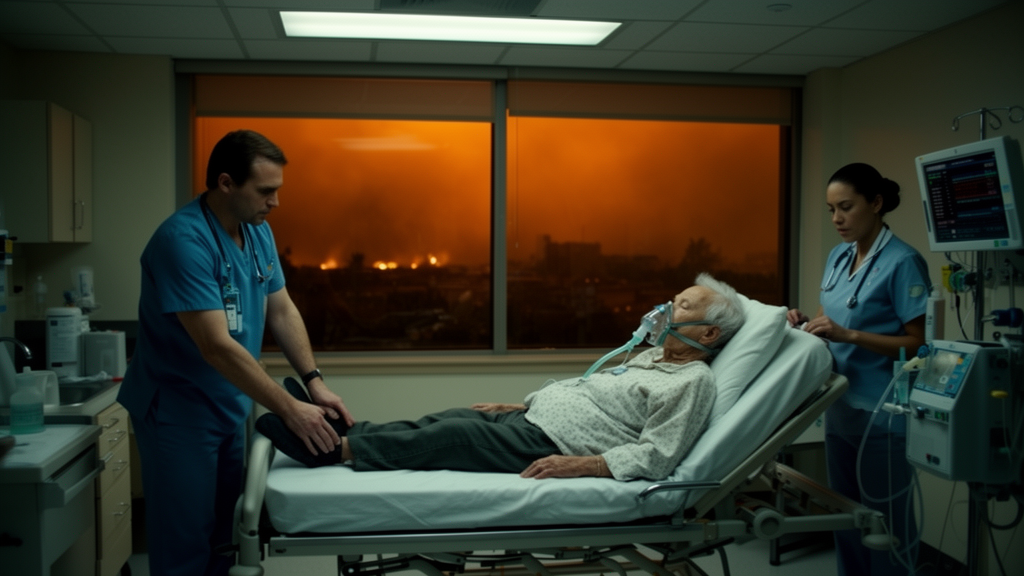
When electric utilities in California preemptively cut power to prevent wildfires, the shutoffs may carry an unexpected health cost, according to a new time-stratified case-crossover study published in PLOS Medicine. Researchers found that severe public safety power shutoffs, known as PSPS events, were associated with higher odds of same-day respiratory emergency department visits and unscheduled hospital admissions among adults aged 20 and older, and that the risk rose further when the outages coincided with wildfire fine particulate matter pollution.
The research team, led by Lauren Blair Wilner and colleagues, identified PSPS events in California from 2013 to 2019 and categorized their magnitude by the number of people left without power in each zip code. They combined this outage data with zip code-level estimates of average daily wildfire PM2.5 and with records of respiratory, COPD-specific, cardiovascular, and psychiatric emergency department visits and unscheduled hospital admissions from the California Department of Health Care Access and Information.
Using a time-stratified case-crossover design in which each case serves as its own control, the researchers estimated the effects of same-day and lagged PSPS events alone, wildfire PM2.5 alone, and their co-occurrence, adjusting for daily temperature. Severe PSPS events were associated with elevated odds of same-day respiratory encounters, with an odds ratio of 1.06 (95% confidence interval: 1.02 to 1.11), and lagged effects over the following three days were similar. The associations were stronger for encounters specifically related to chronic obstructive pulmonary disease, a finding consistent with the concern that people with pre-existing lung disease, or those who depend on electricity-powered medical equipment, are especially vulnerable when the grid goes down.
The clearest signal emerged when outages and smoke overlapped. Compared with no PSPS event or wildfire exposure, the joint occurrence of a PSPS event and wildfire PM2.5 concentrations 10 micrograms per cubic meter higher was associated with higher odds of respiratory encounters, at an odds ratio of 1.16 (95% confidence interval: 1.10 to 1.22), with evidence of multiplicative interaction between the two exposures. In other words, the combined burden of losing power while breathing wildfire smoke exceeded what either exposure alone would predict.
Not every category of acute care showed a link. Associations were null for cardiovascular and psychiatric encounters, suggesting that the observed harm concentrates in respiratory outcomes rather than across all cause-specific utilization.
The authors note important limitations. Exposure was assigned at the residential zip code level, which aggregates circuit-level outage data and does not account for individual behavior. The analysis also could not account for the possibility that PSPS events themselves influence wildfire PM2.5 exposure, leaving room for exposure misclassification.
Subject of Research: Health effects of planned power outages and wildfire fine particulate matter exposure on acute healthcare utilization in California
Article Title: Co-exposure to planned power outages and wildfire PM 2.5 and acute healthcare utilization in California: A time-stratified case-crossover study
Article References: Wilner, L. B., Jones-Ngo, C. G., Chen, C., Kwoka, B., Do, V., Kaufman, J. D., Myers, L. C., Benmahrnia, T., & Casey, J. A. (2026). Co-exposure to planned power outages and wildfire PM2.5 and acute healthcare utilization in California: A time-stratified case-crossover study. PLOS Medicine, 23(10), e1005270. https://doi.org/10.1371/journal.pmed.1005270
Image Credits: AI Generated
DOI: 10.1371/journal.pmed.1005270
Keywords: public safety power shutoffs, wildfire PM2.5, respiratory health, COPD, emergency department visits, case-crossover study, California, electric utilities, air pollution, healthcare utilization, Co-exposure, planned
News Source: Ophelia Keating. (October 27, 2026). Planned Power Outages Linked to More Respiratory ER Visits During Wildfire Smoke. Scienmag.