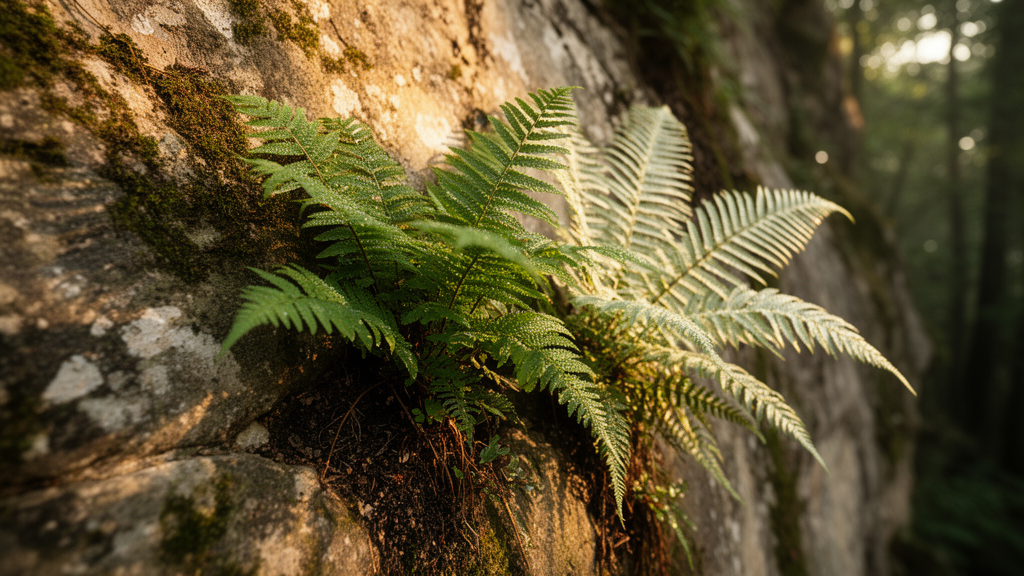
A new study in BMC Plant Biology reports how two groups of Adiantum ferns, endemic to China’s Karst and Danxia landforms, came to differ from one another, and it points to a two-phase process in which geology first set the stage and microclimate later refined the outcome.
The researchers used a hierarchical approach to separate the effects of substrate, elemental coupling, and evolutionary constraints in Adiantum series Gravesiana. Their aim was to clarify the relative contributions of substrate, climate, and phylogeny to differentiation between lineages growing on limestone-derived Karst soils and those on Danxia soils, two dramatically different bedrock types that can occur in close geographic proximity.
The phylogenetic analysis produced a striking asymmetry. Evolutionary signal was strong for soil calcium, carbon, and potassium, and for leaf magnesium, but was absent for leaf calcium and soil magnesium. The authors describe this as an aboveground–belowground decoupling: the chemistry of the soil does not map straightforwardly onto the chemistry of the fern leaves.
Despite pronounced soil contrasts between Limestone and Danxia sites, only leaf calcium and leaf magnesium differed distinctly between A. juxtapositum, which grows on Danxia soils, and the limestone-soil lineages. Soil carbon and calcium correlated only with other soil variables, suggesting they act on diversification indirectly through bedrock-mediated soil differentiation rather than through direct physiological effects on the plants.
Leaf magnesium variation told a different story. It was better explained by taxonomy and microclimate than by soil magnesium itself, indicating that once lineages were established on limestone soils, their leaf magnesium levels were shaped more by inherited traits and local climatic conditions than by the magnesium available in the ground.
From these patterns the authors propose a two-phase diversification model. In the first phase, early branching of A. juxtapositum on Danxia soils was driven by bedrock-mediated soil differentiation, especially involving carbon and calcium. In the second phase, subsequent diversification among lineages on limestone soils was driven by genetic background and microclimate acting through leaf magnesium adaptation.
The study’s authors state that their work reveals stage-specific roles of geology and climate in montane plant diversification. They also note that it provides, in their words, the first experimental evidence for the floristic geo-lithology hypothesis by bridging soil chemistry and biological response — an idea that the geology underlying a region helps shape which plant species occur there.
Mountains are known to generate and sustain high plant diversity, but the roles of geology, habitat heterogeneity, and climate in driving speciation have remained unclear. By disentangling substrate effects from climatic and phylogenetic influences in a single fern group, this study offers a framework for asking similar questions in other montane floras, though the findings here apply specifically to Adiantum series Gravesiana and its Karst and Danxia settings.
Subject of Research: Diversification of Adiantum ferns across China's Karst and Danxia landforms in relation to soil chemistry and leaf magnesium
Article Title: From Calcium tolerance to Magnesium adaptation: divergence of the Karst and Danxia Adiantum ferns
Article References: Wang, A.-H., Zeng, X.-H., Cui, Y.-W., Lv, X.-P., Shu, J.-P., Liao, Y.-J., He, T.-X., Li, Z.-A., Yan, Y.-H., Sun, J.-F., Gu, Y.-F., & Wang, F.-G. (2026). From Calcium tolerance to Magnesium adaptation: divergence of the Karst and Danxia Adiantum ferns. BMC Plant Biology. https://doi.org/10.1186/s12870-026-10200-w
Image Credits: AI Generated
DOI: 10.1186/s12870-026-10200-w
Keywords: Adiantum, ferns, Karst, Danxia, soil chemistry, leaf magnesium, calcium, phylogeny, microclimate, speciation, montane diversity, floristic geo-lithology hypothesis
News Source: Bethany Barker. (October 27, 2026). Soil chemistry and leaf magnesium drove fern divergence on China’s rocks. Scienmag.