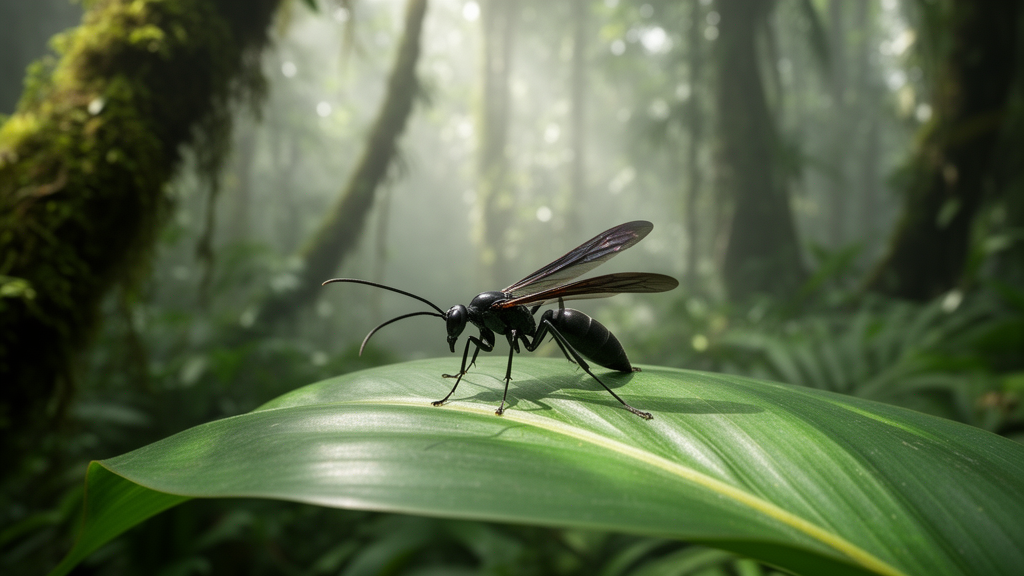
A genus of parasitoid wasps that has never before been documented on Borneo has turned up on the island, and the specimens represent three species entirely new to science. The find is more than a routine addition to a catalogue: it extends the known range of a wood-boring parasitoid lineage deep into the equatorial tropics of Southeast Asia, a region that taxonomists had long treated as a blank space on the genus’s distribution map.
Wroughtonia, established by Cameron in 1899, is a medium-sized genus in the braconid subfamily Helconinae, currently including 58 valid species distributed across the Palaearctic, Nearctic and Oriental regions. Its highest regional diversity has recently been documented in China and Vietnam, with additional records from India and Myanmar. What makes the new discovery striking is geography: until now, the documented diversity of the genus in the Oriental region has been concentrated in its northern and western continental areas, while the southern equatorial parts of the region remained almost entirely blank on distribution maps.
Biologically, Wroughtonia species are koinobiont endoparasitoids, meaning the wasp larva develops inside a host that continues living, and often feeding, for some time before succumbing. For the three newly described Bornean species, however, the actual hosts remain unknown, and the authors note that the biology of all Bornean Wroughtonia species is still undocumented.
The specimens that revealed the genus’s presence on Borneo were collected at Kuala Belalong Field Studies Centre in Brunei, at coordinates 4°34’N, 115°7’E, using Malaise traps, and were gathered by N. Mawdsley in May 1991 as part of material accessioned under BMNH(E) 1991–173. The type specimens are deposited in the Natural History Museum in London. That a single localized trapping effort at one field site yielded three morphologically distinct species of the same genus is itself noteworthy, and the authors draw a pointed conclusion from it: the sympatric occurrence of three distinct species in a localized survey suggests that the previously assumed low species richness of the southern Oriental region is more likely a result of under-sampling than a true biological pattern.
Each of the new species is described in detail from female specimens, with one species also known from males. Wroughtonia belalongensis, named after the Kuala Belalong Field Studies Centre, is a black wasp with a body length of 7.3 millimetres in the holotype female, excluding the ovipositor sheath, which measures 5.6 millimetres. The species is diagnosed by a combination of features including an eye 2.5 times the length of the temple in dorsal view, a crest-shaped frons with a protruding lamella, a face coarsely vermiculate-rugose, a wide and deeply coarsely crenulate precoxal sulcus, and an ovipositor sheath 1.9 times as long as the hind tibia. Its hind tibia is ivory in the basal half and darkened in the apical half, and the fore wing vein r-m is shorter than vein 2-SR. Only the female is known; the male remains undescribed.
Wroughtonia variivena, the largest of the three in sample size, is represented by a holotype female together with two female and two male paratypes from the same Brunei locality. The holotype female has a body length of 9.0 millimetres, with variation in body length across specimens running from 7.0 to 9.0 millimetres. The species name derives from the Latin words varius, meaning variable, and vena, meaning vein, a reference to the variable venation of the hind wing observed in the holotype. That specimen showed a noticeable asymmetry between the left and right hindwings, with one wing bearing an additional closed cell, but because this asymmetry is completely absent in all four paratypes, the authors confirm it as an individual developmental aberration rather than a diagnostic character. Males of the species measure 6.3 to 7.2 millimetres in body length and carry 35 to 40 antennomeres with an ivory band across the 12th to 21st or 12th to 23rd segments.
The third species, Wroughtonia vermiculata, is the largest of the three, with the holotype female measuring 12.3 millimetres in body length and 9.5 millimetres in the setose part of the ovipositor sheath, and variation in body length from 10.7 to 12.3 millimetres. Its name comes from the Latin vermiculatus, meaning worm-like, and refers to the strongly vermiculate-rugose sculpture of the face and the first metasomal tergite. It is distinguished from relatives by mesoscutal lobes that are sparsely rather than densely punctate, a narrow and shallow precoxal sulcus with spaced punctures, a propodeum lacking a large defined areola, a fore wing pterostigma about 3.7 times as long as wide, and dorsal carinae of the first tergite distinct in the basal half. Like W. belalongensis, its male is unknown.
Because the new species resemble described relatives from Vietnam, the authors provide explicit differential diagnoses to separate them. W. belalongensis is similar to W. sonla but differs in having the fore wing vein r-m shorter than vein 2-SR, the first tergite 1.4 times its apical width rather than about as long as its apical width, and a smooth rather than punctate-reticulate second tergite. W. variivena resembles W. undulata but differs in the dorsal carinae of the first tergite being distinct only in the basal 0.7, a first tergite that is reticulate-punctate with smooth apico-lateral portions, and a hind femur lacking the tooth-shaped protuberance seen in W. undulata. W. vermiculata is similar to W. vietnamica but differs in the extent of the first tergite’s dorsal carinae, the coarsely vermiculate-rugose sculpture of the first tergite, and a second tergite that is rugose but apically and medially smooth rather than entirely smooth.
To make the Bornean fauna navigable, the paper includes a formal identification key to the species of Wroughtonia from the island, built on externally visible characters. The key first separates W. belalongensis by its ovipositor sheath 1.9 times longer than the hind tibia, a coarsely vermiculate-rugose first tergite, a fore wing vein r-m shorter than vein 2-SR, and a hind tibia ivory in the basal half and darkened apically. It then distinguishes W. variivena from W. vermiculata by densely punctate mesoscutal lobes, a wide and deeply coarsely crenulate precoxal sulcus, a propodeum with a large well-defined areola and distinct transverse carina, and a pterostigma about 3.0 times as long as wide, against the sparsely punctate lobes, narrow shallow sulcus, undefined areola and longer pterostigma of W. vermiculata.
The descriptive work rests on standard taxonomic methods: specimens were examined with a Nikon SMZ800 stereomicroscope, images were captured with a digital Zeiss AxioZoom camera combined with Helicon Focus software and processed in Adobe Photoshop, and morphological terminology and measurements follow van Achterberg, with sculpture and setation terminology drawing on Belokobylskij. Higher classification follows Chen and van Achterberg and Sharanowski and colleagues. All type material is held at the Natural History Museum, London. For now, the three species are known only from their Brunei type locality, and their hosts, life histories and broader distributions await future fieldwork. What the study establishes firmly is that the equatorial edge of Southeast Asia, long a gap in the map of this parasitoid lineage, holds a fauna worth searching far more thoroughly.
Subject of Research: Taxonomic description of three new Wroughtonia parasitoid wasp species from Brunei, Borneo, representing the first record of the genus on the island.
Article Title: First record of Wroughtonia Cameron ( Hymenoptera , Braconidae , Helconinae ) from Borneo, with description of three new species
Article References: Yan, C.-J., Zu, Z., Ning, Y., & Polaszek, A. (2026). First record of Wroughtonia Cameron (Hymenoptera, Braconidae, Helconinae) from Borneo, with description of three new species. ZooKeys, 1287, 77-89. https://doi.org/10.3897/zookeys.1287.203269
Image Credits: AI Generated
DOI: 10.3897/zookeys.1287.203269
Keywords: Wroughtonia, Braconidae, Helconinae, parasitoid wasps, Borneo, Brunei, new species, taxonomy, Kuala Belalong, Oriental region, entomology, biodiversity
News Source: Drew Townsend. (October 27, 2026). Three New Parasitoid Wasp Species Discovered in Borneo, Marking the Genus Wroughtonia’s First Record on the Island. Scienmag.