Taxonomists studying plant-feeding mites have redrawn part of the family tree of spider mites, demoting a once-independent genus to subgenus rank and describing a brand-new species from the grasses of southern Saudi Arabia. The work reviewed the diagnostic characters of Dolichonobia and Mesobryobia and their described species based on published taxonomic literature, and described a new species based on specimens collected in Jazan Province.
The tribe Hystrichonychini, within the spider mite family Tetranychidae and the subfamily Bryobiinae, comprises seventeen genera. Three of them, Monoceronychus McGregor, 1945, Mesobryobia Wainstein, 1956, and Dolichonobia Meyer, 1974, are morphologically related and stand apart from other genera by their elongate body shape and the development of the propodosomal lobes, structures on the front part of the body. Monoceronychus, with twenty species, is unique among the three in bearing three anterior propodosomal lobes. Mesobryobia itself comprises eleven described species reported from Armenia, India, Kazakhstan, Pakistan, and South Africa, according to the distribution database cited in the study.
The generic status of these mites has shifted repeatedly over the decades. Wainstein considered Mesobryobia a subgenus of Monoceronychus as early as 1960, yet later authors, including Tuttle and Baker, Meyer, Prasad, Mitrofanov and colleagues, and Kamran and colleagues, continued to treat it as a full genus. Meyer erected Dolichonobia in 1974 for two species, D. prolata, the type species, and D. faceta; a third species, D. altaiensis, was added by Cui and Tan in 1993. Dolichonobia was considered morphologically close to Mesobryobia because both bear the setae f1 and h1 on strong tubercles, but it was separated by its poorly developed propodosomal lobes.
That distinguishing feature began to look shaky after Kamran and colleagues argued in 2021 that two Mesobryobia species, M. delospermae and M. brevillosa, themselves have extremely small, poorly developed propodosomal lobes, and that the degree of lobe development is a poor generic diagnostic character. Their identification key even differentiated Mesobryobia species by whether the lobes were poorly or well developed. Because the boundary character could no longer cleanly separate the two genera, the taxonomic distinction between Dolichonobia and Mesobryobia became debatable, prompting the present reevaluation.
The authors did not rely on a single disputed trait. Their comprehensive analysis of all species of both genera identified the shape of the peritremes, the paired respiratory structures above the mouthparts, as a persistent morphological character. Peritremes are anastomosed, meaning fused into a network, in all eleven previously known Mesobryobia species, while they are simple or bifurcate in the three Dolichonobia species. On that basis, Dolichonobia could not be synonymized outright with Mesobryobia; instead, the authors propose it as a subgenus. Mesobryobia is now divided into Mesobryobia (Mesobryobia), with anastomosed peritremes, and Mesobryobia (Dolichonobia), with simple or bifurcate peritremes, and the generic diagnosis of Mesobryobia has been updated accordingly.
This solution follows precedent within the same family. Wainstein had already divided the genus Petrobia into three subgenera according to peritreme shape: Petrobia (Petrobia) with anastomosing peritremes, Petrobia (Tetranychina) with simple, straight or hooked peritremes, and Petrobia (Mesotetranychus) with simple peritremes sometimes ending in a small fork. The authors also note parallel problems elsewhere in the tribe Hystrichonychini: Mahdavi and colleagues in 2024 judged strong versus small dorsal tubercles an inconsistent character for distinguishing the genera Aplonobia and Paraplonobia, because such states depend heavily on the observer’s judgment and lack a clear definition. In the other tribe Bryobinii, Bryobia and Pseudobryobia were originally separated by the presence or absence of prominent propodosomal lobes, but that state later proved variable among Bryobia species, and both diagnoses were updated to rely solely on the number of setae on coxae I and II.
Specimens of the new species were collected by shaking the vegetative parts of plants over white sheets and preserved in small vials of 70 percent ethanol. They were examined and identified under a Leica DM2500 phase-contrast microscope, with body parts captured using an auto-montage imaging system and illustrated in Adobe Illustrator. All measurements are given in micrometers: the idiosoma length was taken between setae v2 and h1, its width between the c3 setae, setal lengths from basal insertion to tip, and legs from trochanter to the bases of the claws and empodium. The morphological terminology follows Lindquist and colleagues. The type material has been deposited in the King Saud University Museum of Arthropods in Riyadh.
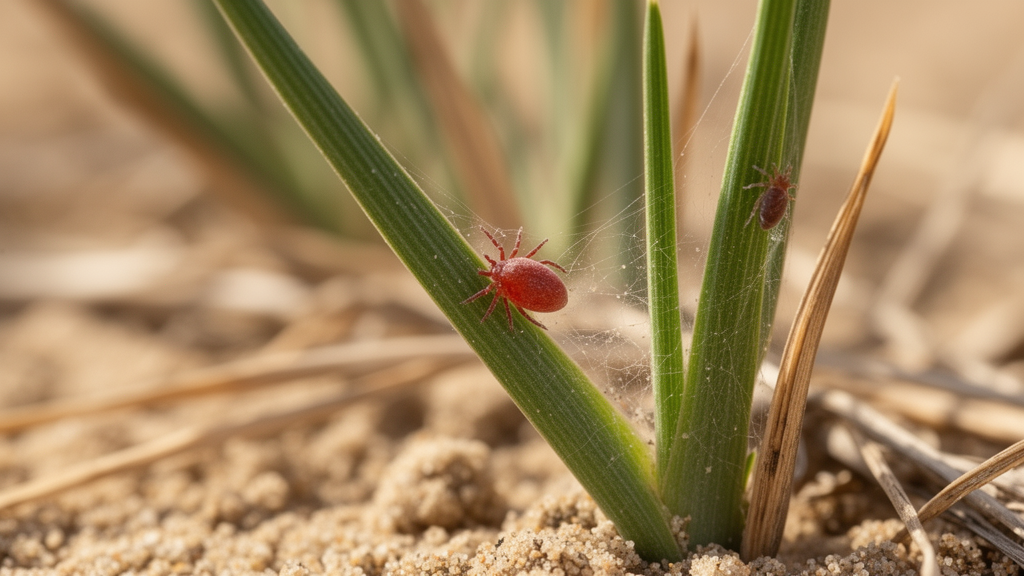
The new species, formally named Mesobryobia (Mesobryobia) neobrevillosa sp. nov., is described on the basis of adult females found inhabiting wild grasses of the family Poaceae in the southern region of Saudi Arabia. The holotype, a female, was collected in Jazan Province on 7 October 2025, together with two female paratypes from the same site and host plants. Adult females measure roughly 410 micrometers in idiosoma length, excluding the gnathosoma, and about 191 micrometers at maximum width, with all dorsal setae lanceolate and serrate and the setae f1, f2 and h1 inserted on strong tubercles. The peritremes end in anastomosing chambers, the trait that places the species in the nominate subgenus, and the empodial pad carries approximately eight pairs of tenent hairs.
Several characters distinguish M. neobrevillosa from its closest relative, M. brevillosa, after which it is named. Both species share setae v2 on prominent tubercles, distally anastomosing peritremes, and a first leg femur with nine setae. The new species, however, lacks the opisthosomal plate that in M. brevillosa includes the setae f2 and h1; its third and fourth femora each carry two tactile setae rather than four; its first to fourth genua bear tactile setae in a 3-3-2-3 formula rather than 5-5-4-6; its third and fourth tibiae each have three tactile setae rather than seven; and its first two propodosomal setae, v2 and sc1, are subequal in length, whereas in M. brevillosa v2 is about twice the length of sc1. Males and immature stages were not found, so the description rests entirely on adult females, and the spermatheca was not visible in the specimens examined.
The revised classification leaves Mesobryobia (Mesobryobia) with twelve species, including the newcomer, and Mesobryobia (Dolichonobia) with the three species originally described in Dolichonobia. The paper provides a key to all fifteen species of the genus, with one exception: M. delospermae is omitted because it was described from the male and deutonymph rather than the adult female. The updated diagnosis of Mesobryobia specifies an absent median propodosomal lobe, three pairs of propodosomal setae, ten pairs of opisthosomal setae, and an elongate or oval idiosoma, distinguishing it from Monoceronychus by the absence of the median lobe. For a group of mites barely a few tenths of a millimeter long, the study shows how a single stable character, the shape of tiny breathing structures, can settle a taxonomic argument that weaker, more subjective traits could not.
Subject of Research: Taxonomic revision of the spider mite genus Mesobryobia and the description of a new species from Saudi Arabia
Article Title: Reconsidering the generic status of Dolichonobia Meyer, 1974 with the description of a new species of Mesobryobia Wainstein, 1956 ( Prostigmata , Tetranychidae ) and a diagnostic key to world species
Article References: Elgoni, N. A., Mirza, J. H., & Alatawi, F. J. (2026). Reconsidering the generic status of Dolichonobia Meyer, 1974 with the description of a new species of Mesobryobia Wainstein, 1956 (Prostigmata, Tetranychidae) and a diagnostic key to world species. ZooKeys, 1296, 1–10. https://doi.org/10.3897/zookeys.1296.211177
Image Credits: AI Generated
DOI: 10.3897/zookeys.1296.211177
Keywords: spider mites, Tetranychidae, taxonomy, Mesobryobia, Dolichonobia, new species, Saudi Arabia, peritremes, propodosomal lobes, Hystrichonychini, diagnostic key, acarology
News Source: Drew Townsend. (October 27, 2026). Spider Mite Genus Demoted as New Species Joins Saudi Arabia’s Grass Fauna. Scienmag.