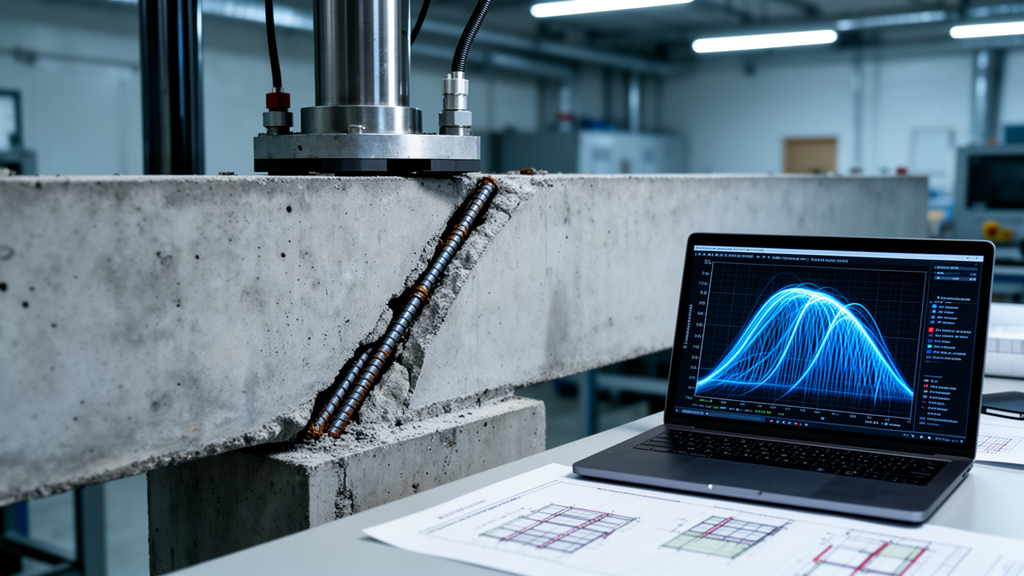
Shear failure in reinforced concrete beams is sudden, brittle and notoriously hard to anticipate. Unlike flexural failure, which announces itself through gradual cracking and visible deformation, shear failure strips a beam of its load-carrying capacity with little warning, making it one of the most dangerous failure modes in structural engineering. A new study published in Case Studies in Construction Materials subjects six machine learning algorithms to an unusually demanding battery of tests, and finds that while they can outperform established design-code equations, their reliability collapses in exactly the region that matters most for safety: very high shear capacities.
The research team, led by Hau Van Nguyen and Khiem Quang Tran, assembled a database of 1,849 reinforced concrete beam specimens drawn from Collins’ well-known experimental compilation. All specimens were conventional steel-reinforced beams without stirrups, spanning wide variation in geometry, material properties and failure behaviour. The nine input variables included web width, flange width, effective depth, shear span-to-depth ratio, longitudinal reinforcement ratio, concrete compressive strength, maximum aggregate size, reinforcement yield strength and load type, with the measured shear capacity as the prediction target. The measured capacities ranged from 1.9 to 1,575 kilonewtons, with a strong right skew that left the upper tail sparsely populated.
Six algorithms were benchmarked under a common protocol: XGBoost, LightGBM and CatBoost as gradient-boosted tree ensembles, Random Forest as a bagging benchmark, Support Vector Regression as a kernel method, and a deterministic artificial neural network built from residual blocks with dropout and weight decay. All models were tuned with the Optuna framework over 100 trials each, using stratified ten-fold cross-validation that jointly stratified by shear span-to-depth regime and shear-capacity tertiles. The gradient-boosted models and the neural network were fitted with Huber-type loss functions on log-transformed targets, a choice intended to limit the influence of a few extreme observations. Every experiment was repeated across fifteen random seeds, with results reported as means and standard deviations.
On aggregate accuracy, all six models performed strongly, with coefficients of determination between 0.88 and 0.92 and mean absolute errors between 18.25 and 22.02 kilonewtons. LightGBM led the field with the lowest mean absolute error of 18.25 kilonewtons and a root mean squared error of 40.45 kilonewtons, sharing the best R² of 0.92 with the neural network and support vector regression. Random Forest fared worst on every metric. Yet the authors caution that aggregate accuracy alone is a poor guide to practical usefulness, because the top models were statistically close and their error distributions overlapped substantially across repeated runs.
The regime-wise analysis revealed stark differences in difficulty. When specimens were grouped by shear span-to-depth ratio, deep beams with ratios below 2.5, where arch action dominates load transfer, produced mean absolute errors of roughly 38 to 45 kilonewtons across all models. Transition beams fell to 10 to 13 kilonewtons, and slender beams with ratios of 4.0 or above stayed below 7 kilonewtons, meaning deep-beam errors were seven to nine times larger. Shear-dominated specimens were likewise harder to predict than specimens whose failure was governed by other modes, presumably because several interacting shear-transfer mechanisms, from aggregate interlocking to dowel action, complicate the mapping from inputs to capacity.
The most consequential finding concerns extreme cases, defined as specimens at or above the 90th percentile of measured shear capacity, corresponding to 310.7 kilonewtons. Every model’s error rose sharply in this upper tail, and residual analysis with LOWESS trend lines showed a progressive drift toward negative residuals as capacity grew. In plain terms, all six models increasingly underestimated the shear strength of the strongest beams, and the tendency worsened precisely in the extreme group. The authors attribute this to sparse data coverage in the high-capacity region rather than to statistical outliers, noting that the high-capacity specimens are valid physical observations that simply occur rarely in experimental databases.
Interpretability checks offered reassurance. Shapley additive explanations ranked the shear span-to-depth ratio as the dominant feature, followed by effective depth, web width and reinforcement ratio, while load-type indicators proved negligible. Monotonicity tests confirmed that all models learned physically sensible relationships: correlation coefficients between the shear span-to-depth ratio and aggregated SHAP responses ranged from −0.96 to −0.99, while concrete compressive strength and reinforcement ratio scored between 0.96 and 0.99, with zero trend reversals in any model. For deep beams, however, the correlations between feature importance and prediction error were weak, spanning only −0.11 to 0.15, indicating that no single feature explains why deep beams are so hard to predict.
Robustness testing told a different story. Under parameter-specific Monte Carlo perturbations, with 500 random runs per data split using literature-based uncertainty models for dimensions, concrete strength and steel properties, the boosting algorithms proved the most fragile. XGBoost’s mean absolute error rose 27.68 percent and its root mean squared error 23.06 percent, with LightGBM and CatBoost close behind. The neural network was the most stable, with increases of just 6.01 and 3.83 percent, followed by support vector regression. The ranking under perturbation therefore inverted the ranking under clean data, demonstrating that the most accurate baseline model is not necessarily the most trustworthy one when inputs carry realistic measurement uncertainty.
Against the design codes, the machine learning advantage was decisive. On the same test specimens, LightGBM achieved a mean absolute error of 18.31 kilonewtons, compared with 30.04 kilonewtons for the CSA equation and 42.93 kilonewtons for ACI, with a statistically significant difference in root mean squared error against CSA at p = 0.0262. In the extreme regime the gap widened: LightGBM’s mean absolute error was about 77 kilonewtons, against roughly 113 for CSA and 174 for ACI. All three methods tended to underestimate high capacities, but LightGBM’s prediction-to-experiment ratios clustered closest to unity. The authors suggest hybrid schemes blending the physics-based CSA equation with the data-driven model as a promising direction.
The study’s limitations are clearly stated. The models produce deterministic point estimates, the database lacks specimen-level uncertainty information, and the results apply only to conventional steel-reinforced concrete beams within the parameter ranges sampled, not to FRP-reinforced or prestressed structures. Prediction errors, the authors emphasise, cannot be read as indicators of structural reliability or code safety. Future work may explore synthetic data augmentation for the high-capacity tail, capacity-weighted losses, regime-specific two-stage predictors, and full reliability-based calibration. For now, the message for the field is sobering: a model that looks excellent on average may still fail quietly where failure matters most.
Subject of Research: Machine learning evaluation for predicting the shear capacity of reinforced concrete beams
Article Title: Engineering-oriented evaluation of machine learning models for shear capacity prediction of reinforced concrete beams across structural regimes and extreme conditions
Article References: Van Nguyen, H., Phan, C. T., Duong, N. T., Tra, N. Q. N., Tran, L. H., Thi Tran, H. M., & Tran, K. Q. (2026). Engineering-oriented evaluation of machine learning models for shear capacity prediction of reinforced concrete beams across structural regimes and extreme conditions. Case Studies in Construction Materials, 25, Article e06656. https://doi.org/10.1016/j.cscm.2026.e06656
Image Credits: AI Generated
DOI: 10.1016/j.cscm.2026.e06656
Keywords: reinforced concrete, shear capacity, machine learning, LightGBM, XGBoost, SHAP interpretability, deep beams, design codes, robustness, structural engineering, extreme values, Optuna
News Source: Teresa Odom. (October 27, 2026). Machine Learning Outperforms Design Codes in Predicting Concrete Beam Shear Strength. Scienmag.