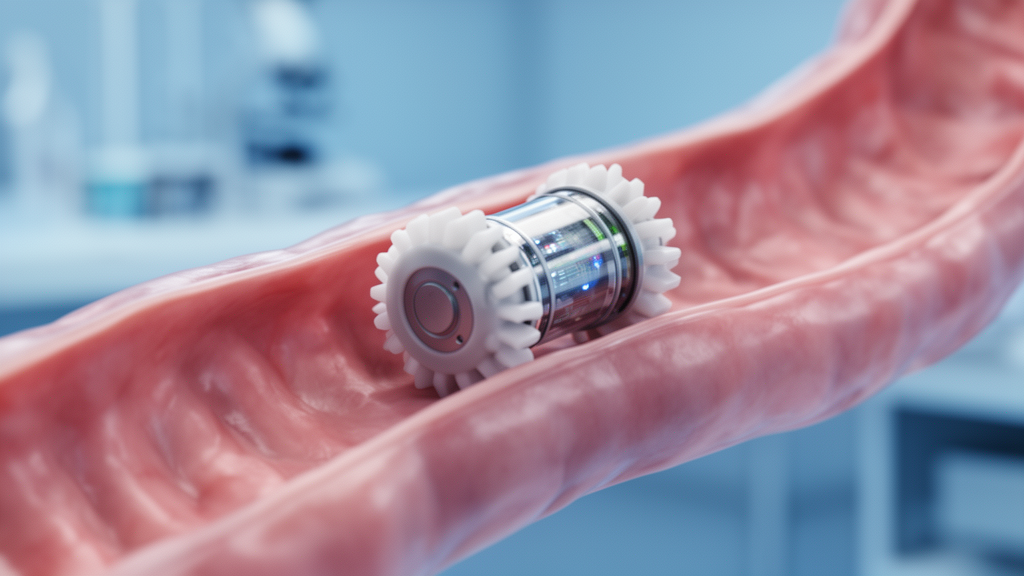
Colonoscopy remains the most effective method for colorectal cancer screening, but successful insertion of the scope demands a high level of operator skill and can cause patient discomfort or even injury. A research team now reports a mechanical redesign aimed at easing that burden: a self-propelled colonoscopy robot driven by soft gears, described in the International Journal of Computer Assisted Radiology and Surgery. The work builds on the group's earlier robot, which used a worm-gear mechanism to generate propulsion at the distal tip of the scope; self-propelled colonoscopy robots that generate propulsion at the distal tip have been actively investigated.
The problem with the earlier design was the rigidity of its gears. Rigid gear teeth pressing against the colonic wall posed a potential risk of excessive contact force. The new approach reinterprets the crawler-based propulsion concept as a soft spur gear driven by a worm-gear mechanism. Because the gear teeth are compliant, they elastically deform under load, providing adaptive traction through that deformation while still transmitting power through gear engagement. In effect, the robot combines the mechanical advantage of gear-based drive with the forgiving contact of a soft interface, so the same surfaces that grip the intestinal wall can yield when forces rise.
To move from concept to hardware, the researchers optimized the gear parameters using gear-design software and then fabricated four different soft-gear configurations. The prototypes were produced by stereolithography 3D printing and evaluated in a colonoscopy training model—a physical simulator used for endoscopy practice rather than living tissue. In straight sections of the model, the robot achieved a maximum propulsive speed of 9.6 millimeters per second and a propulsive force of 1.5 newtons. A clear design trend emerged from the comparison: gears with larger modules produced higher propulsion performance.
The team addressed this with a coaxial double-worm-gear architecture, which, combined with manual steering, enabled the robot to traverse curved sections of the colon model. The authors report that the proposed design demonstrated stable propulsion in the training model while maintaining compliant contact with the intestinal wall, and they highlight the simple and compact mechanical structure as a practical advantage for future minimally invasive robotic endoscopy.
The team is careful to frame the scope of the achievement. The evaluation was limited to a colonoscopy training model, and the results demonstrate mechanical feasibility rather than clinical performance. Further ex vivo and in vivo validation will be required before the concept can be considered for real procedures.
Subject of Research: A soft-gear-driven self-propelled colonoscopy robot evaluated in a colonoscopy training model
Article Title: Investigation of gear design parameters for soft-gear-driven self-propelled colonoscopy robot
Article References: Osawa, K., Duan, K., Ueda, A., Nakadate, R., Arata, J., Nagao, Y., Akahoshi, T., Eto, M., & Tanaka, E. (2026). Investigation of gear design parameters for soft-gear-driven self-propelled colonoscopy robot. International Journal of Computer Assisted Radiology and Surgery. https://doi.org/10.1007/s11548-026-03808-8
Image Credits: AI Generated
DOI: 10.1007/s11548-026-03808-8
Keywords: colonoscopy, surgical robotics, soft gears, worm gear, self-propelled endoscopy, 3D printing, stereolithography, propulsion, compliant mechanisms, medical devices, Investigation, gear
News Source: Denise Maddox. (October 27, 2026). Research report: Investigation of gear design parameters for soft-gear-driven self-propelled colonoscopy robot. Scienmag.