• HOME
  • NEWS
  • EXPLORE
    • CAREER
      • Companies
      • Jobs
    • EVENTS
    • iGEM
      • News
      • Team
    • PHOTOS
    • VIDEO
    • WIKI
  • BLOG
  • COMMUNITY
    • FACEBOOK
    • INSTAGRAM
    • TWITTER
Tuesday, October 27, 2026
BIOENGINEER.ORG
No Result
View All Result
  • Login
  • HOME
  • NEWS
  • EXPLORE
    • CAREER
      • Companies
      • Jobs
        • Lecturer
        • PhD Studentship
        • Postdoc
        • Research Assistant
    • EVENTS
    • iGEM
      • News
      • Team
    • PHOTOS
    • VIDEO
    • WIKI
  • BLOG
  • COMMUNITY
    • FACEBOOK
    • INSTAGRAM
    • TWITTER
No Result
View All Result
Bioengineer.org
No Result
View All Result
Home NEWS Science News Technology

Simulation framework tailors perovskite/silicon tandem solar cells for satellite orbits

by
October 27, 2026
in Technology
Reading Time: 2 mins read
0
Simulation framework tailors perovskite/silicon tandem solar cells for satellite orbits

Simulation framework tailors perovskite/silicon tandem solar cells for satellite orbits

Share on FacebookShare on TwitterShare on LinkedinShare on RedditShare on Telegram

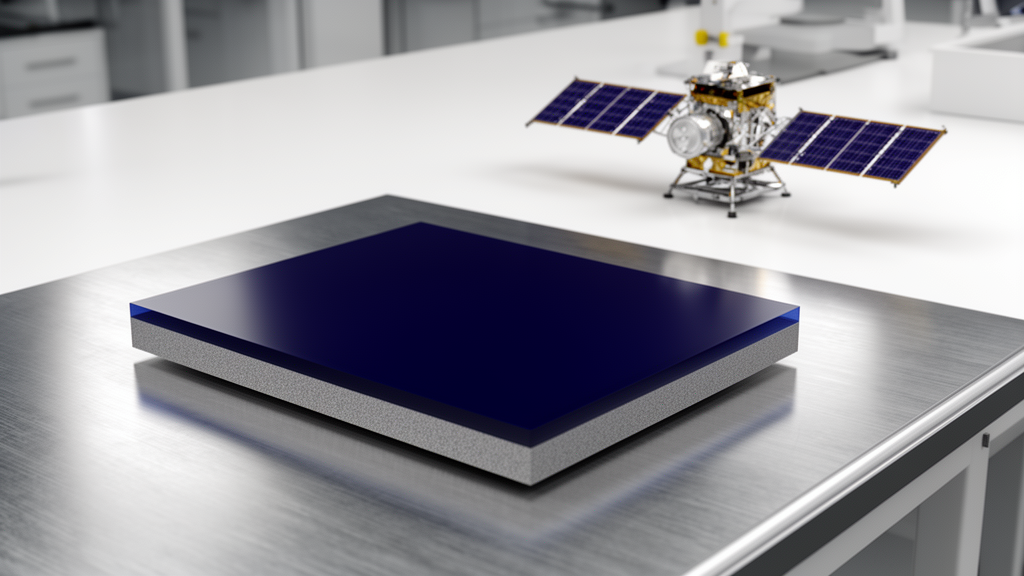
Tandem solar cells that pair metal halide perovskites with silicon have demonstrated power conversion efficiencies above 34%, making them attractive for satellites, where high power density at low cost is essential. But in orbit, power harvesting is complicated by constantly changing solar incidence angles and operating temperatures as a spacecraft moves through its orbit.

A team led by Geon Kim, Seongho Song, Joshua S. Stein, Wanyi Nie and Namyoung Ahn now reports in Communications Engineering an optical and thermal modeling framework designed to address exactly this problem. The framework simulates angle-dependent transmission and absorption spectra and the resulting photocurrents, taking into account the perovskite composition used in the top cell.

Crucially, the model does not stop at static, lab-style illumination. This allows the researchers to evaluate how a tandem cell would actually perform under realistic on-orbit conditions rather than under idealized laboratory lighting.

Using this framework, the team identified optimal perovskite top-cell structures for different satellite types, with the best choice depending on the perovskite composition and the temperatures encountered in orbit. In other words, there is no single universal design: the ideal absorber varies with the mission profile it must serve.

The simulations also revealed a clear trend with bandgap. A higher perovskite bandgap increases the matched photocurrent, the voltage, and the projected efficiency of the tandem device under AM0 illumination, the solar spectrum relevant to space applications. This gives cell designers a direct lever to pull when aiming for maximum in-orbit power generation.

Thickness, however, involves a trade-off. The study found that a broader tolerance for current matching between the two junctions comes at the expense of a larger optimal absorber thickness once on-orbit thermal conditions are taken into account. Designers must therefore balance manufacturing flexibility against the penalties of thicker absorbers under real thermal environments.

The authors position the work as a set of design guidelines for tailoring tandem solar cells to achieve the highest power generation while accounting for satellite motion. Because the article is being shared early as a peer-reviewed, accepted, citable version with a permanent DOI, the framework is already available to the community, though the final Version of Record may include further edits.

Subject of Research: Optical and thermal simulation of perovskite/silicon tandem solar cells for satellite power systems

Article Title: Photonic simulation and design framework for optimizing perovskite/Si tandem solar cells for satellite power systems

Article References: Kim, G., Song, S., Stein, J. S., Nie, W., & Ahn, N. (2026). Photonic simulation and design framework for optimizing perovskite/Si tandem solar cells for satellite power systems. Communications Engineering. https://doi.org/10.1038/s44172-026-00813-2

Image Credits: AI Generated

DOI: 10.1038/s44172-026-00813-2

Keywords: perovskite, silicon, tandem solar cells, satellites, photovoltaics, simulation, bandgap, orbital temperature, AM0 illumination, space power, Photonic, design

News Source: Denise Maddox. (October 27, 2026). Simulation framework tailors perovskite/silicon tandem solar cells for satellite orbits. Scienmag.


Tags: AM0 illuminationbandgapdesignorbital temperatureperovskitephotonicphotovoltaicssatellitessiliconsimulationspace powertandem solar cells
Share12Tweet7Share2ShareShareShare1

Related Posts

NiCo alloy catalysts on nitrogen-doped carbon nanotubes split water efficiently

NiCo alloy catalysts on nitrogen-doped carbon nanotubes split water efficiently

October 27, 2026
3D-printed boron nitride composites tune heat flow through platelet alignment

3D-printed boron nitride composites tune heat flow through platelet alignment

October 27, 2026

NTU Singapore and VFT launch S$15 million lab to advance safer flow batteries for power grids

October 27, 2026

Tau PET Imaging Shows Faster Tau Buildup Tracks Faster Decline in PSP

October 27, 2026

POPULAR NEWS

  • NiCo alloy catalysts on nitrogen-doped carbon nanotubes split water efficiently

    NiCo alloy catalysts on nitrogen-doped carbon nanotubes split water efficiently

    29 shares
    Share 12 Tweet 7
  • Simulation framework tailors perovskite/silicon tandem solar cells for satellite orbits

    29 shares
    Share 12 Tweet 7
  • Mid-pregnancy metabolites linked to children’s growth patterns up to age three

    29 shares
    Share 12 Tweet 7
  • Enzymes and Microbes Work as One System in Fermented Foods, Review Argues

    29 shares
    Share 12 Tweet 7

About

We bring you the latest biotechnology news from best research centers and universities around the world. Check our website.

Follow us

Recent News

NiCo alloy catalysts on nitrogen-doped carbon nanotubes split water efficiently

Simulation framework tailors perovskite/silicon tandem solar cells for satellite orbits

Mid-pregnancy metabolites linked to children’s growth patterns up to age three

Subscribe to Blog via Email

Enter your email address to subscribe to this blog and receive notifications of new posts by email.

Join 85 other subscribers
  • Contact Us

Bioengineer.org © Copyright 2023 All Rights Reserved.

Welcome Back!

Login to your account below

Forgotten Password?

Retrieve your password

Please enter your username or email address to reset your password.

Log In
No Result
View All Result
  • Homepages
    • Home Page 1
    • Home Page 2
  • News
  • National
  • Business
  • Health
  • Lifestyle
  • Science

Bioengineer.org © Copyright 2023 All Rights Reserved.