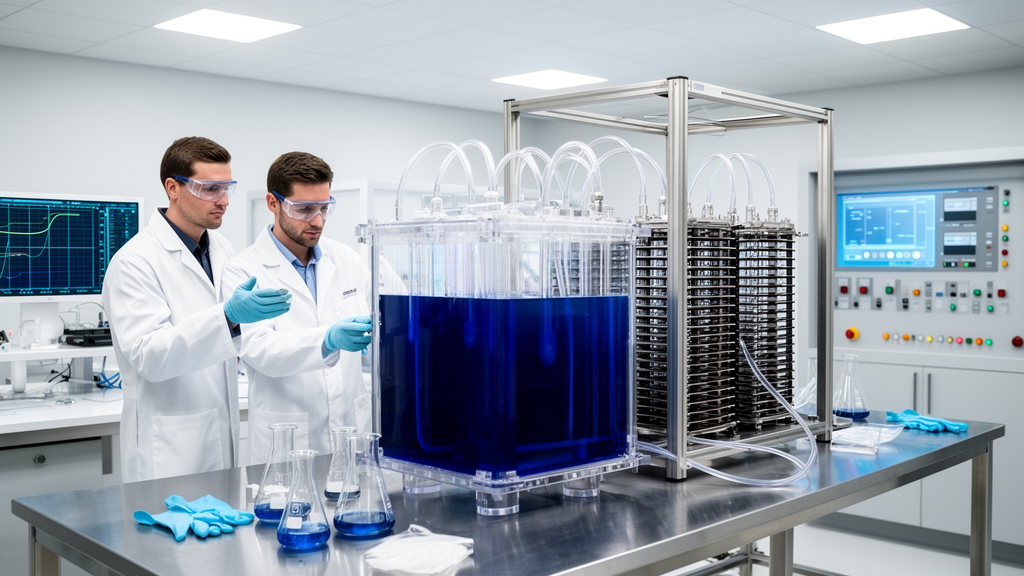
Nanyang Technological University, Singapore (NTU Singapore), through its Energy Research Institute @ NTU (ERI@N), and Singapore energy storage company VFT have launched a S$15 million joint research laboratory to develop safer, more durable and cost-effective batteries for storing renewable electricity and supporting future power grids. The NTU-VFT Joint Lab was launched at the Asia Clean Energy Summit, held as part of Singapore International Energy Week 2026.
Unlike lithium-ion batteries, which store energy within battery cells themselves, VRFBs store energy in liquid electrolytes held in external tanks. Because their storage capacity can be increased simply by using larger tanks, they are well suited to storing and supplying electricity over extended periods, making them a candidate technology for large-scale, long-duration energy storage.
A key safety advantage of the technology lies in its chemistry. VRFBs use non-flammable, aqueous-based liquids to store energy, significantly reducing the risk of battery fires compared with conventional lithium-ion batteries. This characteristic is becoming increasingly relevant as power grids incorporate more intermittent renewable energy sources such as solar and wind, requiring storage systems that can absorb electricity when renewable generation is high and release it when needed, helping to maintain a reliable power supply.
Professor Madhavi Srinivasan, Executive Director of ERI@N, said: “As the global energy transition accelerates, safe and efficient energy storage will become increasingly important to keeping electricity supplies stable and reliable. By combining NTU’s deep expertise in materials science, AI, energy technologies and sustainability with VFT’s industry experience, we aim to develop safer, longer-lasting and sustainable batteries to power our future energy grid.”
She added that VFT’s journey shows how NTU’s research can translate into real-world applications, noting that what began as a spin-off from NTU working on their first generation of energy storage systems has evolved into a company developing commercial energy-storage systems, and expressing that the university is glad to be working with VFT once again to develop the next generation of energy storage solutions and drive further innovation.
Dr Vidal Bharath, Chief Executive Officer of VFT, framed the challenge facing modern power systems: “The challenge is no longer simply generating more renewable energy. Power systems also need safe, reliable and affordable ways to store that electricity for use when renewable generation falls or demand rises.” He said that by combining NTU’s research capabilities with VFT’s experience in developing and deploying flow batteries, the partners aim to overcome the technical and cost barriers to wider adoption of new energy-storage technologies and accelerate commercial deployment.
The research programme at the Joint Lab will pursue several technical directions. Researchers will develop more powerful and efficient flow batteries, including improved battery stacks and cooling systems designed to manage heat and boost performance. Other areas of research include improving power conversion and control systems to increase energy efficiency, and using artificial intelligence to monitor battery performance, detect faults and predict maintenance needs.
Sustainability and cost are also central to the collaboration. The researchers will explore ways to recover and recycle vanadium from industrial waste and alternative sources, an approach that could potentially reduce costs and improve the sustainability of the technology.
The S$15 million collaboration is supported under Singapore’s Research, Innovation and Enterprise 2025 plans and aims to develop new intellectual property, prototypes and technologies that can be progressively validated and incorporated into future commercial energy-storage systems. Beyond technology development, the Joint Lab is intended to strengthen Singapore’s talent and R&D capabilities in long-duration energy storage, helping the country transition towards cleaner and more resilient power systems.
VFT, founded in 2018, is an NTU spin-off based on technology developed at ERI@N. The company raised US$20.5 million in 2025 to expand manufacturing and deployment of its flow-battery systems. The renewed partnership between the university and its spin-off reflects a broader effort to move laboratory-scale advances in energy storage toward commercial systems capable of supporting grids that increasingly depend on variable renewable generation.
Subject of Research: Development of vanadium redox flow batteries for large-scale, long-duration energy storage
Article Title: NTU Singapore and VFT launch S$15 million joint lab to develop safer, longer-lasting batteries for future power grids
Article References: NTU Singapore and VFT launch S$15 million joint lab to develop safer, longer-lasting batteries for future power grids. Original publication (Bibliographic details unavailable.)
Image Credits: AI Generated
DOI: Not provided
Keywords: vanadium redox flow batteries, energy storage, NTU Singapore, VFT, renewable energy, power grids, battery safety, long-duration storage, vanadium recycling, artificial intelligence, Singapore, energy transition
News Source: Faith Mcneil. (October 27, 2026). NTU Singapore and VFT launch S$15 million lab to advance safer flow batteries for power grids. Scienmag.