Researchers in Ibagué, Colombia, have combined expert interviews, a structured literature scan and a multicriteria decision method to rank emerging cardiovascular technologies for local hospitals, and the results reveal a striking split between what institutions should buy first and what best teaches patients about their own hearts. Telemedicine came first in the implementation ranking, followed by coronary Angio CT, Holter monitoring, remote monitoring and 3D modelling and printing. Yet when the same eight experts were asked purely about educational potential, 3D modelling and printing took the top spot, with telemedicine second. The study, published in Heliyon, argues that these two rankings measure different things and should not be confused.
The research team, from institutions working in the intermediate city of Ibagué, set out to answer a practical question: which of the many technologies now promoted for cardiovascular care should a resource-constrained health system actually prioritize? Cardiovascular diseases remain among the leading causes of morbidity, mortality and loss of healthy life years worldwide, with ischaemic heart disease and stroke among the main drivers of lost healthy years. Although advances in diagnosis, acute treatment, risk-factor management and cardiac rehabilitation have improved survival, many patients still need long-term follow-up, continuous education and active participation in self-care. The authors frame cardiovascular education not as a complementary activity but as a core component of disease management, prevention, treatment adherence, shared decision-making and patient empowerment.
The COVID-19 pandemic accelerated the adoption of telemedicine and digital health solutions, demonstrating their value for maintaining continuity of care when physical access to healthcare is limited. Alongside telemedicine, artificial intelligence, digital tools, remote monitoring, advanced imaging and three-dimensional modelling have expanded the possibilities for diagnosis, communication, clinical training and patient education in cardiovascular care. AI-supported tools can assist in interpreting electrocardiograms and other cardiovascular signals, supporting clinical decision-making and professional training through automated analysis and feedback. Three-dimensional modelling and printing, built from high-quality volumetric images obtained by computed tomography, magnetic resonance imaging or echocardiography, can facilitate anatomical visualization, simulation, pre-surgical planning and doctor-patient communication.
To map this landscape, the team ran a Technology Watch process, a structured method for collecting and analysing scientific and technological information to support decisions in a specific sector. The bibliographic search covered the Scopus database from 2015 to 2024, combining terms for cardiovascular disease with terms for digital health, artificial intelligence, telemedicine, remote monitoring, diagnostic imaging, Holter monitoring, 3D modelling and printing, patient education and professional training. The initial search identified 366 studies, which filtering by year, document type and subject area reduced to 117, and further keyword filtering left 107 papers for data extraction and synthesis. Technologies highlighted in the analysis included telemedicine, artificial intelligence, image analysis, computed tomography, magnetic resonance imaging, remote monitoring and 3D printing.
The bibliometric analysis of those 107 studies showed that scientific output has increased significantly since 2018, with a notable rise between 2022 and 2023, a pattern the authors link to the post-COVID-19 push to develop transformative technologies. Cross-country collaboration analysis highlighted the United States, United Kingdom, Netherlands, Australia and China as the leading producers in the dataset. Keyword co-occurrence analysis identified six main nodes: telemedicine, artificial intelligence, rehabilitation, digital health, primary care and cardiovascular disease. The literature scan was then contrasted with local expert opinion to define a shortlist of five candidate technologies for formal prioritization: telemedicine, Holter monitoring, coronary Angio CT, 3D modelling and printing, and remote monitoring.
The expert panel consisted of eight healthcare professionals, each with more than ten years of experience in managing or technologically supporting cardiovascular disease: five cardiologists, three of them pediatric cardiologists, an epidemiologist, a chief nurse and a biomedical engineer. Data were collected through individual semi-structured face-to-face interviews between August and September 2023, each lasting roughly an hour and a half, covering current care protocols, diagnostic technologies, monitoring and follow-up strategies, and the perceived usefulness, limitations and educational potential of emerging technologies. The interviews surfaced vivid local impressions. Experts described how AI-supported software could digitize and automate emergency triage, integrating patient data with test results such as electrocardiograms to issue automatic warnings that could speed triage, sharpen risk categorization, reduce human error and ease staff burden during high-demand periods.
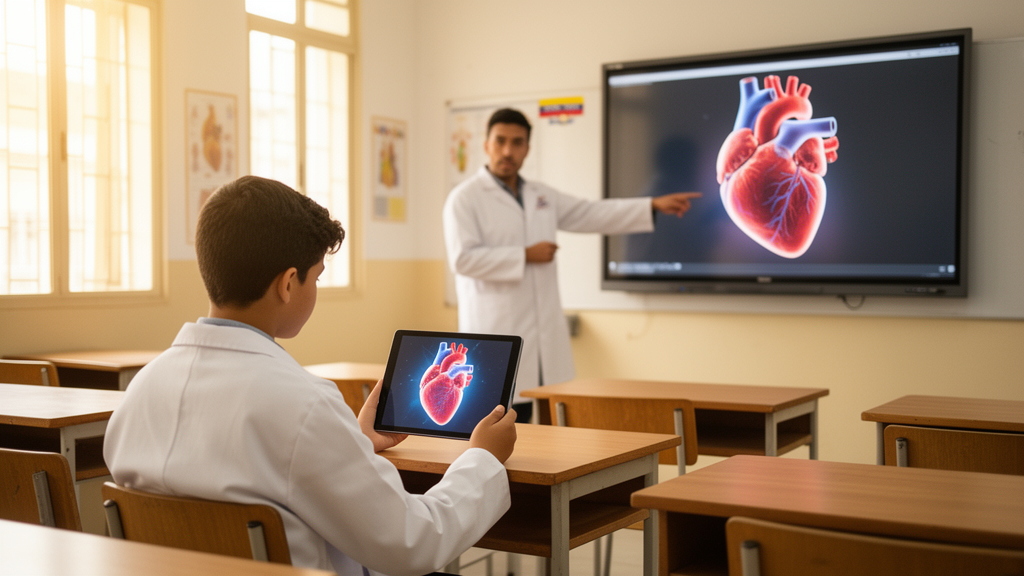
Experts also emphasized that 3D printing of pathological models could transform patient education and prevention. Patients could, in effect, see how their own hearts are doing, rather than relying on two-dimensional still images in pamphlets, and the panel suggested such models could change how people perceive their condition and its consequences if untreated, potentially promoting greater adherence and lifestyle change. The authors are careful to flag that these are perceived and potential benefits: the study did not directly measure patient anxiety, treatment adherence, learning outcomes or professional performance after exposure to any of the technologies, so the educational effects discussed should be understood as expectations supported by expert perceptions and previous literature rather than measured outcomes.
For the formal prioritization, the team applied the Analytical Hierarchy Process, a multicriteria method developed by Thomas Saaty that decomposes complex decisions into a hierarchy of criteria and alternatives compared through pairwise preference judgements. Four criteria were included: cost, clinical impact, support with maintenance and spare parts, and product quality. Regulatory compliance, specifically INVIMA registration, was treated as a mandatory eligibility requirement in Colombia rather than a weighted criterion, so technologies lacking it were excluded before comparison. Notably, the pairwise comparison matrices were built from the judgements of a smaller decision-making subset, the research team together with the biomedical engineering specialist, informed by the broader panel, because the criteria involved technical and operational questions of acquisition, maintenance and institutional feasibility.
The weighting exercise placed clinical impact first at 53 percent, followed by product quality at 27 percent, support, maintenance and spare parts at 13 percent, and cost at 7 percent. All consistency ratios fell below the accepted threshold of 0.10, indicating internally consistent judgements. In the final synthesis, telemedicine ranked first with a weighting of 0.27, coronary Angio CT second at 0.25, Holter monitoring third at 0.23, remote monitoring fourth at 0.15 and 3D modelling and printing fifth at 0.11. Within individual criteria, the Holter monitor led on cost and on support and maintenance, telemedicine led on clinical impact, and coronary CT angiography excelled on product quality, reflecting its accuracy in complex diagnoses.
The authors stress that the fifth-place finish for 3D modelling and printing reflects lower practical priority for immediate institutional adoption under operational criteria, not low educational value. Expert perceptions and previous literature suggest 3D models may have strong educational usefulness for visual and experiential learning, doctor-patient communication, simulation and professional training. Telemedicine’s top ranking aligns with both clinical and educational relevance, supporting continuity of care, remote consultation, access to specialists, patient counselling and self-care guidance, especially where physical access to healthcare is limited. Remote monitoring may help patients understand physiological indicators and warning signs, though effective use requires digital literacy, connectivity, professional supervision and clear protocols for abnormal readings. The study’s contribution, the authors conclude, lies in integrating implementation-oriented prioritization with educational interpretation, and they call for future studies to empirically evaluate the educational and clinical effects of these tools using patient-centred and professional training indicators.
Subject of Research: Prioritization of emerging cardiovascular technologies for implementation and education in Ibagué, Colombia, using expert consultation and the Analytical Hierarchy Process
Article Title: Emerging technologies as educational tools in cardiovascular health: empowering patients and training professionals
Article References: Restrepo Tique, M., Araque, O., & Tovar-Perilla, N. J. (2026). Emerging technologies as educational tools in cardiovascular health: empowering patients and training professionals. Heliyon, 12(16), Article e45627. https://doi.org/10.1016/j.heliyon.2026.e45627
Image Credits: AI Generated
DOI: 10.1016/j.heliyon.2026.e45627
Keywords: cardiovascular disease, telemedicine, 3D printing, analytical hierarchy process, health technology assessment, patient education, remote monitoring, coronary Angio CT, Holter monitoring, artificial intelligence, Colombia, digital health
News Source: Courtney Benton. (October 27, 2026). Cardiovascular Tech Prioritized in Colombia, With 3D Models Top for Education. Scienmag.