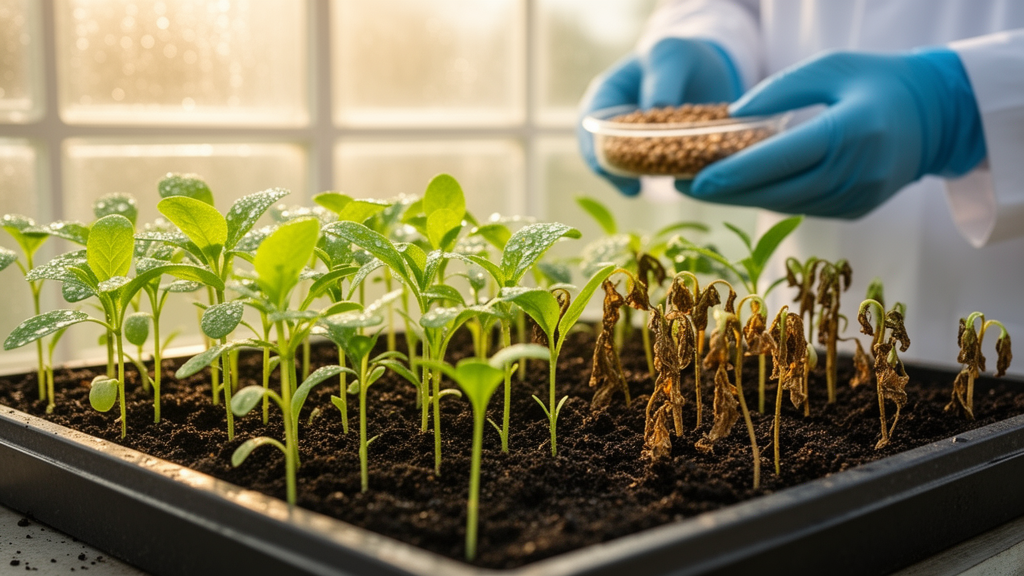
Seed priming, a simple pre-sowing treatment in which seeds are partially hydrated or exposed to mild chemical, biological, or nutrient stimuli before drying, is emerging as one of the most promising low-cost tools for preparing crops against the increasingly erratic stresses of a changing climate. A review published in Frontiers in Plant Physiology by Payal Chakraborty of Amity University and Bandana Bose of Banaras Hindu University synthesizes the growing body of evidence that priming does far more than speed up germination. The authors argue that priming establishes a physiological state of enhanced responsiveness, in which plants retain information from the priming treatment and deploy it more rapidly when drought, heat, salinity, or other stresses recur later in development.
The central concept underlying this effect is stress memory. Unlike animals, plants lack a nervous system, yet they can retain information from prior stress exposure through physiological, biochemical, molecular, and epigenetic modifications that enable a faster and more efficient response when similar stresses recur. The review explains that a primed state is not equivalent to continuous defense activation, which would carry a heavy metabolic cost. Instead, priming establishes a metabolically efficient ready state: defense machinery remains poised rather than switched on, allowing plants to minimize cellular damage, maintain metabolic homeostasis, and recover more rapidly after stress without sacrificing growth during favorable periods.
Seed priming is classified according to the agent used. Hydropriming uses water alone, osmopriming uses solutions such as polyethylene glycol or mannitol, halopriming uses salts, and further variants include nutripriming with micronutrients such as zinc, selenium, silicon, and boron; hormonal priming with abscisic acid, salicylic acid, jasmonic acid, or melatonin; biopriming with beneficial microbes such as PGPR, Trichoderma, and Bacillus; nanopriming with silver, silica, or zinc oxide nanoparticles; and thermopriming with mild heat. Each approach triggers distinct physiological and molecular responses, from antioxidant activation and osmotic adjustment to immune priming and multi-layer molecular reprogramming, but all share the goal of initiating early metabolic processes without allowing the radicle to emerge.
At the molecular level, the review describes priming-induced stress memory as a dynamic continuum comprising stress perception, signal transduction, transcriptional reprogramming, epigenetic stabilization, memory maintenance, and rapid recall. During controlled imbibition, seeds initiate DNA repair, mitochondrial activation, RNA and protein synthesis, reserve mobilization, reactive oxygen species signaling, antioxidant activation, hormonal adjustments, and the synthesis of protective proteins. Early signaling involves cytosolic calcium, reactive oxygen species, nitric oxide, phospholipid-derived messengers, and phytohormones, amplified through calcium-dependent protein kinases, CBL-interacting protein kinases, and MAPK cascades. These modules translate transient signals into stable biochemical responses by regulating transcription factors such as WRKY, NAC, DREB, MYB, and bZIP, which orchestrate genes involved in osmotic adjustment, antioxidant defense, detoxification, and membrane stabilization.
A defining molecular signature of memory is the behavior of so-called memory genes. Genome-wide studies in Arabidopsis thaliana identified stress-memory genes whose expression patterns differ between initial and subsequent stress exposures: some remain transcriptionally elevated during recovery, while others show enhanced re-induction following renewed stress, so that primed plants display accelerated calcium influx, enhanced ROS homeostasis, faster MAPK activation, and prompt induction of memory-associated genes upon re-exposure. Non-memory genes, by contrast, respond similarly during each stress event. The review stresses that persistent molecular changes alone do not establish functional memory; stronger evidence comes when those changes are linked to an enhanced or accelerated response upon subsequent stress.
Epigenetic regulation is presented as the principal mechanism stabilizing long-lasting memory. Priming induces persistent modifications in chromatin architecture, including DNA methylation, histone acetylation, histone methylation such as H3K4me3, histone variant exchange, nucleosome repositioning, and chromatin remodeling. These marks keep stress-responsive loci in a transcriptionally permissive or poised state, reducing the time required for gene activation during subsequent stress. Non-coding RNAs, including microRNAs, small interfering RNAs, and long non-coding RNAs, cooperate with chromatin modifications to regulate somatic and, in some cases, transgenerational memory. The review also highlights the conserved histone variant H2A.Z as a temperature-responsive chromatin component: in Arabidopsis, loss of the ARP6 subunit reduced H2A.Z occupancy and caused constitutive activation of heat-responsive genes, while in Brachypodium distachyon disrupted H2A.Z deposition compromised heat acclimation and significantly reduced grain yield under elevated temperatures. The authors note, however, that such chromatin studies provide mechanistic context rather than direct demonstrations of seed-priming-induced memory.
Metabolic reprogramming forms a second major layer of the memory system. Priming alters both primary and secondary metabolism, including the tricarboxylic acid cycle, carbohydrate and amino acid metabolism, nitrogen assimilation, and the synthesis of phenolic compounds and flavonoids. Soluble sugars such as sucrose, glucose, fructose, raffinose, and trehalose accumulate and serve protective functions, stabilizing proteins and membranes and contributing to osmotic adjustment, while also acting as signaling molecules through carbon-sensing pathways such as TOR and SnRK1. Proline, gamma-aminobutyric acid, and glycine betaine preserve cellular homeostasis under adverse conditions, and primed plants show increased accumulation of branched-chain and aromatic amino acids that supply precursors for antioxidant synthesis and phenylpropanoid metabolism. Importantly, the review argues that these metabolic adjustments are not merely consequences of stress but active determinants of memory, because metabolites such as S-adenosyl-L-methionine, acetyl-CoA, and NAD+ serve as substrates or cofactors for chromatin-modifying enzymes, directly linking metabolic status to epigenetic regulation.
Multi-omics studies provide much of the concrete evidence. An integrated transcriptome-metabolome analysis showed that silver nanoparticle priming in rice under salinity triggers coordinated reprogramming, with sustained accumulation of osmoprotective metabolites and upregulation of WRKY and NAC transcription factors together with salt-tolerance genes such as OsHKT2;4, OsHAK5, CAX4, and CCX4. A recent RNA-seq study in winter wheat found that priming established persistent transcriptional reprogramming involving glutathione metabolism, phenylpropanoid biosynthesis, and primary carbon and nitrogen metabolism that was rapidly re-induced during drought, with photosynthesis-related genes moderately downregulated in a strategic shift from growth to defense preparedness. Metabolite profiling in Arabidopsis revealed persistent alterations in central carbon metabolism, amino acid metabolism, antioxidant pathways, and osmoprotection extending into the recovery phase, although the authors caution that persistent metabolic reconfiguration should be distinguished from memory itself, which requires a demonstrable alteration in the response to subsequent stress. Building on such work, Srivastava and colleagues proposed the primeomics framework, integrating transcriptional, chromatin, protein, metabolic, hormonal, and redox layers to identify molecular markers for climate-resilient crop varieties.
The review also addresses the contested question of transgenerational inheritance. Persistent changes in DNA methylation, histone modifications, chromatin accessibility, and small-RNA profiles may provide molecular links between priming-induced responses and effects in progeny, but the authors emphasize that detecting such signatures alone does not establish true transgenerational inheritance, and generation-specific designs are needed to distinguish intergenerational from transgenerational effects. Supporting evidence includes a study showing that progeny of drought-exposed plants exhibited enhanced drought tolerance with sustained activation of antioxidative defenses, and a genome-wide association analysis in wheat that identified candidate genomic regions associated with transgenerational drought responses, though that study did not establish that drought exposure induces favorable alleles. The authors also note that the adaptive value of memory depends on its timely resetting, since prolonged maintenance of stress-responsive states may impose energetic costs and restrict growth.
Translating these laboratory findings into consistent field performance remains a substantial challenge. The effectiveness of priming depends strongly on genotype, priming agent, concentration, duration, environmental conditions, and the timing and severity of subsequent stress, and the review identifies memory stability, environmental variability, field-level consistency, and post-priming seed storage as key unresolved issues. The authors argue that the future of seed priming lies in its transition from a germination-enhancing technique to a precision climate-resilience strategy, integrating optimized priming protocols with breeding programs, precision agriculture, climate forecasting tools, and digital decision-support systems, supported by multi-environment field validation and standardization.
Subject of Research: How seed priming establishes stress memory, metabolic reprogramming, and epigenetic regulation to improve crop climate resilience
Article Title: Relevance of seed priming in perspective of stress memory, metabolic modulation and climate resilience in growing plants
Article References: Chakraborty, P., & Bose, B. (2026). Relevance of seed priming in perspective of stress memory, metabolic modulation and climate resilience in growing plants. Frontiers in Plant Physiology, 4, 1951942. https://doi.org/10.3389/fphgy.2026.1951942
Image Credits: AI Generated
DOI: 10.3389/fphgy.2026.1951942
Keywords: seed priming, stress memory, epigenetic regulation, metabolic reprogramming, chromatin remodeling, climate resilience, transgenerational inheritance, multi-omics, nanopriming, biopriming, abiotic stress, crop breeding
News Source: Alan Morgan. (October 27, 2026). Seed priming may prime plants for future stress through memory and metabolic reprogramming. Scienmag.