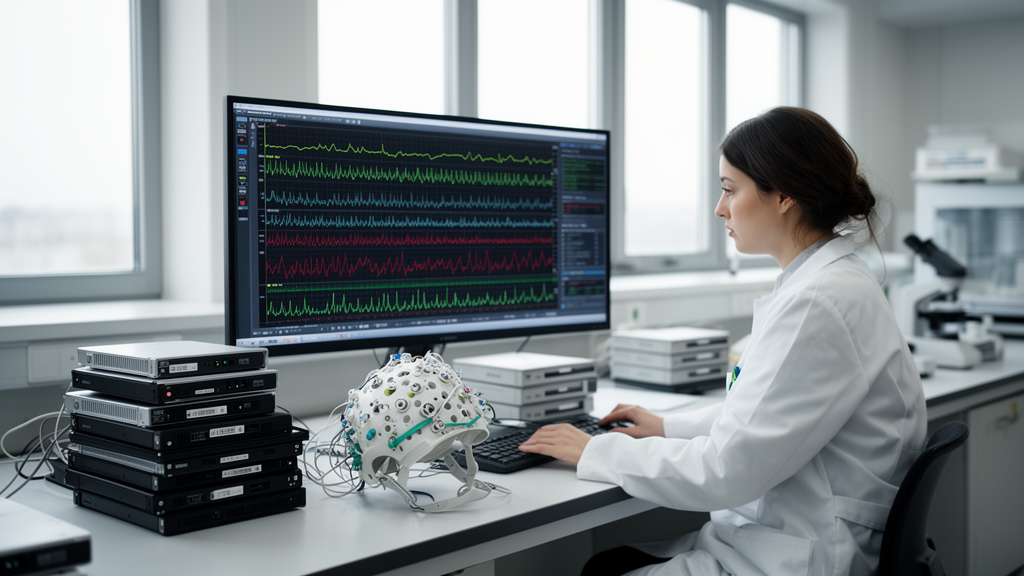
None of the widely shared datasets used to train emotion-decoding models from electroencephalography (EEG) was recorded while people moved through designed spaces, according to a systematic review published on 20 October 2026 in Frontiers in Neuroinformatics. The few spatial recordings that exist, all released since 2023, are single studies cited at most once, leaving researchers in neuroarchitecture to borrow corpora recorded from seated participants watching films, listening to music, playing games or holding conversations. The review, led by Seung Yeul Ji and colleagues at Hanyang University and the University of New South Wales, appraises 27 of those borrowed datasets to determine which can actually be found, obtained and reused as sources for transfer learning.
Following the PRISMA 2020 reporting framework, with the dataset rather than the paper as the unit of analysis, the team ran two search passes and identified 27 publicly obtainable datasets, 22 in the first pass and 5 in the second. None was designed for spatial research. Each dataset was scored against a published codebook of 52 criteria covering three instruments: openness judged against the FAIR principles, AI-readiness as a measure of usefulness as a transfer source, and ontology maturity on a five-level scale describing how far emotion labels can be mapped onto other vocabularies. Every identifier and access route was checked, with the routes of all 27 datasets re-verified on 11 September 2026.
The openness results reveal a field that is easy to find but hard to combine. Interoperability was the weakest FAIR principle, averaging 2.044 against a FAIR composite of 2.857, because the typical release is a MATLAB .mat file or another non-standard format. Only two of the 27 datasets, EmoEEG-MC and the Daly deposit, validate against the BIDS-EEG standard. Just 8 datasets were fully open, and a dataset-level persistent identifier was missing for 13 of the 27 corpora, or 48.1 percent. The missing identifiers cluster among the most heavily used datasets: DEAP, all eight SEED variants, DREAMER, AMIGOS, MAHNOB-HCI and MPED rely on descriptor-paper identifiers or laboratory web pages.
Durability emerges as the most striking problem. Three of the six most-cited corpora, DEAP, AMIGOS and MAHNOB-HCI, could not be reached through their published routes at the September 2026 re-check, and each scored the lowest Accessibility rating in the corpus as a result. The review also found that more-cited corpora tend to be less open: adoption, measured as OpenAlex citation counts of the descriptor records, correlated negatively with FAIR scores (Spearman ρ = −0.504 on raw counts). The authors note that a corpus without a dataset-level identifier has delegated its persistence to a single web server, so heavy citation confers no durability, and the literature built on these corpora may become impossible to check or extend with new data.
AI-readiness, scored on a 1.0 to 4.0 scale as the equally weighted mean of annotation specificity, task alignment and ontology-maturity sub-scores, averaged 2.684 with a median of 2.60 and a range of 2.10 to 3.33. No dataset reached the top of the scale, because the highest states require a controlled vocabulary or formal emotion ontology that no dataset possesses. The two highest composites were reached by opposite routes: AMIGOS through its annotation, the only dataset with three independent annotators of its released labels, and EmoEEG-MC through its structure, which combines a validated BIDS-EEG schema with rich mixed labels. Readiness followed label design rather than access class, cohort size or recording hardware, and seven of the eight SEED variants sat at or below the corpus median despite sharing an identical 62-channel montage.
Ontology maturity painted a similar picture of unrealised potential. Sixteen of the 27 datasets, 59.3 percent, sat at Level 3, the relational or dimensional affect model in which labels carry coordinates on dimensions such as valence, arousal and dominance. Four datasets remained at Level 1 with flat positive, neutral or negative labels, seven at Level 2 with named emotion categories, and none reached Level 4, a formal emotion ontology, or Level 5, an emotion knowledge graph. The absence of Level 4 rests on positive evidence: the one deposit whose descriptor ships resolvable ontology terms attaches them to the study record rather than to its affect labels, and its event files contain no terms from standard emotion ontologies.
Perhaps the most consequential statistical finding is that openness and readiness are nearly unrelated. Across the 27 datasets, FAIR openness and AI-readiness correlated at just ρ = 0.08, and the association turned negative once ontology level was held constant, meaning that among datasets at the same ontology level, the more open ones tend to be the less ready. Ontology level, by contrast, tracked readiness at ρ = 0.68, although the authors caution that part of this association reflects shared measurement, because label structure feeds both instruments. Open access alone is therefore a poor guide to reuse, and a dataset can be easy to download yet weak as a training source, or rich in labels yet hard to obtain.
For neuroarchitecture specifically, the review identifies three gaps that no appraised dataset fills. First, in all 27 datasets the participant stays in one place while emotional material is delivered, whereas in a building the person chooses where to look, when and for how long, a regime no decoder trained on film epochs has encountered. Second, none records EEG during locomotion, although walking changes both the signal, through motion and muscle artefacts, and the experience itself. Third, no appraised label set names the place-specific constructs that spatial studies collect, such as comfort, workload or the willingness to approach or avoid. Even the easiest seated-to-seated transfer is costly: prior work cited in the review reports accuracy dropping from 86.56 percent within one dataset to 58.1 percent when a model trained on SEED was tested on DEAP, with domain adaptation recovering only part of the loss.
The review offers concrete recommendations for future releases, framed for groups planning their first spatial recordings. New datasets should be born FAIR, released in BIDS-EEG under CC0 or CC-BY licences with a persistent dataset-level accession and a datasheet documenting consent scope and permitted secondary use. They should record gaze and position time-locked to the EEG, mark the events participants themselves select, annotate with a controlled emotion vocabulary mapped both to valence-arousal-dominance and to architectural concepts, and publish standard transfer splits with readers for open EEG libraries. The authors also acknowledge limitations: the sample is small, the eight related SEED variants reduce the effective independence of observations to roughly 20 units, the reproducibility test used three language-model rater personas sharing one model rather than human raters, and the readiness score has not been validated against measured transfer performance, a test the authors propose but have not run.
Subject of Research: Openness, AI-readiness and ontology maturity of EEG emotion-recognition datasets for reuse in neuroarchitecture
Article Title: EEG emotion-recognition datasets for neuroarchitecture: an appraisal of openness, AI-readiness and ontology maturity
Article References: Ji, S. Y., Kim, M. K., & Jun, H. J. (2026). EEG emotion-recognition datasets for neuroarchitecture: an appraisal of openness, AI-readiness and ontology maturity. Frontiers in Neuroinformatics, 20, Article 1971441. https://doi.org/10.3389/fninf.2026.1971441
Image Credits: AI Generated
DOI: 10.3389/fninf.2026.1971441
Keywords: EEG, emotion recognition, neuroarchitecture, FAIR principles, open data, transfer learning, systematic review, BIDS-EEG, ontology, AI-readiness, dataset appraisal, affective computing
News Source: Ophelia Keating. (October 27, 2026). Most EEG emotion datasets are hard to reuse, review of 27 finds. Scienmag.