Sowing Quênia guinea grass alongside maize, whether in the same row or between rows, left behind residues that measurably improved soil health and lifted the yield of the soybean crop that followed, according to a two-season field experiment conducted in the Brazilian state of Goiás. The study, carried out at the Federal Goiano Institute’s Rio Verde campus between January 2021 and March 2022, compared soybean grown on residues from maize monoculture, Quênia guinea grass monoculture, and two maize–grass intercropping arrangements against a conventional soybean system with no surface residue cover. In the intercropped treatments, the forage grass was established either within the maize rows at a depth of 6 centimeters or between the rows, 0.25 meters from the maize line, at a shallower 2 centimeters.
The experimental site sits at 748 meters above sea level in the municipality of Rio Verde, on a clayey Oxisol classified in the Brazilian system as a Typic Acriferric Red Latosol, containing 562 grams per kilogram of clay. The area had been managed under integrated crop–livestock practices for more than a decade before the trial began, with a pre-experiment soil organic matter content of 30.7 grams per cubic decimeter in the 0–20 centimeter layer. During the study period, mean annual air temperature was 24.6 degrees Celsius and rainfall totaled roughly 1,600 millimeters, distributed evenly enough that the researchers note it likely influenced one of their key microclimate findings.
In the first season, maize hybrid P4285 and Panicum maximum cv. BRS Quênia were grown in monoculture and intercropping for silage production. After harvest in May 2021, the grass was cut repeatedly through the June–August off-season to simulate grazing, then allowed to regrow and desiccated with glyphosate in October 2021 to form surface mulch for no-till soybean establishment. Soybean cultivar Bônus IPRO 8579 was mechanically sown on 1 November 2021 at a row spacing of 0.50 meters and a target population of 240,000 plants per hectare, and harvested on 5 March 2022. Notably, no potassium fertilizer was applied to the residue-covered treatments, on the rationale that nutrient cycling from the mulch would supply the crop; only the conventional treatment received potassium chloride, at 85 kilograms of K2O per hectare.
The experiment followed a randomized complete block design with five treatments and three replicates, totaling 15 plots. Soil respiration, measured 90 days after soybean sowing with an LI-8100A CO2 flux system, showed no significant differences among the cover systems. Soil moisture likewise did not differ significantly among treatments, a result the authors attribute partly to the site’s long management history and the well-distributed rainfall during the soybean season. What did change sharply was temperature: any soil cover reduced surface temperature by 32.9 percent, to a mean of 20.9 degrees Celsius, and temperature at 5 centimeters depth by 18.5 percent, to 25.58 degrees Celsius, compared with the bare conventional system, where means were 31.3 degrees at the surface and 31.4 degrees at depth.
Soil chemistry told a more nuanced story. The highest pH values appeared in the conventional, residue-free system, while the highest concentrations of phosphorus, potassium, calcium, magnesium, cation exchange capacity, sum of bases, base saturation, and total nitrogen were found in treatments carrying Quênia guinea grass mulch, whether from monoculture or intercropping, followed by maize mulch, with the conventional system lowest. Exchangeable acidity and exchangeable aluminum did not differ significantly among treatments. The researchers point out that despite the absence of potassium fertilization in the residue treatments, the high release rate of potassium from the cover crop biomass supported nutrient cycling efficiently enough to supply the succeeding soybean crop.
Biological indicators responded even more strongly. Quênia guinea grass mulch raised β-glucosidase activity, an enzyme tied to the carbon cycle, by 1.3-fold relative to maize mulch and 2.0-fold relative to bare soil. Acid phosphatase, linked to phosphorus cycling, peaked in the grass monoculture at 1.3 and 1.7 times the levels under maize mulch and no cover, respectively. Arylsulfatase, which reflects sulfur cycling, followed the same pattern as β-glucosidase, increasing 1.3-fold and 2.3-fold. Soil organic carbon rose 20.77 percent under grass mulch compared with maize mulch and 38.18 percent compared with no cover, though the authors note the enzyme activities proved more sensitive than carbon content in detecting management-induced differences.
Applying the Four Quadrant Model, which plots average specific enzyme activity against soil organic carbon to classify soil health trajectories, the researchers found that all Quênia guinea grass treatments fell in Quadrant 1, indicating healthy soil with both high enzyme activity and high organic carbon. The maize monoculture occupied a transitional position between Quadrant 4, representing recovery, and Quadrant 1, marked by high enzyme activity but low organic carbon. The conventional bare-soil system sat in Quadrant 3, signifying low enzyme activity, low organic carbon, and poor functional quality. For clayey Oxisols, the model’s thresholds are 4.30 milligrams of p-nitrophenol per kilogram of soil per hour for enzyme activity and 15.55 grams per kilogram for soil organic carbon.
The soybean plants themselves responded in kind. Net photosynthetic rate increased by roughly 52 percent under grass monoculture residues, 46 percent under the within-row intercropping, and 59 percent under the between-row intercropping, compared with soybean grown without soil cover, while maize mulch produced no significant photosynthetic advantage over the bare system. Stomatal conductance was significantly higher under all residue treatments than without cover, and transpiration rose under every residue system except the within-row intercropping. Intrinsic water-use efficiency, however, showed no significant differences among systems, a contrast with earlier studies that the authors attribute to the specific environmental conditions of the trial. Leaf chlorophyll index rose by about 27.4 percent on average under soil cover, plant height was unaffected, and aboveground biomass was greatest in the within-row intercropping, followed by the between-row system.
Yield differences were substantial. Maize mulch alone raised soybean grain yield by about 10 percent over the conventional system’s 3,637 kilograms per hectare. Adding Quênia guinea grass pushed yields far higher: 4,998 kilograms per hectare after grass monoculture, 4,739 after within-row intercropping, and 5,158 after between-row intercropping. Regression analyses found that β-glucosidase activity, arylsulfatase activity, acid phosphatase activity, and total organic carbon explained 92.5, 92.8, 78.6, and 62.3 percent of the variation in soybean grain yield, respectively, all significant at p < 0.0001. Principal component analysis condensed 27 variables into six components with eigenvalues above 1.0 that together explained 92 percent of total variance, with the first component alone accounting for 65.5 percent and separating the bare-soil treatment from all residue-covered systems. Pearson correlations showed strong positive associations among soil biological properties, chemical fertility, soybean physiology, and yield, while soil surface and subsurface temperatures correlated negatively with most variables.
The authors conclude that Quênia guinea grass can be recommended as a cover crop regardless of sowing method, contributing to the sustainability of soybean-based systems in the tropics. They caution, however, that the study captured short-term responses at a single site with a long integrated crop–livestock history, and they call for further long-term research across different locations, soils, and climates to confirm whether the improvements in soil health and productivity accumulate over successive growing seasons. Within those limits, the trial offers a concrete demonstration that in the Brazilian Cerrado, the choice of what grows beneath and beside a maize crop can echo through the soil and into the harvest of the season that follows.
Subject of Research: Effects of Quênia guinea grass sowing arrangements in maize intercropping on soil health and succeeding soybean performance in the Brazilian Cerrado
Article Title: The sowing of Quênia guinea grass within-row and between-row in maize intercropping affects soil health, physiology, and yield of the succeeding soybean
Article References: de Pinho Costa, K. A., Gonçalves e Silva, J. A., da Silva, L. M., Borges de Castro Dias, M., da Costa Severiano, E., Carvalho Costa, A., Silva, F. G., Vilela, L., de Carvalho Mendes, I., Habermann, E., & Martinez, C. A. (2026). The sowing of Quênia guinea grass within-row and between-row in maize intercropping affects soil health, physiology, and yield of the succeeding soybean. Journal of Agriculture and Food Research, 32, Article 103386. https://doi.org/10.1016/j.jafr.2026.103386
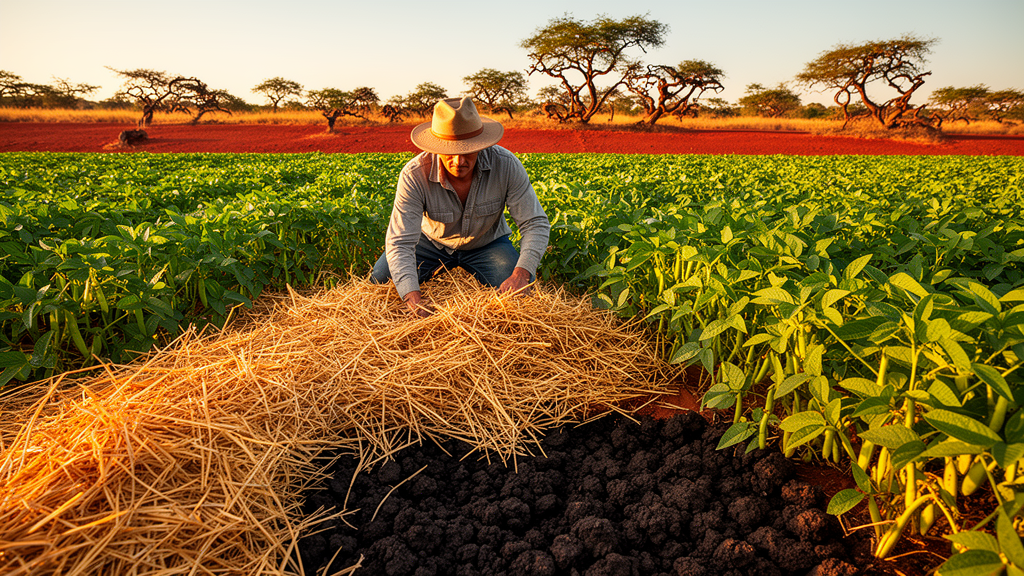
Image Credits: AI Generated
DOI: 10.1016/j.jafr.2026.103386
Keywords: Quênia guinea grass, maize intercropping, soybean, soil health, soil enzymes, soil organic carbon, no-tillage, Brazilian Cerrado, cover crops, integrated crop-livestock systems, soil temperature, grain yield
News Source: Alan Morgan. (October 27, 2026). Guinea grass mulch boosts soil health and soybean yields in Brazilian Cerrado. Scienmag.