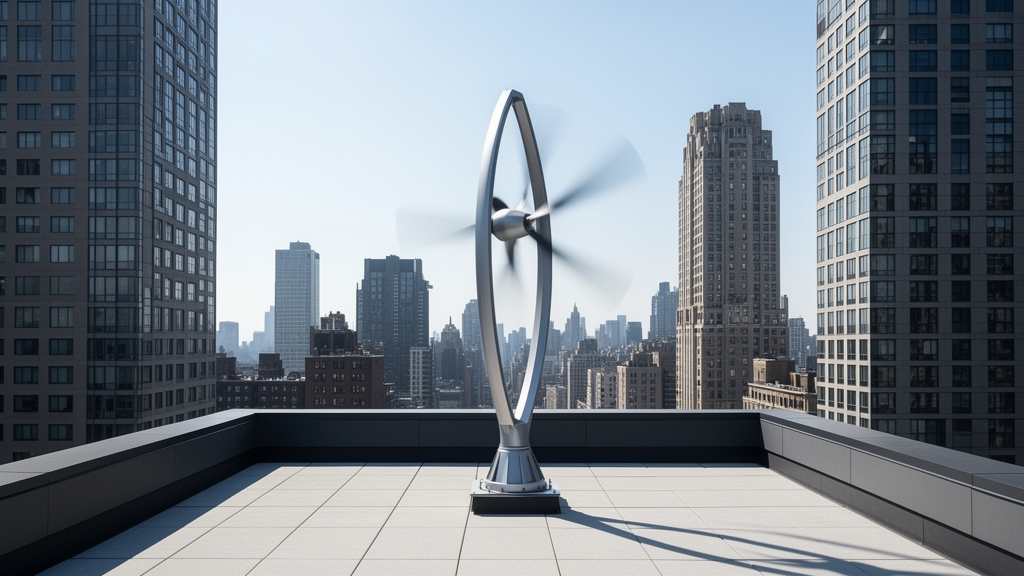
A comprehensive study utilizing advanced computational fluid dynamics (CFD) simulations has revealed that the success of integrating vertical-axis wind turbines (VAWTs) into urban environments hinges critically on the precise micro-siting and orientation of the turbines on flat rooftops. Researchers investigated the aerodynamic performance, starting torque, static flow fields, and vortex structures of H-type VAWTs installed on a standardized low-rise building model, demonstrating that the surrounding urban architecture profoundly influences the turbine’s operational efficiency and structural integrity. The findings provide essential engineering guidance, establishing a clear strategy for maximizing wind energy capture while mitigating detrimental aerodynamic loads in dense built-up areas.
The challenge of harnessing wind energy in cities is compounded by the complex flow conditions created by dense building groups, significant height differences, and inherent turbulence. While VAWTs are considered a clean and eco-friendly alternative due to their low noise pollution and rapid wake recovery—allowing for denser turbine placement—their performance is highly sensitive to their placement. This study addressed a significant gap in understanding the coupled aerodynamic interactions between the built structures and the VAWTs themselves, specifically focusing on how the turbine’s wake influences the rooftop’s inherent flow structures, such as leading-edge vortices and separation zones. By employing numerical simulations using ANSYS Fluent, the researchers analyzed the aerodynamic behavior of a stationary VAWT under various installation positions and azimuth angles, focusing on key indicators like starting torque, wake wind speed, static flow fields, and vortex structures.
The methodology employed in this investigation was rigorous, utilizing the SST k-ω turbulence model, which is uniquely suited for simulating rotating machinery and complex fluid dynamics problems. This model blends the robustness of the k-epsilon model in the far field with the accuracy of the standard k-ω model near the boundary layer, making it ideal for capturing phenomena like flow separation and adverse pressure gradient effects—critical features in the complex flow around buildings and rotating blades. The computational domain was carefully scaled, with dimensions set at 16Z × 20Z × 7Z, where Z is the building height, ensuring that the building’s impact on wind turbine performance was fully accounted for. Furthermore, mesh independence verification was conducted by testing six different computational schemes with varying mesh quantities, ultimately selecting a mesh count of 4.45 million to ensure computational accuracy while optimizing resource usage, thereby guaranteeing the reliability of the simulation results.
The analysis of starting torque coefficient—defined as the ratio of the turbine’s generated torque to the torque due to the incoming dynamic pressure—revealed that the turbine’s position relative to the building geometry is the single most influential factor. At the center of the roof (positions L1 and L2), the starting torque coefficient remained consistently low, typically below 0.02, indicating a severely limited self-starting capability, likely due to sheltered flow conditions and the absence of strong, directional velocity gradients. In stark contrast, when the VAWT was positioned closer to the building wall (L4 and L5), the amplitude of torque fluctuation increased significantly, with the coefficient varying between 0.08 and 0.09 at position L4, peaking at 60° azimuth. This suggests that the interaction between the rotor and the flow deflection induced by the wall enhances the turbine’s ability to initiate rotation.
A detailed examination of the static flow field further illuminated these positional effects. At the central locations (L1 and L2), the wind turbine is situated within a recirculation zone above the building, causing the incoming flow direction to shift based on the turbine’s azimuth angle—for instance, shifting from the lower oblique side at 0° to the upper oblique side at 80°. Conversely, when installed at the leading edge (L3 and L4), the turbine is located in the high-speed flow region, or displacement zone, where the wind flow accelerates and converges. At position L3, the wind speed can reach 1.2 times the incoming wind speed, a factor that significantly contributes to the enhanced aerodynamic performance and higher starting torque observed at these front-facing locations.
The pressure field analysis provided crucial insight into the aerodynamic forces acting on the blades. At the central positions (L1 and L2), the entire turbine operates within a negative pressure region, where wind pressure coefficients are consistently negative, indicating a suction zone characteristic of cross-flow conditions above a flat roof. As the turbine moves toward the leading edge (L3, L4, and L5), the distribution of wind pressure coefficients changes dramatically: a high-pressure region gradually expands, while the negative pressure region on the leeward side becomes more prominent. At position L5, when the azimuth angle reaches 80°, the negative pressure region extends, reducing the pressure difference across the downstream blades, which consequently weakens the aerodynamic force and reduces kinetic energy capture efficiency.
Vorticity analysis, conducted using the Q-criterion, provided a three-dimensional visualization of the flow field’s rotational structures. The results confirmed that both siting location and azimuth angle significantly affect vortex shedding. At the central position (L1), the vortices shed from the building completely cover the entire wind turbine, resulting in extremely unsteady operating conditions. However, placing the turbine near the building wall (L4 and L5) leads to an increase in the size of the wake vortices, which interact with the overall rooftop flow structure. Furthermore, as the azimuth angle increases, more small-scale fragmented vortices are generated on the blade surface, which is linked to local flow separation and unsteady loads, potentially reducing the turbine’s operational stability.
The study’s findings translate into vital practical guidance for urban wind energy development. To achieve optimal wind energy capture, the research strongly recommends deploying VAWTs in proximity to the building’s frontage, specifically within the flow acceleration zone (such as position L3), where the turbine can exploit the high-velocity flow to substantially improve startup performance and power generation output. This strategic placement allows the turbine to avoid the low-wind-speed shelter zone in the building’s center and to mitigate immersion in destructive vortices. However, the significant dependence of the wake pressure distribution on the azimuth angle highlights a critical design consideration: fixed-position VAWTs will be subjected to highly unsteady aerodynamic loads. Therefore, future installations must consider adaptive control strategies or carefully planned orientation to reduce load fluctuations and improve the long-term structural durability of the equipment.
While the study provides a robust theoretical foundation for optimizing urban wind energy systems, it acknowledges several limitations. The simulations utilized a simplified uniform inlet wind profile, which cannot fully replicate the shear and turbulence characteristics of real urban atmospheric boundary layers. Moreover, the Reynolds-Averaged Navier-Stokes (RANS) model, while efficient, cannot fully resolve the transient, large-scale vortex dynamics crucial to wake interaction. The current analysis also assumes rigid blade structures and investigates only discrete operating points, ignoring potential aeroelastic effects. These limitations underscore the need for subsequent research employing more advanced, scale-resolving simulation methods and systematic experimental validation to further refine the integration of VAWTs into complex urban microclimates.
Subject of Research: Aerodynamic performance and optimal placement of vertical-axis wind turbines on urban rooftops.
Article Title: Study on flow field characteristics and micro-siting of vertical-axis wind turbines on flat rooftops in urban areas
Article References: Wang, X., Ke, H., Hu, J., Ogirima, M. M., Adamu, A. A., & Yang, H. (2026). Study on flow field characteristics and micro-siting of vertical-axis wind turbines on flat rooftops in urban areas. Results in Engineering, 32, Article 113579. https://doi.org/10.1016/j.rineng.2026.113579
Image Credits: AI Generated
DOI: 10.1016/j.rineng.2026.113579
Keywords: Vertical-axis wind turbines, Urban aerodynamics, CFD simulation, Micro-siting, Wind energy, Starting torque, Turbulence modeling, flow, field, characteristics, vertical-axis, wind
News Source: Denise Maddox. (October 27, 2026). Urban Wind Power Optimization: How Rooftop Location Dictates VAWT Performance. Scienmag.