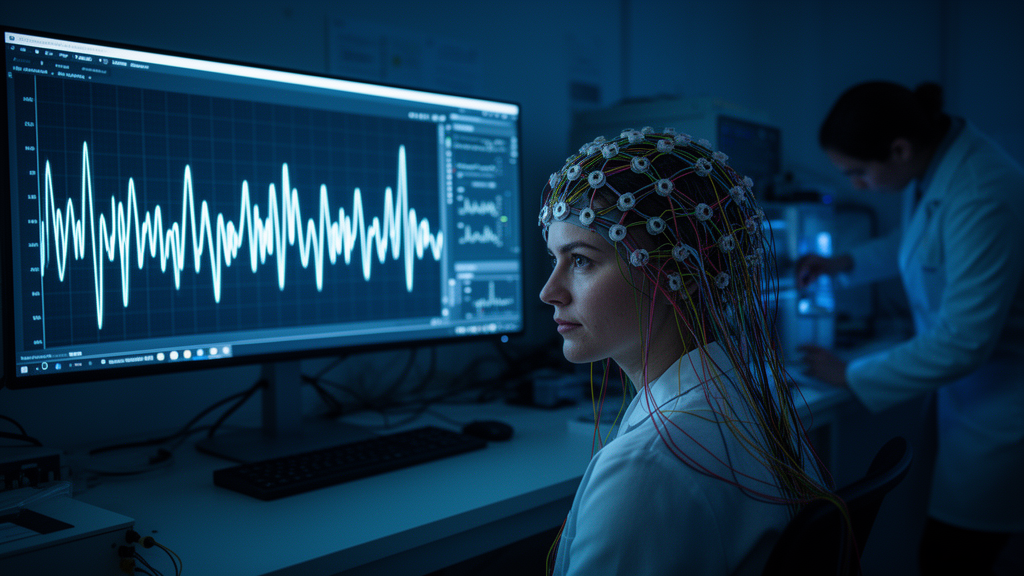
Why do smart people fail at tasks they are fully capable of doing? According to a new hypothesis paper published in Frontiers in Neuroergonomics, the answer is often not a lack of ability but a lack of access. A person may reason flawlessly in one interval and stumble in the next without any change in underlying intelligence, because fatigue, stress, interruption, and attentional drift push the brain’s operating point away from the state in which that ability is actually expressed. The paper, authored by Ibrahim Mourad of Paragon Intelligence LLC, proposes treating this problem not as a puzzle of enhancement but as an engineering challenge: a closed-loop control problem, in which a sensing-and-intervention system helps a user enter, stabilize, and recover their best available cognitive state for a specific task.
The framework, formally called closed-loop cognitive state control and informally dubbed “supercognition,” is deliberately narrow in what it claims. The author is explicit that the term does not denote omniscience, thought reading, unlimited memory, or trait-level intelligence amplification. The target is not a new mind but better real-time control over the best functional state the existing nervous system can safely express. The paper is a hypothesis and conceptual framework article: it reports no human participants, no animal subjects, no empirical measurements, and no simulations. Every claim about how such a system would behave is prospective, awaiting a validation program the paper specifies in detail but has not run.
The architecture proposed has five layers. The first is multimodal sensing, drawing on electroencephalography, functional near-infrared spectroscopy, eye tracking and pupillometry, heart-rate variability, respiration, electrodermal activity, typing cadence, speech dynamics, task telemetry, and brief self-report. The guiding principle is to maximize state information per unit burden rather than to maximize sensor count, since an intrusive sensor may degrade the very state it is meant to support. Notably, the paper argues that task telemetry—the digital traces of how someone interacts with their work—is free, unobtrusive, and individually calibrated by construction, and may for some states carry more usable information than any physiological channel.
The second layer infers the user’s latent cognitive state from these signals. The paper treats cognition as a partially observable dynamical system and recommends a hybrid approach: a learned encoder maps raw multimodal data windows to a low-dimensional feature vector, while a switching state-space model operates on that vector, representing cognition as continuous but punctuated by discrete regimes. Candidate methods include hidden semi-Markov models, Kalman filtering, particle filters, and Riemannian covariance methods, each with stated data requirements, latencies, and characteristic failure modes. Crucially, the inference layer outputs a posterior probability distribution, not a label, and must remain calibrated and stable even when a sensor drops out.
The third layer is where the framework departs most sharply from existing systems. Rather than merely classifying the current state, it forecasts transitions—estimating the probability of leaving a high-performing region before performance actually collapses. The decisive metric is not forecast accuracy in the abstract but the achieved distribution of lead time at a fixed false-alarm rate, evaluated against how long an intervention takes to act. An accurate prediction arriving 400 milliseconds before an event is useless if the shortest admissible intervention needs two seconds to take effect. Survival and hazard models, sequence models, and Gaussian-process forecasts are named as candidate implementations, with the caveat that deep sequence models are frequently overconfident and require explicit calibration because the controller consumes probabilities, not point predictions.
The fourth layer selects interventions: adaptive pause timing, attention-reset cues, task-framing adjustments, pacing changes, sensory environment modulation, breathing protocols, neurofeedback, and task or automation reallocation. The central claim is not that any specific intervention is universally effective, but that intervention effects are state-dependent and individualized—the same reminder may restore focus during drift yet fragment stable engagement, and the same breathing protocol may reduce stress during overload yet add friction when a person is under-engaged. A non-learned safety layer sits between policy and delivery, enforcing constraints and abstaining when the state estimate is too uncertain to support a decision.
The fifth layer, the personal neural twin, is the element the author identifies as most at risk of being a vision statement rather than a specified construct. It is a longitudinal, individualized model of the user’s state transitions and intervention responses, updated between sessions against a replay buffer of historical data, with structural parameters frozen within a session for safety. The paper adopts the National Academies’ definition of a digital twin and notes soberly that a scoping review of 149 human-digital-twin studies published between 2017 and 2024 found only about 12 percent fully met those criteria, with substantial fractions amounting to mere digital shadows or static models. The twin carries its own null hypothesis: if, after adequate data, an individualized longitudinally updated model provides no improvement over a population model with per-session calibration, the layer should be removed and the architecture reduced to four.
What is genuinely new here, the author argues, is not the components—multimodal sensing, state inference, state-conditioned adaptation, per-user calibration, and the digital-twin metaphor all have substantial prior art—but five commitments: defining the objective over a region of latent state space with entry latency, dwell time, recovery latency, and drift magnitude as endpoints; making transition prediction with quantified lead time the control trigger; treating intervention burden as an explicit cost and hard constraint; making the longitudinal model separately falsifiable; and separating predictive from causal claims with stated evidentiary requirements for each. The paper is candid that the first three points reformulate objectives existing systems address implicitly, and that the fourth is the element with the least supporting evidence.
The framework also engages directly with the literature that challenges its own feasibility. Cognitive-state classifiers generalize poorly across subjects, sessions, devices, and tasks, which is why the framework restricts itself to within-task-class operation. Physiological signatures of workload and fatigue shift across sessions, days, and devices, making non-stationarity the normal case. Neurofeedback evidence is contested, with benefits potentially attributable to expectancy, environment, and practice rather than the trained process, and quantitative review finds no reliable cognitive effect of single-session transcranial direct current stimulation in healthy populations. Brain-wide association studies require thousands of participants for stable estimates, and small-sample effects are systematically inflated. The cognitive-training literature adds a further warning: brain-training programs improve trained tasks reliably, related tasks less consistently, and everyday cognitive performance not at all, so the framework defines its endpoints on the operational task itself rather than claiming transfer.
The proposed validation program is staged with explicit stop rules. Early milestones are observational: identifying a performance-anchored target region within a person and task class across 20 to 40 participants and 8 to 12 sessions, characterizing how much within-person data individual models require, and determining achievable drift-prediction lead times. Later milestones involve micro-randomized trials in which intervention options are randomized at many within-person decision points, allowing causal effects and their moderation by inferred state to be estimated. The decisive comparison pits closed-loop, state-conditioned intervention against open-loop intervention matched on dose, timing, and content, isolating the contribution of state conditioning from the intervention itself. The paper also addresses ethics at length: consent must be ongoing and revocable, the user must be able to inspect and override the inferred state, neural data must be protected, and coercive deployment in workplaces and schools is constrained by the European Union’s AI Act, which prohibits emotion inference in workplaces and educational institutions subject to narrow exceptions, and by UNESCO’s 2025 recommendation on the ethics of neurotechnology. The author’s conclusion is measured: nothing in the paper is evidence that the architecture works, but the observational and forecasting milestones most likely to falsify it are also the cheapest to run—and if the framework fails, it has been specified precisely enough to be abandoned.
Subject of Research: A hypothesis framework for closed-loop, real-time control of task-specific high-performance cognitive states in neuroergonomics
Article Title: Closed-loop cognitive state control: a hypothesis framework for real-time estimation, stabilization, and recovery of task-specific high-performance cognitive states
Article References: Mourad, I. (2026). Closed-loop cognitive state control: a hypothesis framework for real-time estimation, stabilization, and recovery of task-specific high-performance cognitive states. Frontiers in Neuroergonomics, 7, 1909443. https://doi.org/10.3389/fnrgo.2026.1909443
Image Credits: AI Generated
DOI: 10.3389/fnrgo.2026.1909443
Keywords: closed-loop control, cognitive state, neuroergonomics, brain-computer interface, neurofeedback, digital twin, personal neural twin, cognitive enhancement, wearable neurotechnology, micro-randomized trial, transition prediction, research ethics
News Source: Cassandra Pierce. (October 27, 2026). A New Framework Proposes Controlling High-Performance Brain States in Real Time. Scienmag.