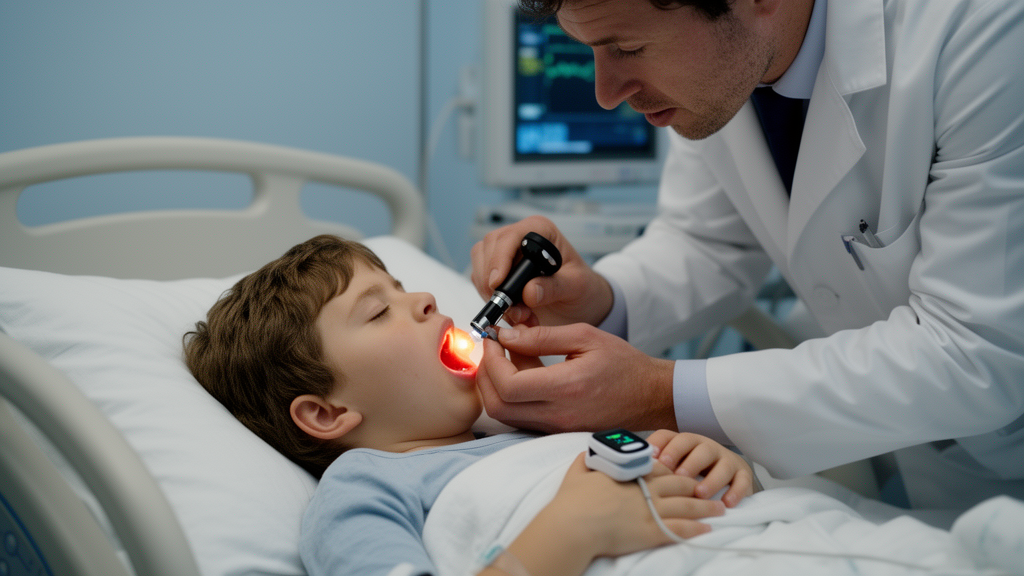
Snoring, mouth breathing, and pauses in breathing during sleep are among the most common reasons young children are referred to ear, nose, and throat clinics, and in the vast majority of cases they point to enlarged adenoids and tonsils. A newly published case report in Frontiers in Pediatrics describes how, in one 3-year-old boy, that familiar picture concealed something far more dangerous: an embryonal rhabdomyosarcoma growing in the nasopharynx, the space behind the nose.
The boy had previously been healthy when he developed snoring, mouth breathing, witnessed apneas, and persistent nasal obstruction during an acute viral upper respiratory illness. Symptoms of this kind are so frequently associated with adenotonsillar hypertrophy in children that the initial working explanation was an ordinary one, made more plausible by the concurrent infection.
The first diagnostic attempt was itself inconclusive. Flexible nasopharyngeal endoscopy was limited by copious secretions and by the child’s poor cooperation, and no obvious mass was identified. The report’s authors emphasize that an incomplete examination of the nasopharynx should not be treated as reassuring when symptoms persist or change, a point that proved decisive in this case.
The turning point came when the boy developed epistaxis, or nosebleeds. That red-flag feature prompted a repeat endoscopic evaluation, which this time revealed a left-sided nasopharyngeal mass. The emergence of bleeding, along with progressive nasal obstruction and failure to improve as expected, is precisely the pattern the authors flag as warranting timely reassessment.
Cross-sectional imaging then demonstrated the true extent of the disease: an aggressive parameningeal lesion with erosion of the skull base and extension into the cavernous sinus, an area at the side of the head containing critical nerves and blood vessels.
The diagnosis was established by histopathological examination of tissue from the mass, supported by positive immunohistochemical staining for desmin, myogenin, and MyoD1, markers that together confirmed embryonal rhabdomyosarcoma, a cancer arising from primitive muscle-forming cells.
The report records subsequent tumor regression and stable findings on long-term imaging follow-up. Approximately four years after completion of therapy, the boy remained clinically well, an outcome the authors present as evidence of the value of eventual correct diagnosis and multidisciplinary treatment, while noting that the delay in reaching that diagnosis is the central lesson of the case.
The report’s broader message concerns diagnostic anchoring, the tendency to settle on a common explanation when its symptoms overlap with a rare one. In pediatrics, obstructive sleep apnea is genuinely common and most often benign, which makes the occasional exception easy to miss, particularly when an apparently benign condition such as adenotonsillar hypertrophy or a viral infection coexists with the warning signs. The authors argue that the emergence of epistaxis, progressive nasal obstruction, or failure to improve as expected should prompt timely reassessment and consideration of cross-sectional imaging to exclude an underlying structural lesion.
As a single-patient case report, the article cannot establish how often nasopharyngeal malignancy masquerades as sleep apnea, and its conclusions rest on one child’s clinical course rather than on comparative data. Its value lies in the concrete sequence it documents: a limited first endoscopy, a red-flag symptom, a repeat examination, imaging, biopsy, and a treatment pathway that led to long-term survival. For clinicians managing pediatric snoring, the practical takeaway is narrow but specific, namely that incomplete visualization of the nasopharynx combined with evolving symptoms deserves a second look rather than continued observation.
Subject of Research: A pediatric case report of nasopharyngeal rhabdomyosarcoma initially mistaken for obstructive sleep apnea
Article Title: Case Report: When obstructive sleep apnea is not benign—nasopharyngeal rhabdomyosarcoma in a 3-year-old
Article References: Abusido, T., Alghaihab, M., Alyami, A., Alfadhel, A., Jarwann, R., Aldhbiban, L., Alharbi, M., & Almuhesseny, A. (2026). Case Report: When obstructive sleep apnea is not benign—nasopharyngeal rhabdomyosarcoma in a 3-year-old. Frontiers in Pediatrics, 14, Article 1971652. https://doi.org/10.3389/fped.2026.1971652
Image Credits: AI Generated
DOI: 10.3389/fped.2026.1971652
Keywords: obstructive sleep apnea, rhabdomyosarcoma, nasopharyngeal mass, pediatrics, epistaxis, diagnostic delay, endoscopy, skull base erosion, proton radiotherapy, case report, Case, Report
News Source: Ophelia Keating. (October 27, 2026). Research report: Case Report: When obstructive sleep apnea is not benign—nasopharyngeal rhabdomyosarcoma in a 3-year-old. Scienmag.