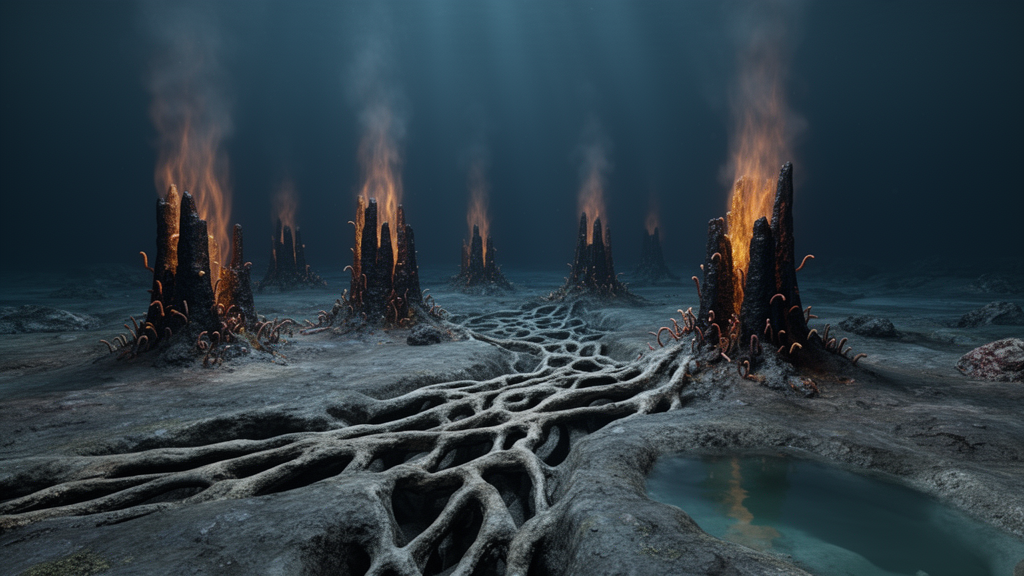
Hydrothermal vents have long ranked among the most compelling candidates for the cradle of life, prized for their steep redox gradients and abundant chemical energy. But a new conceptual paper in The Science of Nature argues that this focus on any single environment may be misplaced. Shinya Kato proposes that the beginnings of metabolism may have depended not on what happened inside one setting, but on the transitions of molecules between connected environments — vents, ice–water interfaces, and adjacent aqueous compartments — each performing a complementary chemical role.
The framework, which Kato calls environmental structural ecology, is explicitly a hypothesis rather than a reconstruction of history. The article presents no new experimental validation, and the author is careful to state that neither the proposed environmental connections nor their contribution to the emergence of heritable metabolism or the last universal common ancestor is established. What the paper offers instead is a structured way to ask testable questions about whether coupling different environments could produce a measurable chemical benefit that isolated settings cannot.
The core idea borrows vocabulary from ecology, but with strict caveats. Producer-like, consumer-like, and decomposer-like functions are used as nonexclusive analogies for chemical production, the use of supplied organic compounds, and breakdown yielding potentially reusable products. Kato stresses that these labels do not denote demonstrated abiotic metabolisms. Decomposition, for instance, is not synonymous with heterotrophy or organotrophy as understood in living organisms; it is a functional analogy intended to guide experimental design, not a claim that prebiotic chemistry already possessed the organization of an evolved ecosystem.
Under this scheme, hydrothermal systems are cast as potential sites of transformation and recycling. Elevated temperatures can accelerate hydrolysis, while mineral-mediated reactions and reducing conditions can redirect organic compounds into other reaction pathways. Whether products persist or accumulate depends on the balance among supply, reaction, retention, and removal: rapid through-flow may shorten residence times, whereas pores and mineral surfaces may retain particular compounds. The decomposer-like analogy is considered useful only where supplied organic compounds are broken down into products that remain available for subsequent reactions. Illustrative reaction classes include peptide-bond hydrolysis and the decarboxylation of a beta-keto acid, though the paper is explicit that these are not measured vent rates or evidence of energy-conserving metabolism.
Importantly, the framework does not make heterotrophy the necessary first metabolism. Because decomposition depends on pre-existing organic substrates, hydrothermal autotrophic scenarios that address the upstream supply of organic carbon remain compatible with the proposal. Kato also notes that thermodynamic treatments of emerging chemoautotrophic chemistry, while relevant, do not by themselves demonstrate reaction kinetics or an autonomous proto-metabolic network. The point is reinforced by earlier experimental work showing that iron-promoted chemistry can support the synthesis and breakdown of metabolic precursors simultaneously, underscoring that construction and destruction need not be assigned to separate environments.
At the other end of the temperature spectrum, ice–water interfaces are proposed as candidate settings for producer-like functions. During freezing, solutes can become concentrated in liquid microenvironments, and experimental studies support particular reaction steps in ice: polymerization of supplied activated ribonucleotides has been demonstrated in eutectic ice phases, and RNA polymerase ribozyme activity has been shown in ice using supplied substrates and an existing ribozyme. These results support concentration and selected synthetic or catalytic reactions under the tested conditions. They do not, however, establish spontaneous RNA formation from simple feedstock, indefinite product retention across freeze–thaw cycles, or the sustained evolution of an autonomous reaction network.
The framework is candid about its gaps. It does not explain the complete synthesis of bases, sugars, nucleosides, and nucleotides, although it cites a demonstrated route to activated pyrimidine ribonucleotides that bypasses free ribose and free nucleobases. A recently proposed auroral-belt hypothesis suggests that geomagnetic focusing could organize particle-driven atmospheric chemistry and deliver precursors to polar environments, but this remains a possible upstream supply mechanism rather than evidence that aurorae produce complete nucleotides or that polymerization occurs in the auroral reaction zone. Atmospheric composition, precursor survival and deposition, and compatibility with subsequent ice chemistry all remain unresolved, and early-Earth polar ice availability is itself uncertain.
Connecting the environments raises further constraints. A linked scenario requires transfer to occur faster than destructive loss, and requires compatible pH, salinity, temperature, and reactant concentrations at receiving sites. Local exchange near cold-water hydrothermal mixing zones is one candidate; long-distance transfer between polar ice and deep vents introduces additional dilution and survival constraints. The proposed sequence is framed as a dependency on available substrates, not an established geographical or evolutionary chronology. Transport among the settings, the paper emphasizes, is not established.
To move from concept to evidence, the paper lays out proposed evaluation methods rather than performed analyses. Coupled abiotic reactors representing retention and hydrothermal transformation could be compared with isolated reactors supplied with matched total feedstock and energy inputs, with controls distinguishing transfer alone from exposure to a second reaction environment and accounting for residence time and dilution. Specific compounds would be tracked through each stage to measure survival, conversion, and incorporation of transferred products into subsequent reactions. Crucially, a recycling benefit requires evidence of reuse; recovering smaller breakdown products alone would be insufficient, and failure to observe reuse or an advantage of coupling would argue against the proposed benefit within that experimental range.
Other proposed tests reach into modern biology and genomics. Thermophilic microorganisms from contemporary hydrothermal systems could be compared with related taxa from cooler settings for hydrolytic and degradative capacity, while controlling for substrate supply and phylogeny — though any enrichment would characterize present ecology rather than establish the first metabolic role of vents. Reconstructions of the last universal common ancestor’s physiology could test the compatibility and evolutionary histories of inferred carbon-fixation and catabolic functions, explicitly comparing gene-transfer and differential-loss explanations. Kato notes that LUCA, as reconstructed from genomic data, possessed a metabolically complex physiology and is generally understood not as the first life form but as a population already substantially biochemically integrated; yet that complexity does not by itself identify the number or locations of ancestral environments, nor does it establish prior producer-like, consumer-like, or decomposer-like lineages. The deep divergence between Archaea and Bacteria, similarly, does not establish separate environmental origins, and metabolite exchange alone would not establish a common lineage. The central hypothesis — that life’s beginnings may have depended partly on transitions between environments rather than on processes within any single environment alone — is offered as something to be assessed by measuring product survival, subsequent reaction, and the effects of coupling relative to isolated systems, with the framework’s proposed chemical functions to be evaluated as hypotheses rather than a reconstruction of life’s actual history.
Subject of Research: A conceptual framework proposing that complementary chemical functions across connected hydrothermal, icy, and aqueous environments may have shaped the early emergence of metabolic roles
Article Title: Rethinking hydrothermal vents: a structural ecology perspective on the early emergence of metabolic roles
Article References: Kato, S. (2026). Rethinking hydrothermal vents: a structural ecology perspective on the early emergence of metabolic roles. The Science of Nature, 113(6), Article 139. https://doi.org/10.1007/s00114-026-02189-x
Image Credits: AI Generated
DOI: 10.1007/s00114-026-02189-x
Keywords: hydrothermal vents, origin of life, prebiotic chemistry, metabolic roles, ice–water interfaces, LUCA, environmental structural ecology, recycling, RNA polymerization, serpentinization, abiotic reactors, early Earth
News Source: Drew Townsend. (October 27, 2026). Hydrothermal Vents Reimagined: Life’s Origins May Hinge on Linked Environments. Scienmag.