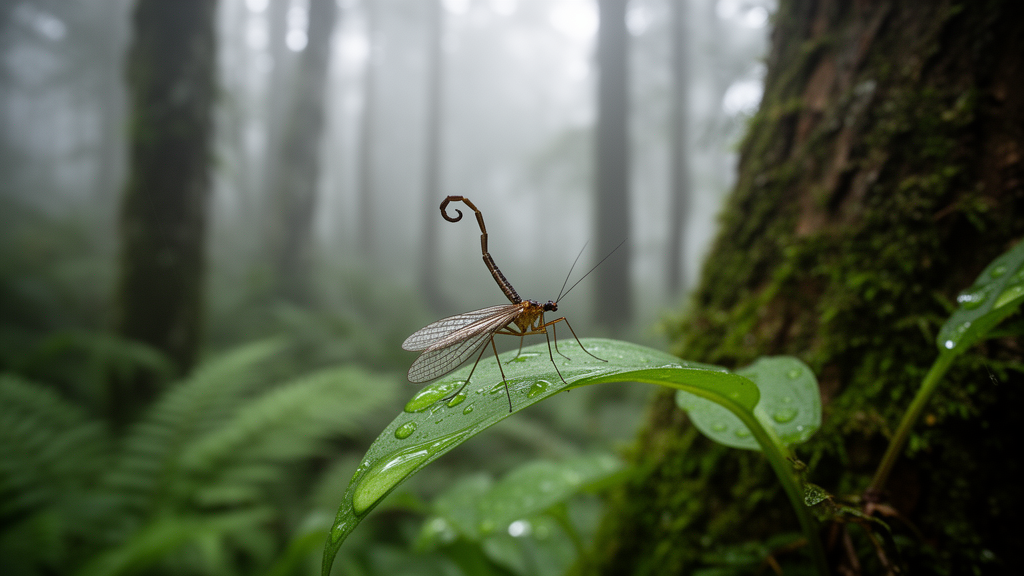
A comprehensive taxonomic review of the scorpionfly genus Sinopanorpa, published in the journal Deutsche Entomologische Zeitschrift, has raised the number of recognized species in the genus from four to six, with the new species named Sinopanorpa minshanicola and Sinopanorpa shennongjiaica after the mountain regions where they were collected. The work, based on specimens housed in the Entomological Museum of Northwest A&F University in Yangling, Shaanxi, also provides an updated identification key that distinguishes all six species by subtle but consistent differences in male and female genital structures. The genus, erected in 2008 with Panorpa tincta Navás, 1931 as its type species, is set apart from its relatives by a distinctive combination of traits: wing membranes that are deeply yellow with sooty brown markings, a second radial vein that is generally three-branched, the absence of anal horns on the sixth abdominal segment of males, a basal part of the seventh abdominal segment that is much thinner than the rest, and a male gonostylus whose basal process is modified into a sharp crescent-shaped blade.
Females add their own signature, with a medigynium, the sclerotized genital plate, carrying an extremely elongated thin axis. The two new species were separated from their relatives using precisely these characters, many of which are visible only under magnification after careful dissection. In the laboratory, genitalia were macerated in cold 10% sodium hydroxide for three to five minutes and rinsed with distilled water before being examined and photographed under stereoscopic zoom microscopes, with image stacks assembled using auto-montage imaging equipment. Specimens were collected with nets from the mountain regions of central China, some spread and pinned and others preserved in 75% or 95% ethanol, and a distribution map was generated from collection labels and published locality records.
Sinopanorpa minshanicola, collected in the Minshan Mountains of Sichuan and southern Gansu provinces, is diagnosed by a dark transverse band across the ocellar triangle of the head, shortened ventral parameres that extend only slightly over the basal lobe of the gonostylus, a short, simple and acute but non-furcated basal process on the gonostylus, and an elongate female medigynium whose axis extends half its length beyond the main plate. The specific epithet combines the name of the type locality, Minshan, with the Latin suffix -cola, meaning dweller. The holotype male was taken at Laohegou in Pingwu County, Sichuan, at 1800 meters, with paratypes from the same site and from Liujiaping in Wenxian County, Gansu, at 2080 meters.
Males of the new Minshan species bear forewings measuring 15.96 to 16.70 millimeters in length and 3.84 to 3.92 millimeters in width, with a light yellow membrane, a prominent orange-yellow pterostigma, a broad apical band covering the whole wing tip, and a complete pterostigmal band whose basal and distal branches are equal in width. The sixth abdominal segment is reddish yellow and greatly elongated, twice as long as the fifth, and carries a patch of golden hairs along its midpoint. Females are slightly larger, with forewings of 16.30 to 16.76 millimeters, vaguer wing markings and no marginal spot. Adults were collected from late June to the end of July at the edges of coniferous and broad-leaf mixed forests with dense sub-shrubs, most often in moist microhabitats on alpine shrub or forest understory between 1600 and 2100 meters above sea level.
The second new species, Sinopanorpa shennongjiaica, named after the Shennongjia Nature Reserve in Hubei Province, lacks the transverse head band of its Minshan relative, instead showing a black ocellar triangle on an otherwise plain yellowish-brown vertex. It is further characterized by orange coloring on the male sixth abdominal segment and on female terga IV to VI, greatly elongated ventral parameres that reach distinctly beyond the median tooth of the gonostylus to its distal fourth, a gonostylus whose well-developed basal lobe splits into two separate acute elongate hooks, and a female subgenital plate with an X-shaped ridge running its whole length. The holotype was captured at Tianyan at 1800 meters in July 2018, with paratypes from Dalongtan and Jiuhuping at elevations up to 2200 meters, all taken on herbaceous groundcover in moist, cool valleys.
Males of S. shennongjiaica have forewings of 15.32 to 16.34 millimeters with a deeply yellow membrane and faint grayish-brown markings, while females reach 16.64 to 17.12 millimeters and retain a marginal spot that the males lack or bear only in elongate form. The antennae are filiform with 44 to 45 segments, and the tarsal claws are serrate with six teeth. The taxonomic detective work behind the revision also involved correcting an earlier misidentification: specimens from Sichuan and southern Gansu that had previously been assigned to the widespread species S. tincta are now recognized as belonging to S. minshanicola.
This reassignment matters for biogeography. S. tincta remains distributed across the Qinling, Bashan and Minshan mountains, but the other five species are all geographically restricted. S. minshanicola appears endemic to the Minshan Mountains, while S. digitiformis, S. nangongshana, S. baokangensis and the newly described S. shennongjiaica are confined to microhabitats of the eastern Bashan Mountains, including the Shennongjia area. The authors note that further phylogeographic analyses will be needed to clarify the causes of this disproportionately clustered distribution pattern across central China’s mountain systems.
All known Sinopanorpa species inhabit high-elevation environments between 1600 and 2200 meters in the Qinling, Minshan, Bashan and Shennongjia mountains, where adults fly in summer at the edges of coniferous and broad-leaf mixed forests with dense sub-shrubs. Their microhabitats are consistently cool and moist valley sites at high altitude with high precipitation. The researchers conclude that these are typical cool-adapted insects, a preference they share with the related scorpionfly genus Cerapanorpa, which has previously been characterized as cold-adapted. This makes Sinopanorpa an attractive model for investigating how cold-adapted insect lineages speciate and spread across mountain landscapes, questions the team is pursuing in ongoing work on the distribution patterns of Chinese Panorpidae, including the search for centers of biodiversity and areas of endemism and the key factors driving speciation.
Remarkably, the biology of the type species S. tincta has been studied in considerable depth since the genus was erected, providing a rich backdrop to the taxonomy. The species completes one generation per year, with adults on the wing from late June to mid-September. Females deposit ovoid eggs, their shells etched with a ridge network on the chorion, in clusters within soil cavities. The larvae are eruciform, caterpillar-like, equipped with three pairs of thoracic legs and eight pairs of abdominal prolegs, and they carry a pair of lateral compound eyes on the head, each composed of roughly 40 ommatidia. In the adults, the compound eyes are of the apposition type, with each retinula built from eight retinula cells, and three dorsal ocelli on the vertex each contain a corneal lens, a layer of corneagenous cells and fused rhabdoms.
The mandibulate mouthparts of S. tincta are modified for consuming liquid food after extra-oral digestion, with hair brushes on the hirsute epipharynx, galea, labial palps and hypopharynx doing the gathering. The salivary glands show striking sexual dimorphism: males possess six extremely elongate secretory tubules, while females have only a short, less-developed tube. The male glands produce salivary secretions that serve as nuptial gifts offered to females during mating. The female spermatheca consists of a bean-shaped reservoir and an elongated duct, while the male reproductive system comprises a pair of testes each with three follicles, a pair of elongate vasa deferentia and an ejaculatory sac, with the vas deferens coiled at its distal end into an epididymis and expanded in its middle portion into a well-developed seminal vesicle. Phylogenetic analyses have confirmed that Sinopanorpa is monophyletic, forming a sister group to part of the paraphyletic genus Panorpa from which it was carved out. With six species now formally recognized, an updated identification key in hand, and two of them known only from single mountain systems, the revision provides a foundation for mapping how these cool-adapted scorpionflies diversified across the rugged terrain of central China.
Subject of Research: Taxonomic review of the scorpionfly genus Sinopanorpa in central China with descriptions of two new species
Article Title: Taxonomic review of the genus Sinopanorpa Cai & Hua, 2008 ( Mecoptera , Panorpidae ) with descriptions of two new species
Article References: Hua, Y., Gao, K., & Xing, L. (2023). Taxonomic review of the genus Sinopanorpa Cai & Hua, 2008 (Mecoptera, Panorpidae) with descriptions of two new species. Deutsche Entomologische Zeitschrift, 70(2), 283-290. https://doi.org/10.3897/dez.70.104621
Image Credits: AI Generated
Keywords: Sinopanorpa, scorpionflies, Mecoptera, Panorpidae, new species, taxonomy, China, Shennongjia, Minshan Mountains, cool-adapted insects, entomology, biodiversity
News Source: Gavin Prescott. (October 27, 2026). Two New Scorpionfly Species Discovered in China’s Mountain Forests. Scienmag.