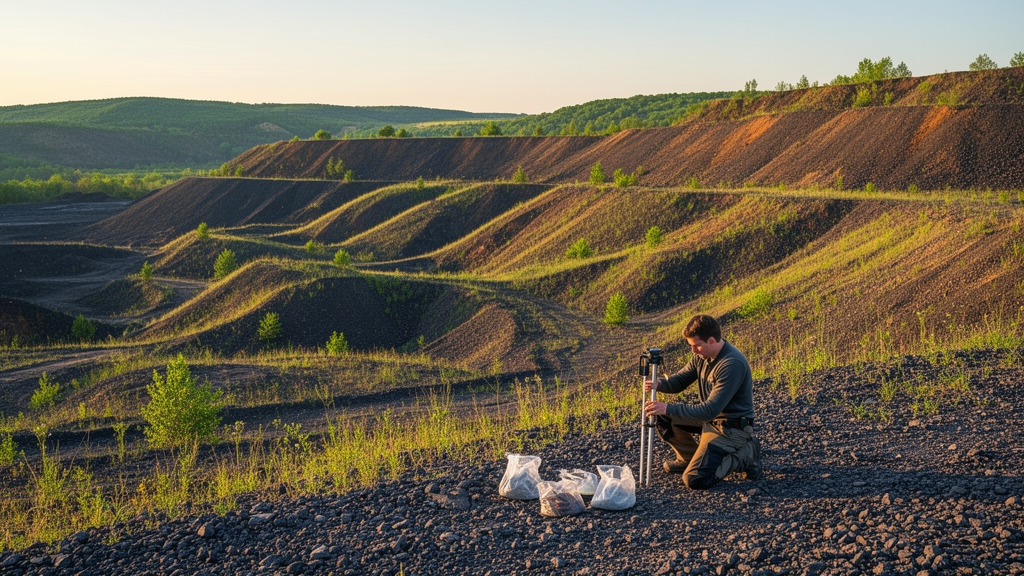
Open-pit coal mining leaves behind some of the most heavily disturbed landscapes on Earth, and the waste rock dumps that pile up beside the pits are rarely uniform. A new study at the Antaibao mine on China’s Loess Plateau shows that the fine-scale shape of these artificial landforms exerts a measurable, quantifiable control over where carbon accumulates in plants and soils, with implications for how reclaimed mine sites are restored.
The research, published in Plant and Soil, focused on three dump sites at Antaibao. The team combined high-resolution digital elevation models with field sampling to build a topographic analysis method grounded in fractal theory, a mathematical framework for describing patterns that repeat across scales. They then used structural equation modelling to trace the causal pathways linking terrain, soil properties and carbon storage.
The analysis showed that measures of dump topography complexity, including the fractal parameters ΔD, D(1), Δα and Δf, were important correlates of the spatial distribution of both plant carbon and soil organic carbon. In other words, the ragged micro-relief of a waste dump is not just scenery; it tracks closely with where carbon ends up being stored across the site.
The two carbon pools behaved differently. Plant carbon displayed more pronounced carbon island effects and greater spatial heterogeneity, with ΔD values ranging from 0.76 to 0.97, meaning vegetation carbon clustered into distinct patches. Soil organic carbon, by contrast, followed a more dispersed distribution pattern and was heavily influenced by terrain complexity, spreading more evenly across the dump surface.
The structural equation models revealed that topographic factors operate at multiple scales and do not act uniformly. Multi-fractal topographic variability exerted a significant negative direct effect on soil organic carbon, with a path coefficient of β = -0.492 (p = 0.0012). At the plot scale, local topography had a significant negative impact on plant carbon, with β = -0.290 (p = 0.0056). In both cases, more complex or differentiated terrain was associated with lower carbon content.
Reclamation age and soil properties also emerged as important regulatory factors for soil organic carbon, indicating that time since restoration and the chemical and physical condition of the developing soil mediate how strongly topography constrains carbon accumulation. The soil properties themselves showed multifractal characteristics that the authors describe as low-dimensional, highly heterogeneous and fragmented, with D(1) values between 0.33 and 0.37, underscoring how patchy the reconstructed ground remains.
The study’s highlights note that the carbon sink function of these dumps is driven by a combination of artificial landforms and natural succession. That distinction matters because it separates what engineers build from what ecology then does with it: the engineered slope shapes set the template, and spontaneous vegetation development fills in the carbon over time, unevenly.
Based on these findings, the researchers propose a differentiated ecological restoration strategy tailored to topographic variation. Rather than treating a whole waste dump as a single reclamation unit, the framework suggests targeting interventions to micro-terrain zones, offering a management approach intended to support carbon neutrality goals and ecological rehabilitation in mined landscapes on the Loess Plateau and potentially beyond.
As a field study at a single mining complex, the work ties topographic differentiation to carbon storage patterns through correlational and structural equation modelling rather than controlled experiments, and the authors’ conclusions are framed as a targeted management framework for dump reclamation. Even so, the message is striking: on land rebuilt from mine waste, the shape of the ground itself helps decide how much carbon the landscape can hold.
Subject of Research: Topographic control of soil and plant carbon storage on reclaimed coal mine waste dumps
Article Title: Soil and plant carbon affected by topographic differentiation at coal mine waste dump sites
Article References: Jing, Z., O’Connor, D., Wang, J., Liu, Y., & Liu, B. (2026). Soil and plant carbon affected by topographic differentiation at coal mine waste dump sites. Plant and Soil. https://doi.org/10.1007/s11104-026-09162-7
Image Credits: AI Generated
DOI: 10.1007/s11104-026-09162-7
Keywords: coal mining, waste dumps, soil organic carbon, plant carbon, fractal theory, topography, Loess Plateau, ecological restoration, structural equation modelling, carbon storage, land reclamation, Soil
News Source: Alan Morgan. (October 27, 2026). Fractal Terrain Analysis Reveals How Micro-Topography Shapes Carbon Storage on Coal Mine Dumps. Scienmag.