A study published in Nature Physics reports that the three-dimensional shape a cell adopts on a curved surface is governed by a single physical quantity: the balance between how hard the cell pulls on the substrate and how strongly it sticks to it. The research, led by Yi Liu, Baoce Sun and Raymond H. W. Lam together with an international team of collaborators, examined curvature sensing at two levels, individual cells and continuous cell monolayers, in an effort to identify the physical principles behind a process that has remained poorly understood despite its importance in tissue and organ development and in wound healing.
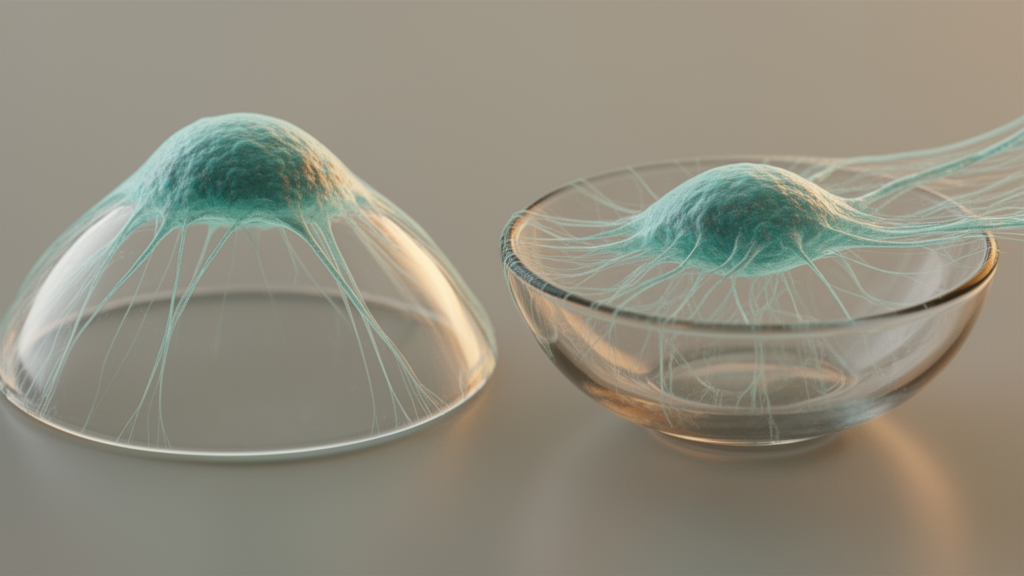
The central concept in the study is what the researchers call the cell–substrate interfacial stress ratio. This ratio is defined as the balance between the cell’s contractile stress, the pulling force the cell generates through its own cytoskeleton, and the cell–substrate adhesion stress, the grip the cell maintains on the surface. According to the study, this single ratio determines which of two predominant three-dimensional morphology modes a cell adopts: complete adhesion, in which the cell conforms fully to the curved surface, or partial interior detachment, in which parts of the cell body lift away from the substrate.
The team found that when the interfacial stress ratio is much higher than one, meaning contractile stress dominates over adhesion, a rapid morphological shift occurs from complete adhesion to partial interior detachment. The researchers describe this transition as irreversible, because it proceeds toward a lower-energy state. In other words, once a cell on a curved surface has crossed this threshold and partially detached from the interior of the curve, the study indicates it does not simply flip back to full adhesion.
A key strength of the work is the breadth of conditions under which the researchers observed this mode switching. According to the paper, the same transition appeared across various cell types, under pharmacological perturbations that alter cell behavior, and across multicellular layers, where sheets of cells rather than single cells were examined. The authors argue that this consistency points to a universal biophysical framework for regulating three-dimensional cell morphology, one that does not depend on the biochemical identity of a particular cell type.
The findings also connect curvature sensing to measurable intracellular characteristics. The study indicates that curvature sensing mediates intracellular properties, and that both substrate curvature and cell characteristics feed into the interfacial stress ratio that ultimately decides the morphology mode. This places the stress ratio as the pivotal variable linking what a cell senses about its geometric environment to the shape it ultimately assumes. Curvature sensing has long been recognized as critical to three-dimensional cell morphology, but the mechanism by which cells actually sense and respond to curvature has been unclear.
Because the researchers observed partial detachment of cell layers, the framework appears to scale from the single cell to tissue-like sheets, which is relevant for understanding how multicellular layers behave on curved surfaces during development and repair. The reported mode switching and its irreversibility were observed in the experimental systems described, across the cell types and perturbations examined, and the authors present the interfacial stress ratio as a framework supported by those observations. The study thus provides a compact physical principle for a long-standing question: how cells decide, on a curved three-dimensional surface, whether to hold on completely or to let part of themselves go.
Subject of Research: Physical mechanism of three-dimensional cell curvature sensing and morphology
Article Title: Three-dimensional cell morphology is mediated by curvature sensing and interfacial stress
Article References: Liu, Y., Sun, B., Hu, S., Luu, N., Ren, J., Liu, L., Zhang, J., Qu, Y., Zhang, R., Song, J., Yang, M., Zhou, A., Wu, H., Sun, D., Hu, J., Lau, D., Chen, W., & Lam, R. H. W. (2026). Three-dimensional cell morphology is mediated by curvature sensing and interfacial stress. Nature Physics. https://doi.org/10.1038/s41567-026-03482-2
Image Credits: AI Generated
DOI: 10.1038/s41567-026-03482-2
Keywords: cell morphology, curvature sensing, biophysics, interfacial stress, cell adhesion, contractile stress, cell detachment, mechanobiology, cell monolayers, Nature Physics, wound healing, tissue development
News Source: Denise Maddox. (October 27, 2026). Cell Shape on Curved Surfaces Ruled by a Single Stress Balance. Scienmag.