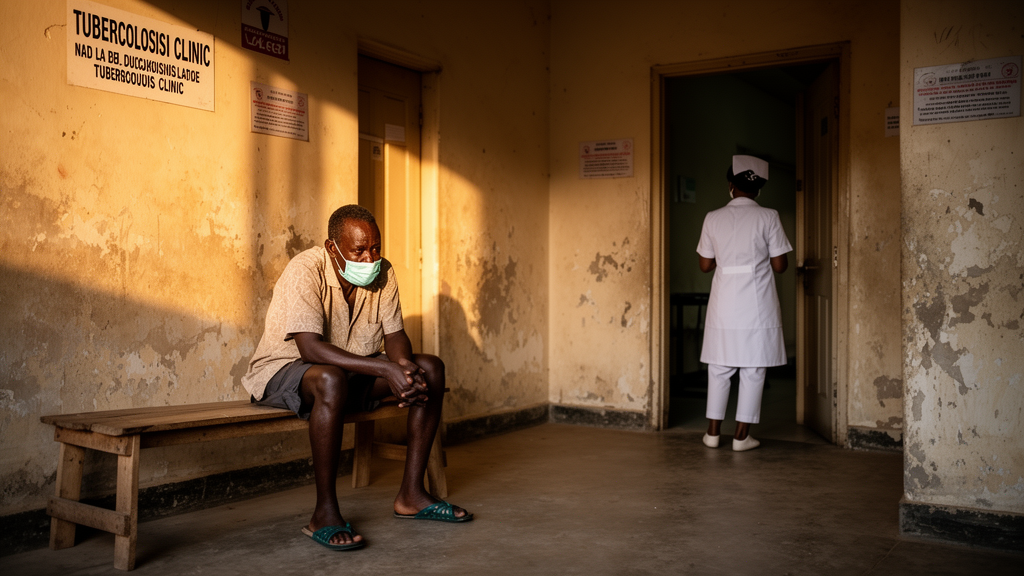
People undergoing treatment for drug-resistant tuberculosis in Lagos, Nigeria, report that stigma inside the very clinics meant to heal them can weigh more heavily than the disease itself, according to a qualitative study published in BMC Public Health. Researchers found that healthcare settings exposed patients to a diagnosis they could otherwise conceal, and that some patients weighed the humiliation they experienced against the benefit of free treatment — with one choosing costly private care and reportedly suffering adverse clinical consequences as a result.
The study, led by Olusola A. Adejumo with colleagues, held five focus group discussions with 53 people with drug-resistant tuberculosis at five purposively selected outpatient clinics in Lagos. All participants were adults who had been on treatment for at least three months. Discussions were audio-recorded, transcribed verbatim, and analysed using reflexive thematic analysis, with reporting guided by the Consolidated Criteria for Reporting Qualitative Research. The researchers interpreted their findings through Link and Phelan’s stigma framework, which distinguishes labelling, stereotyping, separation, status loss, and discrimination.
Four themes emerged from the analysis. The first concerned how the healthcare setting itself strips away the concealment that many patients rely on elsewhere in their lives. Visible practices, particularly healthcare workers’ use of face masks, marked participants out as diseased in front of others. Several participants who wanted to report mistreatment did not know how to do so, and responded instead by concealing their diagnosis even further.
The second theme captured a painful calculation that some patients made between dignity and access. Free treatment is a central benefit of the public DR-TB care pathway, yet some participants weighed that benefit against the humiliation they experienced in care. One participant sought costly private care as a result, and the study reports adverse clinical consequences in that account. This trade-off, the authors note, illustrates how mistreatment can push patients away from the services designed for them.
The third theme linked these experiences to disengagement from care. Participants described reluctance to attend appointments, and in one account, contemplation of discontinuing treatment altogether. Because drug-resistant tuberculosis requires prolonged regimens, the researchers suggest that such stigma-driven avoidance could undermine treatment retention, although as a qualitative study it documents experiences rather than measuring outcomes across a population.
The fourth theme extended beyond the clinic walls. Healthcare workers’ infection-prevention counselling — including some advice that participants described as having limited transmission-based rationale — was carried by patients into their homes. Family responses to that advice ranged from resistance to compliance, shaping household dynamics in ways patients had not chosen.
A striking overall finding was that participants described stigma as more severe within healthcare settings than in the community. The researchers attribute this to two factors: patients’ inability to conceal their diagnosis from healthcare workers, and the authority those workers hold over their care. Within Link and Phelan’s framework, the reported experiences map onto labelling, stereotyping, separation, status loss, and discrimination occurring inside healthcare environments themselves.
The authors conclude that healthcare-associated stigma is a significant barrier to patient-centred DR-TB care in Nigeria, and that some patients weigh mistreatment against the benefit of free treatment when deciding whether to stay in care. They call for interventions at multiple levels: training healthcare workers in respectful, evidence-based care; establishing accessible mechanisms for reporting mistreatment; and providing psychosocial support for patients. Addressing stigma, they argue, may improve treatment retention, dignity, and DR-TB outcomes in high-burden settings.
As a qualitative study based on focus group discussions with 53 patients at selected clinics in a single city, the research captures lived experience in depth rather than estimating how widespread these experiences are. Even so, its central message is unambiguous: for the patients interviewed, the way they were being treated mattered more to them than the tuberculosis itself, and care systems that ignore that reality risk losing the very people they exist to treat.
Subject of Research: Healthcare-associated stigma among people with drug-resistant tuberculosis in Lagos, Nigeria
Article Title: “The way I am being treated matters more to me than the TB itself”: experiences of stigma in healthcare settings among people with drug-resistant tuberculosis in Lagos, Nigeria: a qualitative study
Article References: Adejumo, O. A., Haffejee, F., Daniel, O., & Jinabhai, C. (2026). “The way I am being treated matters more to me than the TB itself”: experiences of stigma in healthcare settings among people with drug-resistant tuberculosis in Lagos, Nigeria: a qualitative study. BMC Public Health. https://doi.org/10.1186/s12889-026-29850-4
Image Credits: AI Generated
DOI: 10.1186/s12889-026-29850-4
Keywords: drug-resistant tuberculosis, stigma, healthcare settings, Nigeria, Lagos, qualitative research, focus groups, treatment adherence, patient dignity, thematic analysis, BMC Public Health, infection prevention
News Source: Ophelia Keating. (October 26, 2026). Drug-Resistant TB Patients in Lagos Say Mistreatment in Clinics Cuts Deeper Than the Disease. Scienmag.