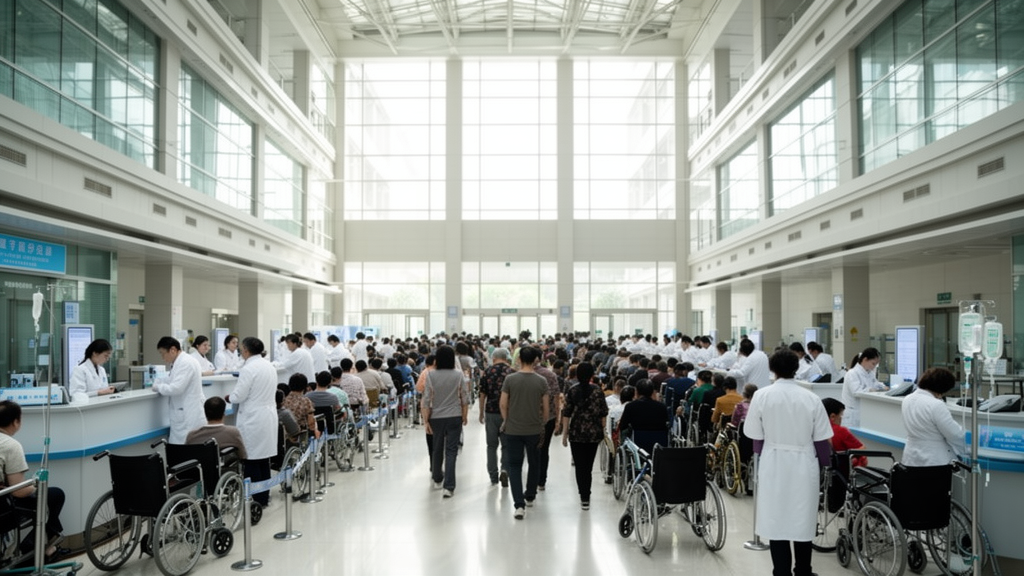
China poured resources into its healthcare system for more than a decade, yet the population health outcomes it was meant to buy have not kept pace. A new analysis of all 31 mainland Chinese provinces from 2012 to 2024 finds that medical service provision expanded steadily while a composite measure of population health actually slipped, and that 27 of the 31 provinces were locked in negative decoupling over the full period, meaning growth in medical inputs was not matched by proportional health gains.
The study, published in Frontiers in Public Health, was led by Xianxian Wang of Jintan Affiliated Hospital of Jiangsu University, with colleagues from Northeast Agricultural University and Changzhou Jintan District Traditional Chinese Medicine Hospital. The team built a balanced panel dataset from the China Statistical Yearbook and the China Health Statistical Yearbook, supplemented by provincial yearbooks, with monetary variables converted to constant prices using provincial price indices. Their central question was whether the enormous expansion of hospitals, beds, staff and spending since the 2009 New Medical Reform has translated into measurable improvements in how long and how well people live.
To answer it, the researchers first had to measure two complex systems on a common scale. They compiled 29 indicators, 15 for medical service provision and 14 for population health outcomes, drawn from the WHO–UNICEF Primary Health Care Measurement Framework and China’s Healthy China 2030 Planning Outline. The medical side covered medical facilities, health workforce, health financing, service activity and performance, and financial burden, including counts of Grade A tertiary hospitals, licensed physicians, registered nurses, pharmacists, outpatient visits, hospital admissions and mortality rates. The health side spanned overall health, maternal health and child health, from life expectancy and notifiable infectious disease rates to maternal mortality, hospital delivery, perinatal mortality and underweight prevalence in children under five.
The composite scores were produced with an integrated CRITIC–Entropy–TOPSIS method. CRITIC weighting accounts for both the contrast intensity, measured as the standard deviation of each indicator, and the conflicting character, measured through correlations among indicators, while entropy weighting reflects the dispersion of indicator values. The two normalized weight vectors were averaged, and TOPSIS then calculated each province’s relative closeness to an ideal solution, yielding scores between 0 and 1 for each system in each province and year. This design improves on a traditional entropy-weight approach, which ignores redundancy and conflict among indicators.
The results reveal a striking divergence. The national median medical service provision score rose from about 0.295 in 2012 to 0.373 in 2024, reflecting continuous expansion of infrastructure, human resources and financing. Yet the median population health outcomes score fell from approximately 0.739 to 0.696 over the same period, with provincial distributions converging into a narrower band between roughly 0.70 and 0.85. The authors attribute part of the post-2020 health decline to disruptions of routine services during the COVID-19 pandemic, including chronic disease management and routine immunization, alongside rising chronic disease burdens and demographic aging.
Spatially, the two systems moved in opposite directions. Provincial gaps in medical provision widened, particularly after 2020, with high scores concentrated in eastern coastal provinces and major inland hubs. By 2024, Shandong reached 0.694 and Guangdong 0.673, while Tibet, Qinghai and Ningxia remained in the low categories at roughly 0.20 to 0.25. The Northeast region had the lowest overall capacity, rising only from 0.270 to 0.313. Health outcomes, by contrast, converged: Beijing and Shanghai maintained high values of 0.895 and 0.880 in 2024, Heilongjiang climbed to 0.919, but Sichuan and Yunnan declined into the low category, and Tibet stayed at the bottom with values between 0.430 and 0.627.
To classify the relationship between the two systems, the team applied the Tapio decoupling model, which uses elasticity rather than a base-year-sensitive index. The decoupling index is the percentage change in population health outcomes divided by the percentage change in medical service provision, with critical thresholds at 0.8 and 1.2 dividing the results into eight states grouped as decoupling, coupling and negative decoupling. The picture was bleak and persistent. In 2012–2016, expansive negative decoupling dominated, with 19 provinces in that category and 6 more in strong negative decoupling. In 2016–2020, four western provinces briefly moved into the more favorable weak decoupling category, but strong negative decoupling rose to 14 provinces. From 2020 to 2024, 24 provinces fell into strong negative decoupling and four into expansive negative decoupling, with only three provinces in intermediate coupling states. Over the full twelve years, 20 provinces remained in strong negative decoupling and 7 in expansive negative decoupling, tracked through Sankey diagrams of category transitions.
The final step asked which regional conditions were associated with this mismatch, using an interpretable machine learning framework. An XGBoost model, a tree-based ensemble that captures non-linear associations and interactions without a predefined functional form, was trained to predict the decoupling index from six contextual variables drawn from the WHO’s Social Determinants of Health framework: gross domestic product, government health expenditure, urbanization rate, population density, investment in pollution control and average years of education. The model achieved an R-squared of 0.6936 on the test set, with an RMSE of 0.0351 and an MAE of 0.0228. SHAP values, derived from cooperative game theory, then decomposed each prediction into additive feature attributions.
Population density emerged as the most important predictor, with a mean absolute SHAP value of 0.0174, followed by urbanization rate at 0.0126 and government health expenditure at 0.0119. Random Forest and LightGBM models trained on the same samples produced largely consistent rankings, with rank correlations of 0.886 and 0.829 respectively against the XGBoost ordering. The dependence plots showed non-linear patterns: predicted decoupling values generally rose with population density up to around 1,146 persons per square kilometer before leveling off near 0.050, and urbanization rates above roughly 57 percent, and especially above 80 percent, were associated with positive SHAP values. Government health expenditure showed a non-monotonic association, with positive attributions below approximately 28.6 billion yuan and negative attributions at higher spending levels. Average years of education peaked near 10.65 years, pollution control investment showed declining attributions after roughly 0.305 billion yuan, and GDP attributions fell after about 905 billion yuan. The authors stress that these turning points are empirical reference points within their sample and fitted model, not fixed policy thresholds or causal effects.
The study has clear limitations that the authors acknowledge. The analysis relies on annual provincial yearbook data, and neither composite system captures timeliness and quality of care, mental health, functional health or self-reported well-being; measurement uncertainty in the underlying data may also propagate into the scores. The SHAP findings are specification-conditional contextual associations rather than causal effects, and the importance ranking was stable under CRITIC-only and entropy-only weighting but more sensitive under equal weighting. Provincial averages also mask large within-province differences among cities, counties and rural areas. Still, the core message stands: across most of China, medical investment outgrew health outcomes, and the authors argue that policy should shift from resource-driven expansion toward efficiency, with fiscal support tailored to local health needs, stronger cross-regional healthcare cooperation, and coordinated planning across demographic, socioeconomic and environmental conditions.
Subject of Research: Decoupling between medical service provision and population health outcomes across Chinese provinces
Article Title: Decoupling analysis of medical service provision and population health outcomes: a hybrid evaluation and machine learning approach
Article References: Wang, X., Qi, Z., & Yang, L. (2026). Decoupling analysis of medical service provision and population health outcomes: a hybrid evaluation and machine learning approach. Frontiers in Public Health, 14, Article 1946647. https://doi.org/10.3389/fpubh.2026.1946647
Image Credits: AI Generated
DOI: 10.3389/fpubh.2026.1946647
Keywords: medical service provision, population health outcomes, decoupling analysis, Tapio model, XGBoost, SHAP, China, health policy, CRITIC-Entropy-TOPSIS, regional disparities, machine learning, public health
News Source: Phoebe Ingram. (October 26, 2026). China’s Medical Boom Fails to Deliver Health Gains, Decoupling Study Finds. Scienmag.