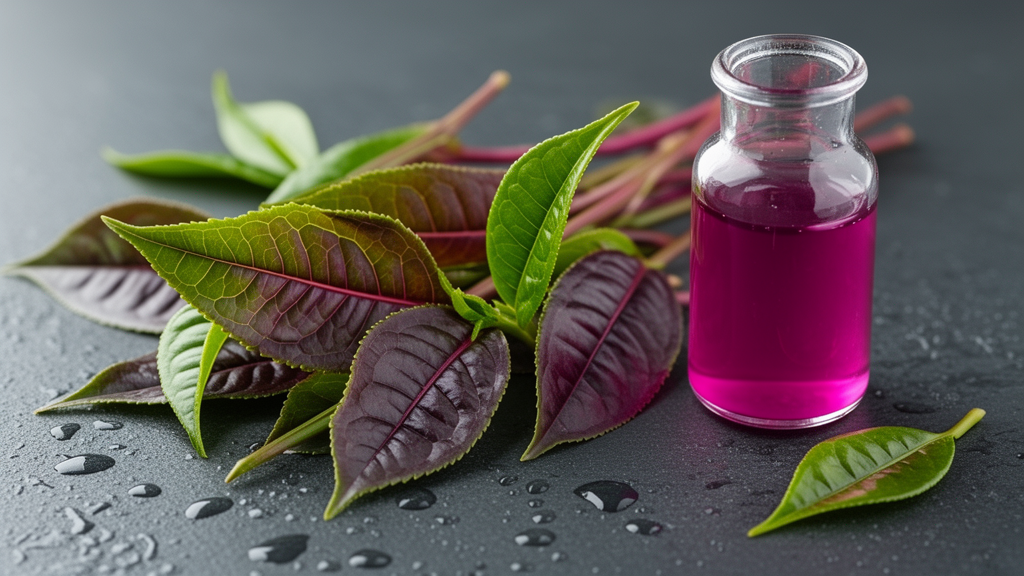
Purple leaves of Nekemias grossedentata, the raw material for vine tea, owe their color to a specific set of anthocyanin pigments rather than to a single dominant compound, according to a study published in BMC Plant Biology. The research, conducted as an open-access metabolomic and colorimetric analysis, set out to clarify why some leaves of this species turn purple while others remain green, a question with commercial relevance because purple vine tea could diversify the range of products derived from the plant. The team compared green leaf samples, designated LM1 and LM2, with three purple leaf samples, ZM1, ZM2 and ZM3.
Chlorophyll measurements showed that the green leaves carried substantially more of the green pigment, with total chlorophyll content ranging from 2.011 to 2.218 milligrams per gram. Anthocyanins, by contrast, emerged as the dominant pigments determining visible color: total anthocyanin content in the purple leaves ranged from 2322.31 to 7493.18 micrograms per gram, significantly exceeding the 166.11 to 1014.05 micrograms per gram measured in green leaves. Using metabolomic profiling, the researchers putatively characterized 81 anthocyanin components across the samples.
These belonged mainly to three pigment families: derivatives of cyanidin, delphinidin and peonidin, represented by 32, 10 and 10 components respectively, annotated at MSI Level 2 confidence. The analysis revealed that each purple leaf type accumulated a distinct signature pigment. ZM1 was enriched in cyanidin-3-O-glucoside at 809.87 micrograms per gram, ZM2 in malvidin-3,5-O-diglucoside at 1620.16 micrograms per gram, and ZM3 in delphinidin-3,5-O-diglucoside at 1884.85 micrograms per gram.
To identify which compounds best separated the leaf types, the authors applied OPLS-DA analysis. Four anthocyanins stood out as key differential compounds: cyanidin-3-O-glucoside, delphinidin-3-O-galactoside, delphinidin-3,5-O-diglucoside and petunidin-3-O-glucoside. The study then linked pigment chemistry to measurable color.
Colorimetric analysis showed that the a* value, which describes the red-green axis of perceived color, was critical for distinguishing hue: it was positive in purple and reddish leaves and negative in green leaves. Correlation analysis added a further finding: total anthocyanin content showed a highly significant negative correlation with the L* value, the measure of lightness, meaning that leaves with more anthocyanin appeared darker.
Meanwhile, peonidin derivatives displayed a highly significant positive correlation with the a* value, leading the authors to identify this pigment family as a key driver of purple coloration in the species. The authors emphasize that these are correlations between pigment composition and color parameters, not demonstrations of the underlying biosynthetic mechanism.
The contrast between the two leaf groups was consistent across the dataset. Green leaves combined high chlorophyll with comparatively low anthocyanin levels, while purple leaves combined low chlorophyll with anthocyanin accumulation up to several times higher than any green sample measured. This pattern supports the conclusion that anthocyanins, not chlorophyll differences alone, dominate the visible color distinction in this species.
The identification of distinct signature pigments in each purple leaf type also suggests that leaf coloration in N. grossedentata is chemically heterogeneous. Different purple samples accumulated different major anthocyanins, and the multivariate analysis singled out four compounds that best discriminated between the leaf types, indicating that color variation reflects the balance of multiple pigment components rather than the presence of one compound.
By pinpointing the specific anthocyanins and color parameters associated with purple leaf formation, the study provides a theoretical basis for developing new cultivars of vine tea with diverse and desirable leaf color traits, supporting product diversification in a crop whose purple form holds market potential.
Subject of Research: Correlation between anthocyanin composition and leaf coloration in Nekemias grossedentata
Article Title: Correlation between the composition and content of anthocyanins and leaf coloration in Nekemias grossedentataz,2
Article References: Wu, Y., Yang, M., Tian, L., Qin, C., Xiao, C. Z., Sun, Y. B., Tong, J., & lian Tian, C. (2026). Correlation between the composition and content of anthocyanins and leaf coloration in Nekemias grossedentataz,2. BMC Plant Biology. https://doi.org/10.1186/s12870-026-10263-9
Image Credits: AI Generated
DOI: 10.1186/s12870-026-10263-9
Keywords: Nekemias grossedentata, vine tea, anthocyanins, leaf coloration, cyanidin, delphinidin, peonidin, chlorophyll, OPLS-DA, color parameters, plant pigments, BMC Plant Biology
News Source: Alan Morgan. (October 26, 2026). Anthocyanin profiles explain purple leaf coloration in vine tea plant. Scienmag.