Researchers at the National Institute for Materials Science (NIMS) in Japan have developed a simple coating-and-drying process that creates a porous “anchor” layer capable of strongly bonding materials that normally refuse to stick together. The team, led by Shunto Arai of the Research Center for Macromolecules and Biomaterials, showed that a mesh-like film with nanometer- to micrometer-sized pores can join a flexible polymer to glass with a strength exceeding 7 megapascals, approximately double the vertical tensile strength achieved without the structured layer. The work was published in the journal Small on September 10, 2026.
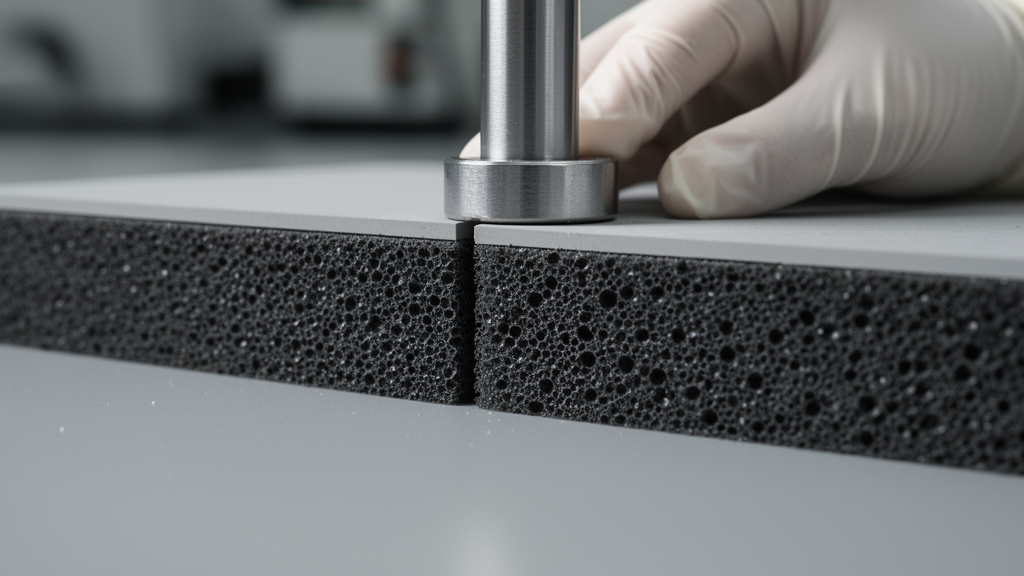
The method exploits a physical phenomenon called viscoelastic phase separation. When a carefully formulated solution is coated onto a surface and dried, the components separate as the solvent evaporates, spontaneously organizing into a mesh-like porous structure that the researchers call a printable porous anchor (PPA). No scratching, etching, or other surface treatment of the substrates is required. The resulting layer works through a hybrid mechanism: on one side it adheres to a substrate such as glass through chemical affinity, while on the other side its tiny pores allow a soft polymer to become incorporated into the structure, creating a mechanical anchor effect through physical interlocking.
This dual mechanism addresses a long-standing limitation in multi-material manufacturing. Combining hard materials such as metals, glass, and ceramics with soft polymers like rubber and plastics is increasingly important for lightweight vehicles, flexible electronics, and soft robots, yet dissimilar materials are notoriously difficult to bond. Conventionally, engineers have had to design and develop a bespoke adhesive for each material pairing, a case-by-case approach that adds cost and complexity. An alternative of roughening substrate surfaces through mechanical scratching or chemical etching can improve adhesion, but it increases energy consumption, complicates the manufacturing process, and generates processing residues that raise environmental concerns.
In their experiments, the team applied the PPA between glass and a flexible polymer that has low intrinsic adhesion to glass. The structured layer approximately doubled the vertical tensile strength compared with conventional bonding, with the joint exceeding 7 MPa. The researchers attribute this resistance to interfacial fracture to the topology of the adhesive layer itself: rather than relying solely on chemical compatibility between the adhesive and both substrates, the porous structure converts part of the load into mechanical interlocking, so the joint no longer depends entirely on finding a chemistry that works for both sides of the interface.
The NIMS team positions the PPA as a potential platform technology rather than a single-purpose adhesive. Because the porous layer is printable and can be formed by simple solution coating and drying, the same structural principle could in principle accommodate a wide variety of material combinations without redesigning the adhesive for each one. The researchers are currently pursuing two extensions: imparting conductivity to the anchor layer so that bonded interfaces can also dissipate heat and maintain electrical connectivity, and formulating the layer from highly heat-resistant materials capable of withstanding harsh environments.
If those development efforts succeed, the technology could expand design flexibility in fields where multi-material structures are expected to become essential, including next-generation mobility, wearable devices, and soft robotics. For now, the reported results establish that structuring the adhesive layer itself, rather than the substrate surfaces, offers a route to strong joints between incompatible materials, achieved with nothing more elaborate than coating a solution and letting it dry.
Subject of Research: A porous adhesive layer formed by solution coating and drying that bonds dissimilar materials through combined chemical affinity and mechanical interlocking
Article Title: “Porous anchor” that strongly bonds dissimilar materials formed simply by coating and drying
Article References: “Porous anchor” that strongly bonds dissimilar materials formed simply by coating and drying. Original publication (Bibliographic details unavailable.)
Image Credits: AI Generated
DOI: Not provided
Keywords: adhesives, dissimilar materials, porous anchor, viscoelastic phase separation, multi-material structures, bonding strength, NIMS, polymers, glass, materials science, soft robotics, manufacturing
News Source: Denise Maddox. (October 26, 2026). Porous adhesive layer roughly doubles bonding strength between dissimilar materials. Scienmag.