Credit: Journal of Hepatology
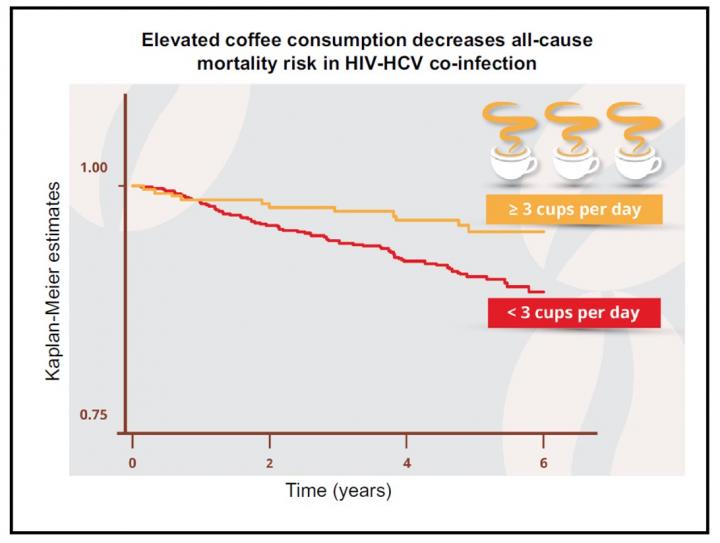
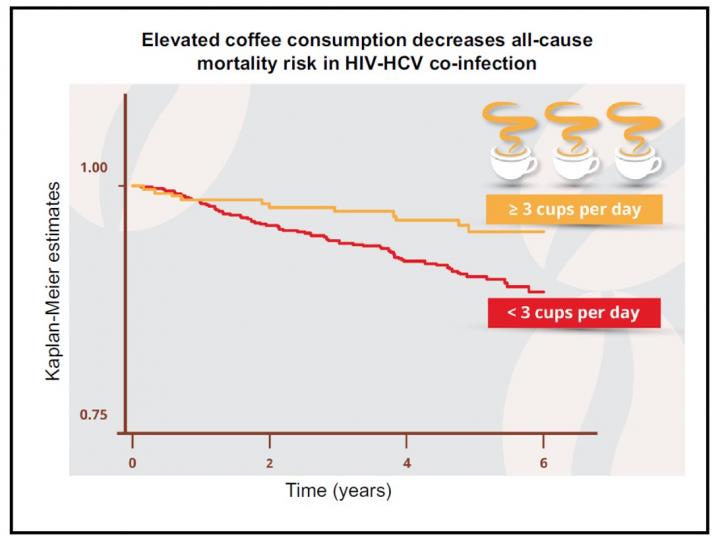
Amsterdam, The Netherlands, September 25, 2017 – Patients infected by both human immunodeficiency virus (HIV) and hepatitis C virus (HCV) are at specific risk of end-stage liver disease and greater risk of cardiovascular diseases and cancer. In addition, HIV infection accelerates the progression of chronic hepatitis C to fibrosis and development of cirrhosis and end-stage liver disease. In these HIV-HCV co-infected patients, drinking at least three cups of coffee each day halved the risk of all-cause mortality according to a new study published in the Journal of Hepatology.
This study is the first to investigate the relationship between coffee consumption and the risk of all-cause mortality in HIV-HCV co-infected patients. "This is a very exciting time for HCV research as a cure that can eradicate the virus is now available for all patients," explained lead investigator Dominique Salmon-Céron, MD, PhD, of the Service des Maladies Infectieuses et Tropicales, Hôpital Cochin, and Université Paris Descartes, Paris, France. "However, even when cured of HCV, patients co-infected with HIV have a higher risk of death with respect to the general population, due to an accelerated aging process that may result from cancer, complications related to diabetes and to liver disease, and from cardiovascular events."
Coffee is known to have anti-inflammatory and liver-protective properties. In the general population, drinking three or more cups of coffee a day has been found to be associated with a 14% reduction in the risk of all-cause mortality. This is probably due to the properties of polyphenols contained in coffee that can protect the liver and also reduce inflammation.
Investigators used data from a five-year follow-up of 1,028 HIV-HCV co-infected patients enrolled in the French national ANRS CO13-HEPAVIH cohort. ANRS CO13-HEPAVIH is an ongoing French nationwide prospective cohort of HIV-HCV co-infected patients that collects both medical and psychosocial/behavioral data over time via annual self-administered questionnaires.
At enrolment, one in four patients reported drinking at least three cups of coffee daily. Over the five years, 77 deaths occurred, almost half attributable to hepatitis C. However, the mortality risk was 80% lower in those who were cured of (i.e. who "cleared") hepatitis C thanks to treatment.
Further analysis showed that drinking at least three cups of coffee daily was associated with a 50% reduction in mortality risk even after taking into account HCV clearance, HIV- and HCV-related factors, and other sociobehavioral factors, such as having a steady partner and not smoking. Healthy behavior change should be promoted by physicians following HCV clearance.
This research highlights the importance of behaviors – coffee consumption and not smoking in particular – on reduced mortality risk. These results can help promote behavioral changes in HIV-HCV patients, which in turn can result in improved survival. With respect to coffee consumption, individuals who do not drink coffee because of caffeine can still benefit from the comparable anti-inflammatory effects of decaffeinated coffee.
First author Maria Patrizia Carrieri, PhD, of the HEPAVIH Study Group, Faculté de Médecine, Aix Marseille University, INSERM, IRD, SESSTIM, Marseilles, France, observed that coffee consumption provides more protective effects on mortality in the HIV-HCV population than in the general population.
"The results of our study show that while curing HCV is fundamental, it must be complemented by behavioral changes if we are to improve health and survival in HIV-infected patients whether or not they cleared HCV. "I think we need to better monitor coffee consumption, together with other behaviors, such as alcohol use, smoking, physical activity, and to propose interventions to our patients which facilitate healthy behaviors even after HCV clearance. We also suggest that those patients who cannot tolerate a high intake of caffeine should consider drinking a few cups of decaffeinated coffee a day," commented Dr. Salmon-Céron. "Accordingly, I believe that the benefits of coffee extracts and supplementing dietary intake with other anti-inflammatory compounds need to be evaluated in HIV-HCV patients."
###
Media Contact
Sybrand Boer Iwema
[email protected]
31-204-852-781
@elseviernews
http://www.elsevier.com
Related Journal Article
http://dx.doi.org/10.1016/j.jhep.2017.08.005