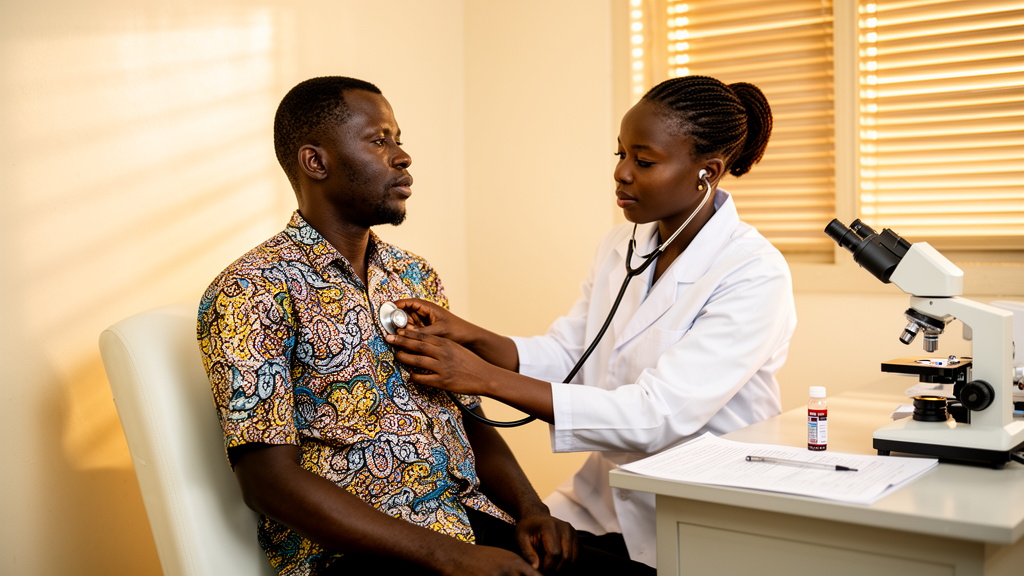
Among people living with HIV who arrived at a Nigerian tertiary hospital’s HIV clinic with symptoms suggesting tuberculosis, roughly one in five turned out to have active TB disease. That is the central finding of a retrospective study published in BMC Infectious Diseases, which reviewed routinely collected data from 162 presumptive tuberculosis cases documented in the clinic’s TB register between October 2022 and December 2025. The result underscores a persistent diagnostic challenge in HIV care: symptom-based screening alone cannot reliably separate those who need tuberculosis treatment from those who do not, and certain patient characteristics mark a substantially higher probability of confirmed disease.
The study population was predominantly female, with 64.8 percent of participants women, and the mean age was 43.1 years with a standard deviation of 13.6 years. Overall, 20.4 percent of presumptive cases received a diagnosis of active tuberculosis, while more than half of the cohort — 53.7 percent — had CD4 cell counts below 200 cells per cubic millimeter, indicating advanced immunosuppression. The researchers extracted sociodemographic and clinical data and analyzed associations with tuberculosis diagnosis using Chi-square or Fisher’s exact tests, followed by multivariable logistic regression, with statistical significance set at p less than 0.05.
Three factors were significantly associated with a tuberculosis diagnosis in the initial analysis. Tuberculosis was confirmed in 31.6 percent of male participants, a proportion that differed significantly from that of female participants (p = 0.014). Diagnosis was also significantly linked to a CD4 count below 200 cells per cubic millimeter, seen in 27.6 percent of cases (p = 0.011), and to the presence of two or more tuberculosis symptoms, observed in 25.2 percent of cases (p = 0.039). These figures describe the distribution of confirmed diagnoses across patient subgroups within this single clinic cohort rather than population-level disease rates.
When the researchers adjusted for other variables simultaneously, two predictors remained independently associated with active tuberculosis. Male participants had 2.70 times the adjusted odds of a tuberculosis diagnosis compared with female participants (adjusted odds ratio 2.70, 95 percent confidence interval 1.20 to 6.07), and those with CD4 counts below 200 cells per cubic millimeter had 2.69 times the adjusted odds compared with patients whose counts were higher (adjusted odds ratio 2.69, 95 percent confidence interval 1.13 to 6.41). Because both confidence intervals exclude 1.0, the associations are statistically robust within this dataset.
The study’s design carries important limitations. As a retrospective review of routinely collected register data from a single tertiary hospital, it depended on the completeness and accuracy of clinical documentation, and it cannot establish causal relationships. The findings describe one Nigerian HIV clinic cohort over a defined window ending in December 2025 and may not generalize to primary care settings, other regions, or clinics with different screening practices. The authors note that data on the diagnostic yield and predictors of confirmed tuberculosis among presumptive cases in Nigeria have remained limited, which motivated the analysis.
Even so, the practical implication is clear for HIV programs. Symptom-based tuberculosis screening is recommended in routine HIV care, but this study shows that among patients flagged by such screening, the probability of confirmed active tuberculosis concentrates in identifiable high-risk groups — particularly men and those with severe immunosuppression. The authors conclude that strengthening tuberculosis surveillance among these high-risk patients in HIV care settings is needed, and the finding that one in five presumptive cases had active disease highlights the ongoing diagnostic burden that tuberculosis places on HIV clinics in high-burden settings.
Subject of Research: Predictors of active tuberculosis among presumptive TB cases in people living with HIV at a Nigerian tertiary hospital
Article Title: Predictors of active tuberculosis among presumptive tuberculosis cases in people living with HIV attending a tertiary hospital in Nigeria
Article References: Adegoke, A. O., Adesina, S. A., Amole, I. O., Akanbi, I. M., Okunade, I. A., Oyewusi, O. O., Durodola, A. O., Awotunde, O. T., & OlaOlorun, A. D. (2026). Predictors of active tuberculosis among presumptive tuberculosis cases in people living with HIV attending a tertiary hospital in Nigeria. BMC Infectious Diseases. https://doi.org/10.1186/s12879-026-14326-y
Image Credits: AI Generated
DOI: 10.1186/s12879-026-14326-y
Keywords: tuberculosis, HIV, CD4 count, Nigeria, retrospective study, diagnostics, presumptive TB, immunosuppression, HIV care, BMC Infectious Diseases, Predictors, active
News Source: Ophelia Keating. (October 26, 2026). Male sex and low CD4 count flag active TB in Nigerian HIV clinic. Scienmag.