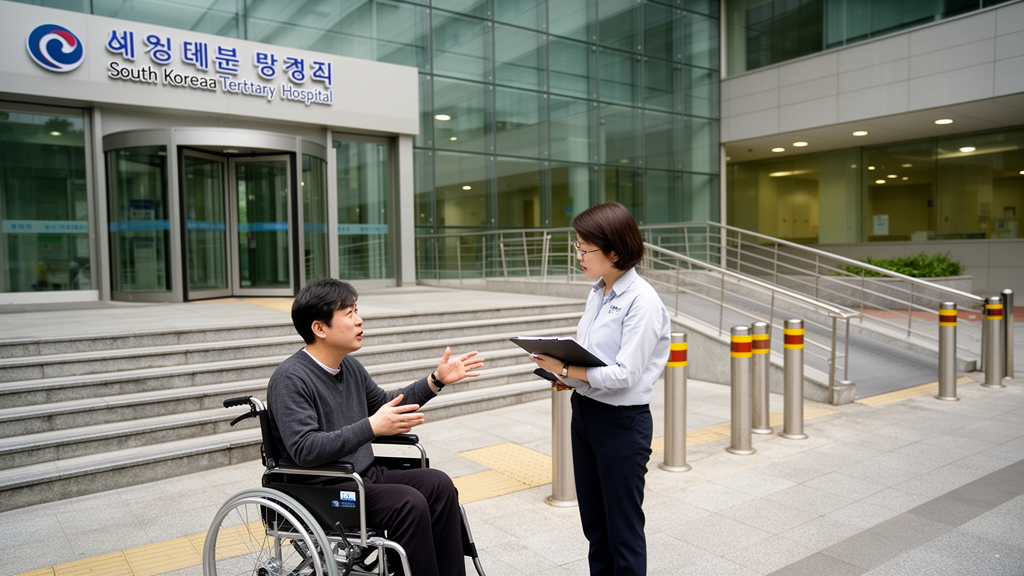
Wheelchair users described persistent barriers to outpatient care at tertiary referral hospitals in South Korea, even though these facilities provide highly specialized medical care. A qualitative study based on in-depth interviews with 11 adult wheelchair users identified problems with transportation, diagnostic equipment, rehabilitation services and clinical encounters. The findings revealed a gap between having formal accessibility provisions and being able to use healthcare services in practice.
Researchers used a descriptive qualitative design and conducted semi-structured, in-depth interviews with 11 wheelchair users aged 19 or older who had experience receiving outpatient care at South Korean tertiary referral hospitals. Participants had physical disabilities and were recruited through purposive and snowball sampling. Their interview data were analyzed thematically. This was a small, interview-based study of wheelchair users’ experiences, not a measurement of access rates, hospital performance or clinical outcomes across South Korea’s health system.
Structural barriers formed the first of three main themes. Participants described transportation difficulties, inaccessible diagnostic equipment and limited access to rehabilitation services. These findings show that advanced hospitals can retain practical accessibility problems even when they offer specialized facilities and formal accessibility measures. The reported barriers were tied to the organization and delivery of care, indicating that accessibility involves whether services are genuinely usable by wheelchair users rather than simply whether a hospital has an accessibility policy or designated physical provision.
The second theme involved clinical encounters influenced by what the researchers described as disability-centered assumptions. Participants reported diminished autonomy, a tendency for their disability to overshadow other aspects of their health, and limited attention to quality-of-life concerns. The theme indicates that accessibility problems were not limited to buildings and equipment. They also arose in interactions with healthcare professionals, where clinical attention and communication did not adequately account for the participant’s broader health and quality of life.
The third theme concerned adaptation to inaccessible healthcare environments. Participants used coping strategies, while some also described gradually disengaging from healthcare services. The study did not determine whether any individual stopped receiving care or identify a single cause of disengagement. Instead, the theme captured how people responded to persistent barriers: they devised ways to cope while potentially reducing their engagement with services. Together, the findings illustrate an advanced-care paradox in which highly specialized medical systems unintentionally reproduce accessibility inequities. The authors concluded that improving access requires more than physical changes, also including disability-competent care practices, coordinated navigation support and systems more responsive to diverse physical needs. Because the sample was limited to 11 participants and the study was qualitative, it cannot establish the prevalence of these barriers or determine whether particular changes would improve access, patient experience or health outcomes.
Subject of Research: Wheelchair users’ experiences of accessibility barriers in South Korean tertiary referral hospitals
Article Title: The paradox of advanced healthcare: a qualitative study of accessibility barriers for wheelchair users in tertiary referral hospitals
Article References: Seol, E.-M., & Nam, S.-H. (2026). The paradox of advanced healthcare: a qualitative study of accessibility barriers for wheelchair users in tertiary referral hospitals. BMC Health Services Research. https://doi.org/10.1186/s12913-026-15521-y
Image Credits: AI Generated
DOI: 10.1186/s12913-026-15521-y
Keywords: wheelchair accessibility, healthcare access, tertiary hospitals, physical disabilities, South Korea, qualitative research, patient autonomy, health equity, rehabilitation services, disability-competent care, paradox, advanced
News Source: Ophelia Keating. (October 26, 2026). Interviews identify wheelchair access barriers in South Korean tertiary hospitals. Scienmag.