Credit: Photo by L. Brian Stauffer.
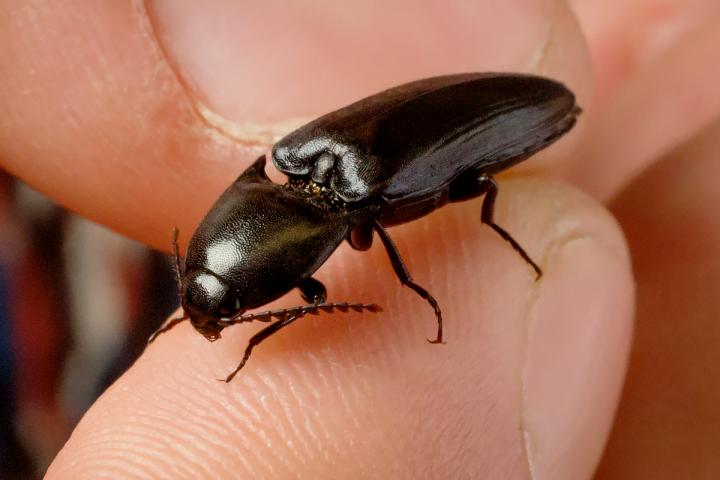
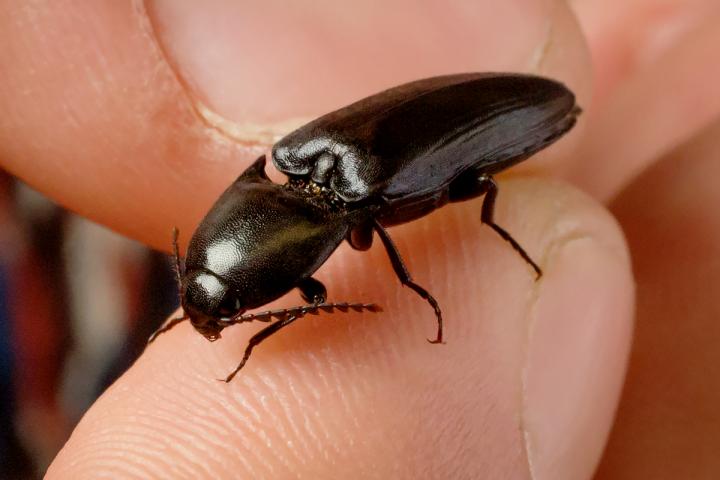
CHAMPAIGN, Ill. — Robots perform many tasks that humans can't or don't want to perform, getting around on intricately designed wheels and limbs. If they tip over, however, they are rendered almost useless. A team of University of Illinois mechanical engineers and entomologists are looking to click beetles, who can right themselves without the use of their legs, to solve this robotics challenge.
The researchers presented their findings at Living Machines 2017: The 6th International Conference on Biomimetic and Biohybrid Systems at Stanford University, and later won second place in a student and faculty research competition at the international BIOMinnovate Challenge, in Paris, France – a research expo that showcases biologically-inspired design in engineering, medicine and architecture.
"This idea came to life when a group of insect physiology students decided to take a closer look at what makes click beetles jump as part of a class project," said department of entomology research scientist and study co-author Marianne Alleyne.
The beetles have a unique hinge-like mechanism between their heads and abdomens that makes a clicking sound when initiated and allows them to flip into the air and back onto their feet when they are knocked over, Alleyne said.
"Very little research had been performed on these beetles, and I thought this legless jumping mechanism would be a perfect candidate for further exploration in the field of bioinspiration," said Alleyne, who teaches a bioinspiration design course with mechanical sciences and engineering professor, co-author and lead investigator Aimy Wissa.
The researchers looked at several species of click beetles, ranging in size from a few just few millimeters to several centimeters in length.
"Each insect goes through an assembly line of analyses that involve basic characterization, high-speed filming to observe the jump and measurements in the Materials Tribiology Lab with co-author and mechanical sciences and engineering professor Alison Dunn, to determine how much force it takes to overcome the friction of the hinge within an individual beetles jumping mechanism," Wissa said. "We observe, model and validate each stage of the jump with the hopes that we can later integrate them into a self-righting robot."
The group has already built several prototypes of a hinge-like, spring-loaded device that will eventually be incorporated into a robot, the researchers said.
"This study is a two-way street – engineers are informing the biologists and vice versa," Wissa said. "We look forward to seeing where this research will take us and are very proud of the attention it received at the BIOMinnovate Challenge expo."
###
The U. of I. department of mechanical sciences and engineering and the department of entomology supported this research. Ophelia Bolmin, the lead author of the study, is supported by the Fulbright U.S. Student Program and the Monahan Foundation.
To reach Aimy Wissa, call 217-244-4193217; [email protected].
To reach Marianne Alleyne, call 217-333-8652; [email protected].
The paper "Pop! Observing and modeling the legless self-righting jumping mechanism of click beetles" is available online and from the U. of I. News Bureau.
Media Contact
Lois E. Yoksoulian
[email protected]
217-244-2788
@NewsAtIllinois
http://www.illinois.edu
Original Source
https://news.illinois.edu/blog/view/6367/559303