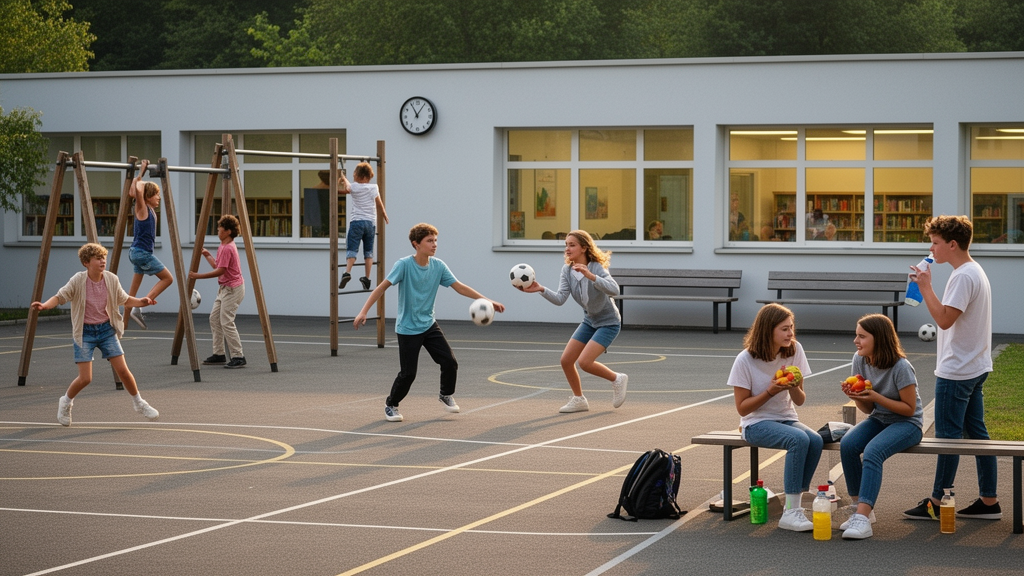
A questionnaire study of 640 Swiss adolescents aged 10–15 found that the timing and setting of play were associated with eating habits, sleep and physical activity in different ways. Digital play was associated with worse healthy eating habits and poorer sleep quality and quantity than analogue play, while evening or nighttime play was associated with worse eating and sleep regardless of play modality. Outdoor play was associated with higher physical activity, and neither the amount of play nor its interaction with play modality was significantly associated with the three lifestyle behaviours examined.
Researchers collected self-administered online questionnaire data from adolescents at school in autumn 2025. They examined healthy eating habits, sleep quality and quantity, and physical activity simultaneously. Play was characterized by its amount, timing and spatial context, as well as whether it was digital or analogue. The researchers used multivariate structural equation modelling, which estimates relationships among multiple observed variables at once and allows the analysis to assess direct and conditional associations between play characteristics and lifestyle behaviours.
Relative to analogue play, digital play was associated with worse healthy eating habits, with an estimate of β = −0.15 and p = 0.001. It was also associated with poorer sleep quality and quantity, with β = −0.11 and p = 0.027. No statistically significant association was detected between digital play and physical activity: the estimate was β = −0.02, with p = 0.700. These results report associations observed in the surveyed adolescents; they do not establish that changing the type of play would cause improvements in eating, sleep or physical activity.
Play timing showed a different pattern from play modality. Evening and nighttime play was associated with worse healthy eating habits, with β = −0.20 and p = 0.001, and with poorer sleep quality and quantity, with β = −0.17 and p = 0.004. These relationships were reported independently of play modality, meaning that the timing associations were not confined to digital play. By contrast, the amount of play and the interaction between play amount and play modality were not significantly associated with the lifestyle behaviours included in the analysis. The results therefore did not show a consistent association between more play and better or worse eating, sleep or physical activity.
Spatial context was associated with physical activity. Outdoor play was linked to higher levels of physical activity, with β = 0.14 and p = 0.008, independently of whether the play was digital or analogue. The researchers also found positive associations among eating habits, sleep and physical activity, except for the relationship between sleep and physical activity. Females reported worse lifestyle behaviours overall, while older adolescents reported worse eating habits. Because the study was observational and relied on a questionnaire at one point in time, it cannot determine whether play patterns influence lifestyle behaviours, whether existing routines shape opportunities for play, or whether other factors affect both. Its findings support examining when, where and how adolescents play when interpreting relationships with everyday behaviours, without demonstrating a causal effect or prescribing a particular change in play routines.
Subject of Research: Associations between play modality, timing and setting and lifestyle behaviours among Swiss adolescents aged 10–15.
Article Title: Exploring the associations between play and lifestyle behaviours in adolescents in Switzerland
Article References: Pedroni, G., & Camerini, A.-L. (2026). Exploring the associations between play and lifestyle behaviours in adolescents in Switzerland. BMC Public Health. https://doi.org/10.1186/s12889-026-29762-3
Image Credits: AI Generated
DOI: 10.1186/s12889-026-29762-3
Keywords: adolescent health, digital play, analogue play, sleep quality, healthy eating, physical activity, outdoor play, Swiss adolescents, questionnaire study, structural equation modelling, Exploring, associations
News Source: Ophelia Keating. (October 26, 2026). Swiss adolescent play patterns linked to eating, sleep and activity. Scienmag.