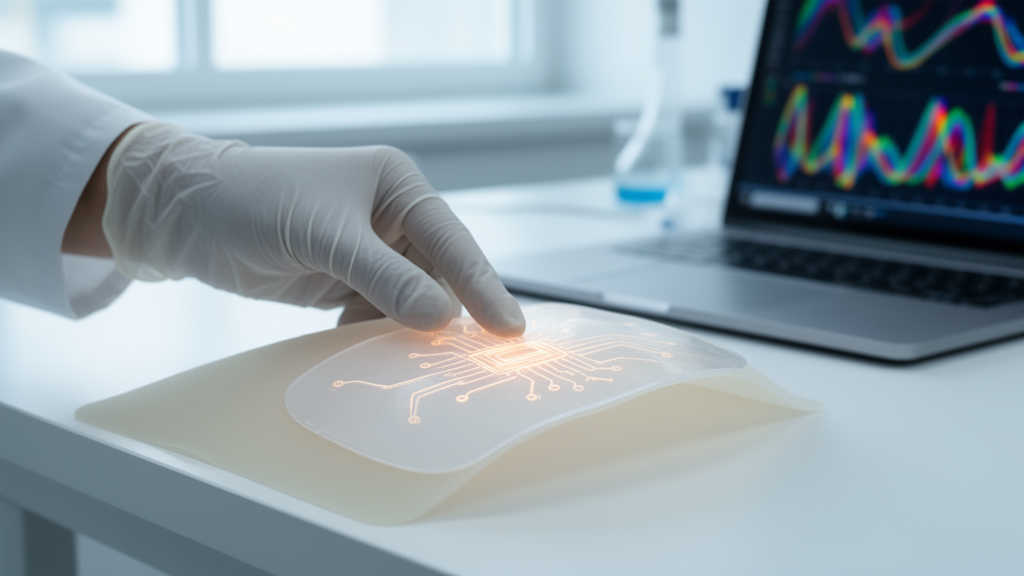
Flexible pressure sensors, key components for wearable devices and human–computer interaction, are evolving from single-material optimization toward intelligent, multimodal integration. A review published in the Journal of Materials Science surveys recent progress across the five main sensing families—piezoresistive, capacitive, piezoelectric, triboelectric, and multimodal designs—and examines how machine learning is being coupled to pressure sensing. Microstructural engineering receives detailed treatment.
The review summarizes how gradient porous architectures, freeze-cast structures, and electrospun networks enhance sensitivity, linearity, and stability—the metrics the authors identify as central to pressure sensing performance. The integration of machine learning and deep learning methods is a core theme. The review highlights a representative network architecture combining a convolutional neural network with a bidirectional long short-term memory network, known as CNN–BiLSTM, and describes its capability to capture nonlinear temporal dynamics and decode complex pressure signals.
Experimental demonstrations illustrate this coupling. One highlighted example is Morse-code recognition achieved through a high-precision acquisition system paired with deep learning, presented as evidence of the potential of flexible pressure sensing combined with deep learning. The review closes by outlining future directions from the perspective of synergistic material–structure–circuit–algorithm co-design, targeting intelligent perception and edge deployment.
As a review, the article synthesizes published advances rather than reporting new experimental results of its own, and its framing is that the field's future lies in the deliberate co-engineering of sensing materials, microstructures, circuits, and learning algorithms.
Subject of Research: Integration of machine learning with flexible pressure sensor materials, microstructures, and signal decoding
Article Title: Machine learning-driven intelligent flexible pressure sensors—review
Article References: Shen, X., Cao, S., Zhang, X., Liu, Z., Liu, X., & Wang, H. (2026). Machine learning-driven intelligent flexible pressure sensors—review. Journal of Materials Science. https://doi.org/10.1007/s10853-026-13921-3
Image Credits: AI Generated
DOI: 10.1007/s10853-026-13921-3
Keywords: flexible pressure sensors, machine learning, deep learning, CNN-BiLSTM, PDMS, MXene, microstructural engineering, wearable devices, human-computer interaction, multimodal sensing, edge deployment, review
News Source: Blake Davidson. (October 26, 2026). Machine Learning Pushes Flexible Pressure Sensors Toward Intelligent Perception. Scienmag.