Credit: Patrick Mansell
A diet that includes plenty of colorful vegetables and fruits may contain compounds that can stop colon cancer and inflammatory bowel diseases in pigs, according to an international team of researchers. Understanding how these compounds work on a molecular level could be an initial step toward finding treatments for people with cancer, they added.
"What we are learning is that food is a double-edge sword — it may promote disease, but it may also help prevent chronic diseases, like colon cancer," said Jairam K.P. Vanamala, associate professor of food sciences, Penn State. "What we don't know is, 'how does this food work on the molecular level?' This study is a step in that direction."
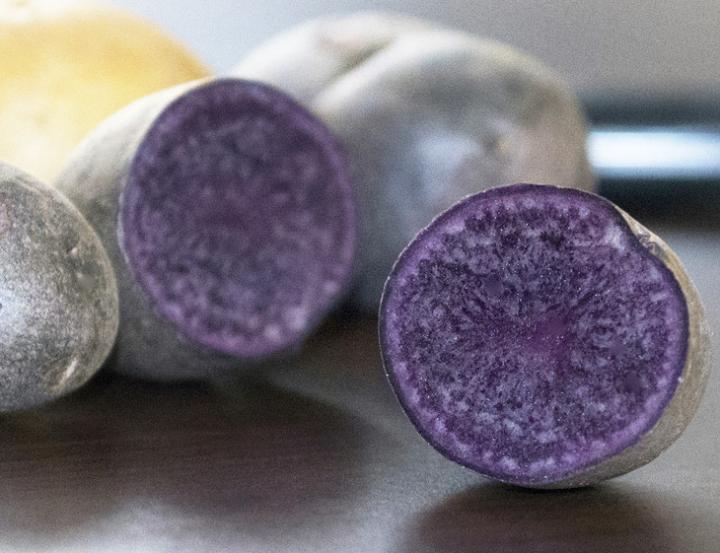
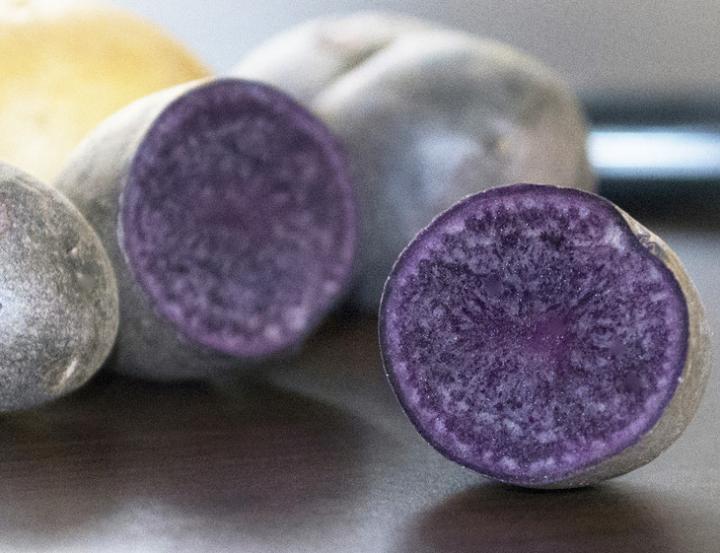
In the study, pigs that were served a high calorie diet supplemented with purple-fleshed potatoes had less colonic mucosal interleukin-6 — IL-6 — compared to a control group. IL-6 is a protein that is important in inflammation, and elevated IL-6 levels are correlated with proteins, such as Ki-67, that are linked to the spread and growth of cancer cells, said Vanamala, who also is a faculty member at the Penn State Hershey Cancer Institute.
According to the researchers, who reported their findings in a recent issue of the Journal of Nutritional Biochemistry, eating whole foods that contain macronutrients — substances that humans need in large amounts, such as proteins — as well as micro- and phytonutrients, such as vitamins, carotenoids and flavonoids, may be effective in altering the IL-6 pathway.
Vanamala said these findings reinforce recent research that suggests cultures with plant-based diets tend to have lower colon cancer rates than cultures with meat-based diets. Colon cancer is the second leading cause of cancer related deaths in the United States and a leading killer in many other Western countries, which tend to include more meat and less fruits and vegetables, he added.
While the researchers used purple potatoes in this study, Vanamala said other colorful fruits and vegetables could prompt similar effects. Colorful plants, including the purple potato, contain bioactive compounds, such as anthocyanins and phenolic acids, that have been linked to cancer prevention.
"For example, white potatoes may have helpful compounds, but the purple potatoes have much greater concentrations of these anti-inflammatory, anti-oxidant compounds," said Vanamala. "We use the purple potato as a model and hope to investigate how other plants can be used in the future."
Another advantage of using whole foods for cancer treatment is that it would benefit the agriculture industry and likely help small farmers around the world.
"If this model works, we can see what works in other countries," Vanamala said. "Instead of promoting a pill, we can promote fruits and vegetables that are very rich in anti-inflammatory compounds to counter the growing problem of chronic disease."
The researchers fed the animals three different diets: a standard diet with 5 percent fat; a high-calorie diet, with 17 percent added dry fat and 3 to 4 percent added endogenous fat; and a high fat diet supplemented with purple-fleshed potatoes.
The expression of IL-6 was six times lower in pigs that ate the purple potato-enhanced feed compared to the control group. Researchers used both uncooked and baked potatoes and found similar effects.
Currently, anti-IL-6 drugs are used against certain type of rheumatoid arthritis? and are being considered to treat? other? ?inflammation-promoted chronic diseases like colon cancer. However, these drugs are expensive and can cause side-effects, including drug tolerance.
Vanamala said that the pig model was used because the digestive system is very similar to the human digestive system, more so than in mice. The diet approach to cancer treatment has also shown similar promise in mice, however, he added.
###
Researchers who worked with Vanamala include Abigail Sido, former graduate student, and Sridhar Radhakrishnan, former post-doctoral scholar, both in food science; Lavanya Reddivari, assistant professor of plant science; Frank Shen, graduate student, and Qunhua Li, assistant professor, both in the statistics, all of Penn State; Vadiraja Bhat, senior applications scientist, Agilent Technologies; Sung Woo Kim, professor of animal sciences, North Carolina State University, and Elisabeth Ericksson, doctoral student in food technology, Lund University, Sweden.
The United States Department of Agriculture supported this work.
Media Contact
Matt Swayne
[email protected]
814-865-9481
@penn_state
http://live.psu.edu
Original Source
http://news.psu.edu/story/481664/2017/09/20/research/whole-food-diet-may-help-prevent-colon-cancer-other-chronic