• HOME
  • NEWS
  • EXPLORE
    • CAREER
      • Companies
      • Jobs
    • EVENTS
    • iGEM
      • News
      • Team
    • PHOTOS
    • VIDEO
    • WIKI
  • BLOG
  • COMMUNITY
    • FACEBOOK
    • INSTAGRAM
    • TWITTER
Thursday, April 2, 2026
BIOENGINEER.ORG
No Result
View All Result
  • Login
  • HOME
  • NEWS
  • EXPLORE
    • CAREER
      • Companies
      • Jobs
        • Lecturer
        • PhD Studentship
        • Postdoc
        • Research Assistant
    • EVENTS
    • iGEM
      • News
      • Team
    • PHOTOS
    • VIDEO
    • WIKI
  • BLOG
  • COMMUNITY
    • FACEBOOK
    • INSTAGRAM
    • TWITTER
  • HOME
  • NEWS
  • EXPLORE
    • CAREER
      • Companies
      • Jobs
        • Lecturer
        • PhD Studentship
        • Postdoc
        • Research Assistant
    • EVENTS
    • iGEM
      • News
      • Team
    • PHOTOS
    • VIDEO
    • WIKI
  • BLOG
  • COMMUNITY
    • FACEBOOK
    • INSTAGRAM
    • TWITTER
No Result
View All Result
Bioengineer.org
No Result
View All Result
Home NEWS Science News Biology

Tiny Brazilian frogs are deaf to their own calls

Bioengineer by Bioengineer
September 21, 2017
in Biology
Reading Time: 2 mins read
0
Share on FacebookShare on TwitterShare on LinkedinShare on RedditShare on Telegram
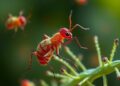
IMAGE

Credit: Sandra Goutte

Pumpkin toadlets, found on the leaf litter of Brazil's Atlantic forest, are among the smallest frogs in the world.

An international team from Brazil, Denmark and the United Kingdom, has discovered that two species of these tiny orange frogs cannot hear the sound of their own calls. (Scientific Reports doi:10.1038/s41598-017-12145-5).

This is a unique case in the animal kingdom of a communication signal persisting even after the target audience has lost the ability to detect it.

– We have never seen this before: These frogs make sounds that they cannot hear themselves, says Associate Professor, Jakob Christensen-Dalsgaard, University of Southern Denmark.

He led the laboratory testing of the frogs' hearing abilities at the University of Southern Denmark. The findings have been confirmed by anatomical studies at Cambridge University, UK, showing that the part of the ear responsible for high-frequency hearing is vestigial in these species.

Lead author of the study is Dr. Sandra Goutte, who was post doc at Universidade Estadual de Campinas, São Paulo, Brazil, when the study was conducted.

Most male frogs call to signal their presence to the opposite sex and find a mate, but this is costly: it could attract predators and parasites, and it uses up energy and time.

– One would think that if a signal is not perceived by its target audience, it would be lost through evolution, says Dr. Sandra Goutte.

Because these tiny frogs are brightly coloured, diurnal and known to use visual signals, the researchers hypothesize that visual communication has replaced acoustic communication.

The movement of the throat when males are calling could constitute a visual signal, in which case the call itself would represent a by-product of the true signalling behaviour.

Like many brightly-coloured tropical frogs, pumpkin toadlets are highly toxic, which may lower the risk of predation when they are calling.

The singular communication system in these pumpkin toadlets is a first example of vestigial sound communication, says Jakob Christensen-Dalsgaard.

Studying the toadlets further will advance our understanding of the mechanisms underlying the evolution of communication systems in animals.

###

Contact: please address questions regarding the article to Associate Professor Jakob Christensen-Dalsgaard or Dr. Sandra Goutte .

The paper is freely available online at: http://www.nature.com/articles/s41598-017-12145-5.

Media Contact

birgittte svennevig
[email protected]
452-759-8679
@@NATsdu

http://www.sdu.dk/en/om_sdu/fakulteterne/naturvide

Related Journal Article

http://dx.doi.org/10.1038/s41598-017-12145-5
Share15Tweet7Share2ShareShareShare1

Related Posts

DNA Transforms from Blueprint to Active Field Agent

DNA Transforms from Blueprint to Active Field Agent

April 2, 2026
UBC Okanagan Study Reveals How Trees Visually Signal Their Spring Rehydration

UBC Okanagan Study Reveals How Trees Visually Signal Their Spring Rehydration

April 1, 2026

Rising Temperatures from Climate Change Associated with Reduced Newborn Size

April 1, 2026

New Study Reveals Respiratory Evolution as Key Driver of Body Size Variation in Early Terrestrial Vertebrates

April 1, 2026
Please login to join discussion

POPULAR NEWS

  • blank

    Revolutionary AI Model Enhances Precision in Detecting Food Contamination

    96 shares
    Share 38 Tweet 24
  • Imagine a Social Media Feed That Challenges Your Views Instead of Reinforcing Them

    1007 shares
    Share 398 Tweet 249
  • Promising Outcomes from First Clinical Trials of Gene Regulation in Epilepsy

    51 shares
    Share 20 Tweet 13
  • Popular Anti-Aging Compound Linked to Damage in Corpus Callosum, Study Finds

    44 shares
    Share 18 Tweet 11

About

We bring you the latest biotechnology news from best research centers and universities around the world. Check our website.

Follow us

Recent News

Childhood Pneumococcal Vaccine Uptake Inequalities Persist in England Despite Schedule Revision

DNA Transforms from Blueprint to Active Field Agent

NIH Invests $30.7M to Boost USC-Led AI Research Cracking Alzheimer’s Code

Subscribe to Blog via Email

Enter your email address to subscribe to this blog and receive notifications of new posts by email.

Join 78 other subscribers
  • Contact Us

Bioengineer.org © Copyright 2023 All Rights Reserved.

Welcome Back!

Login to your account below

Forgotten Password?

Retrieve your password

Please enter your username or email address to reset your password.

Log In
No Result
View All Result
  • Homepages
    • Home Page 1
    • Home Page 2
  • News
  • National
  • Business
  • Health
  • Lifestyle
  • Science

Bioengineer.org © Copyright 2023 All Rights Reserved.