Deep inside nearly every solid-fuel rocket motor, from strategic missiles to orbital launchers, a rubbery polymer called hydroxyl-terminated polybutadiene holds the whole system together. HTPB acts as the matrix that binds oxidizer crystals and metallic fuel particles into a coherent grain, imparting the structural integrity and mechanical properties that propellant chemists demand. Yet the same unsaturated double bonds that make HTPB so useful also make it vulnerable: over years of storage, oxygen attacks the fragile pi bonds of the carbon-carbon double bonds, degrading the polymer and eroding the propellant’s structural properties. A research team led by Devi Vara Prasad Ch, working with Subbaraj Karunakaran and Kuruvilla Joseph, now reports a detailed parametric investigation into partially hydrogenating HTPB using an in-house palladium-zirconium catalyst supported on activated charcoal, achieving roughly 74 percent hydrogenation under optimized conditions in a small Inconel reactor.
The motivation stretches beyond simple aging resistance. Among the strategies for improving the energetics of a composite solid propellant, especially its specific impulse, one route stands out: reducing the average molecular weight of the exhaust gases. Because specific impulse is inversely proportional to the square root of the exhaust molecular weight, stuffing more hydrogen into the binder directly boosts performance. Hydrogenating HTPB saturates its double bonds, raising the hydrogen content of the polymer and, in principle, the specific impulse of the propellant it binds. Complete hydrogenation, however, yields an extremely viscous product that resists processing, so the team targeted partial hydrogenation as a viable compromise that removes the aging liability while keeping the polymer workable in polyurethane-based composites.
The catalyst itself is the study’s claimed novelty. The researchers synthesized both palladium-charcoal and palladium-zirconium-charcoal catalysts by wetness impregnation at room temperature. For the bimetallic version, palladium, zirconium, and activated charcoal were combined in a 2:5:93 weight ratio, using palladium nitrate hydrate and zirconium oxy-nitrate hydrate as precursors dispersed in distilled water and stirred for 12 hours. The precipitate was vacuum-filtered, washed, dried at 105 degrees Celsius, then calcined at 300 degrees Celsius under nitrogen and finally reduced under flowing hydrogen. X-ray diffraction confirmed that palladium was successfully reduced to metallic face-centered cubic Pd0, with no palladium oxide peaks detected, while zirconium existed exclusively as zirconium oxide, appearing in both monoclinic and tetragonal phases. This outcome is chemically expected, since tetravalent zirconium from zirconyl nitrate cannot be reduced to metallic zirconium under hydrogen at the temperatures used.
Microscopy and diffraction painted a picture of a highly agglomerated, irregular catalyst with a rough surface, characteristic of activated-carbon-supported systems. Energy-dispersive spectroscopy verified successful metal loading of 2.4 percent palladium, 4.9 percent zirconium, and 83.3 percent carbon by weight, with minor traces of silicon, aluminum, sodium, and chlorine attributed to the inherent mineral content of the charcoal support. Interestingly, the specific surface area dropped to about 25.2 square meters per gram with a mean particle size near 6.95 micrometers, which the authors attribute to micropore blockage by dispersed metal particles, the mass dilution effect of dense zirconium, agglomeration during thermal treatment, and partial collapse of the microporous structure during high-temperature calcination. The porous charcoal, with a nominal surface area of roughly 1000 square meters per gram, serves as a structural scaffold that disperses the active metals and channels reactants to the catalytic sites.
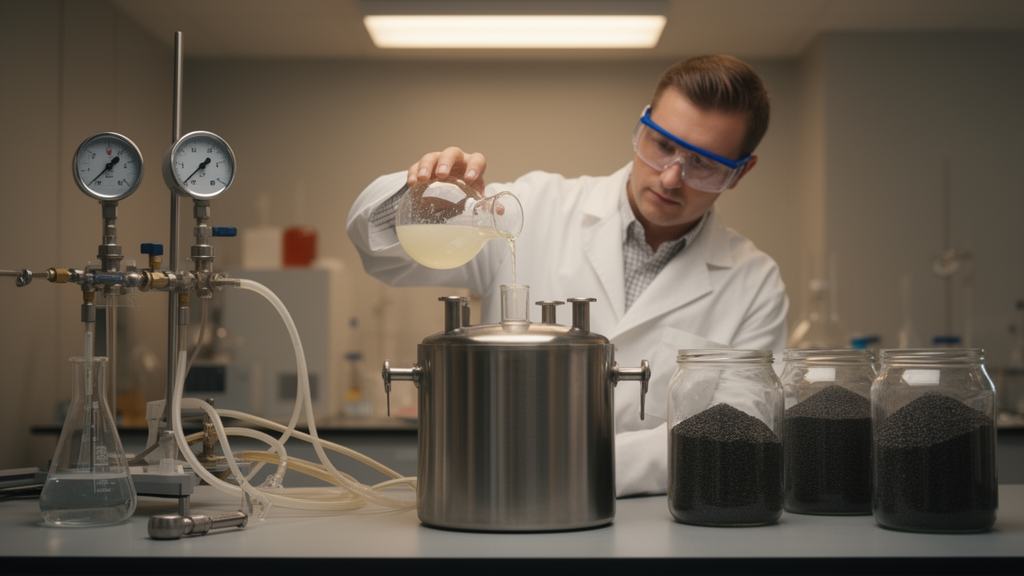
Hydrogenation experiments took place in a 100-milliliter Inconel autoclave equipped with a magnetically driven variable-speed impeller spinning at 800 revolutions per minute. HTPB was dissolved in iso-propyl alcohol and toluene, catalyst added at 1 to 3 percent by weight relative to the polymer, and the vessel flushed three times with hydrogen before pressurization. The reaction is a complex gas-liquid-solid process: hydrogen gas must dissolve, adsorb onto the catalyst surface, and add across the polymer’s double bonds, all hindered by the poor segmental mobility of a high-molecular-weight polymer chain. Each experiment ran for a fixed 6 hours, and the product was recovered by centrifugation and solvent evaporation, with selected runs repeated to confirm reproducibility of both the hydrogenation degree and the product characteristics.
The parametric study systematically varied initial hydrogen pressure, process temperature, solvent-to-feed ratio, and catalyst loading. Pressure experiments at 40, 50, and 60 bar showed that the degree of hydrogenation increases monotonously with pressure, and above 60 bar the solution became so viscous that processing was impractical. During the initial reaction phase, the team observed pressure falling despite rising temperature, which they attribute to hydrogen adsorption on the catalyst surface. To rationalize the data, the researchers defined an apparent equilibrium constant K as the product of a physical component and a chemical component. The chemical term reflects the intrinsic hydrogenation reaction and remains constant at fixed temperature, while the physical term accounts for hydrogen solubility in the solvent mixture, polymer swelling, solvent-solute partitioning, and adsorption-desorption behavior, all of which are sensitive to pressure and solvent composition. A 50 percent pressure increase produced a marked rise in K, indicating that adsorption significantly intensifies with pressure.
Temperature proved equally decisive. At a fixed 60 bar, the degree of hydrogenation increased monotonously with temperature up to 240 degrees Celsius, beyond which viscosity again became prohibitive. Spectroscopic analysis revealed a striking selectivity pattern: the vinyl-type functional isomers, pendant terminal alkene groups hanging off the polymer backbone, were hydrogenated preferentially because they are far more accessible to the metal catalyst surface than the backbone double bonds, which the polymer chain itself sterically shields. Among the backbone isomers, trans units converted more readily than cis units, since the linear, extended trans configuration can adsorb flat on the catalyst, whereas cis units create kinks that crowd the metal-hydride complex. Solvent studies showed that IPA and toluene alone each yielded roughly 64 percent hydrogenation, but combinations of the two solvents outperformed either single solvent, with the ratio HTPB:IPA:toluene of 1:1:2 delivering the maximum conversion of cis, trans, and vinyl isomers. IPA acts as a polar protic transfer-hydrogen donor that enhances chain mobility and solvation, exposing more double bonds to the catalyst.
Characterization of the products confirmed the chemistry in detail. Proton NMR tracked the disappearance of olefinic protons in the 4.8 to 6.2 ppm region and the growth of saturated methylene protons near 1.3 to 1.6 ppm, while carbon-13 NMR qualitatively confirmed the reduction of double bonds around 130 ppm. FTIR spectra showed declining absorption for the characteristic cis, trans, and vinyl double-bond peaks, and the absence of the 1640 per centimeter band indicated advancing hydrogenation. Notably, geraniol and hexane-1-ol-type functional isomers converted fully into vinyl-type isomers during the process. The hydroxyl value, measured by acetylation, barely shifted from the pristine 40.8 milligrams KOH per gram to 41.0 to 41.6, confirming that terminal hydroxyl groups essential for polyurethane curing survived intact. Gel permeation chromatography recorded a 15 to 20 percent apparent molecular weight increase, exceeding the theoretical 2.7 percent mass gain, which the authors attribute to calibration effects from the increased chain flexibility and hydrodynamic volume of the saturated polymer rather than crosslinking, since dispersity remained essentially unchanged at 2.14 to 2.21.
Thermal and pyrolysis studies revealed how hydrogenation reshapes degradation behavior. Thermogravimetric analysis showed that the temperature of 10 percent mass loss rose significantly for the hydrogenated product, indicating improved thermal stability, while differential scanning calorimetry recorded a relatively higher decomposition enthalpy, reflecting the exothermicity of new bond formation outweighing bond scission. Pyrolysis-gas chromatography-mass spectrometry at 550 degrees Celsius delivered perhaps the most vivid evidence: HTPB pyrolysis leaves most carbon as alkenes and cyclo-alkenes such as 1,3-butadiene, cyclopentene, and 4-vinylcyclohexene, whereas the hydrogenated product yielded predominantly straight-chain alkanes and cyclo-alkanes, with cyclo-alkenes and aromatics essentially vanishing. The residual double bonds also underwent palladium-catalyzed isomerization through a reversible hydropalladation and beta-hydride elimination pathway via a pi-allyl intermediate, enriching the remaining unsaturation in the thermodynamically stable trans-1,4 configuration.
The practical implications come with honest caveats. Viscosity measurements showed that once hydrogenation exceeds roughly 60 percent, the product thickens drastically, threatening processability in polyurethane formulations, so the team recommends targeting approximately 60 percent for casting applications. Compatibility analysis by DSC revealed a single glass transition temperature of minus 49.7 degrees Celsius, demonstrating that partially hydrogenated HTPB blends readily and disperses well with unmodified HTPB, validating the blend as a binder system. The bimetallic catalyst, by enhancing activity at the palladium-zirconium interface, reduces the precious-metal dosage and the effective catalyst cost per unit product, though the improvement is tentatively attributed to a synergistic effect that the authors acknowledge requires further study. Quantitative catalyst recycling tests were excluded because the highly dispersed sub-micron particles proved impossible to recover reliably from the viscous reaction medium at laboratory scale. Aging behavior and casting processability remain open questions, but the work establishes palladium-zirconium-charcoal as a credible candidate for producing the partially saturated, hydrogen-rich binders that next-generation propellants may demand.
Subject of Research: Investigation on the effect of parametric factors for synthesis of hydrogenated HTPB using a Pd-Zr-activated charcoal catalyst
Article Title: Investigation on the effect of parametric factors for synthesis of hydrogenated HTPB using a Pd-Zr-activated charcoal catalyst
Article References: Prasad CH, D. V., karunakaran, S., & Joseph, K. (2026). Investigation on the effect of parametric factors for synthesis of hydrogenated HTPB using a Pd-Zr-activated charcoal catalyst. Advances in Industrial and Engineering Chemistry, 2(1), Article 13. https://doi.org/10.1007/s44405-026-00053-0
Image Credits: AI Generated
DOI: 10.1007/s44405-026-00053-0
Keywords: Investigation, effect, parametric, factors, synthesis, hydrogenated, HTPB, Pd-Zr-activated, charcoal, catalyst, scientific research
News Source: Bethany Barker. (October 26, 2026). Investigation on the effect of parametric factors for synthesis of hydrogenated HTPB using a Pd-Zr-activated charcoal catalyst. Scienmag.