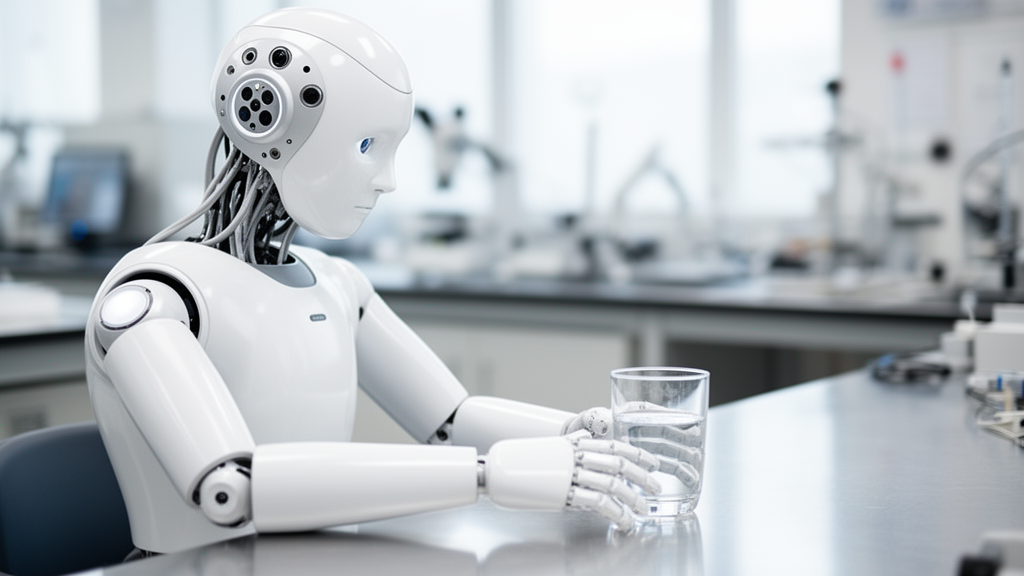
Robots are getting a new sense of the world, and it does not come from a single better camera. A collection of recent research compiled in Frontiers in Robotics and AI and Frontiers in Virtual Reality argues that the next leap in robotic capability will come from machines that combine vision, touch, sound and other signals into a single, coherent picture of their surroundings. The editorial, authored by Shihan Lu of Northwestern University and colleagues, gathers five studies that together trace the full pipeline of multimodal perception, from novel sensor hardware to learning-based control, calibration, reasoning and even human interaction with virtual agents.
The core problem the collection addresses is deceptively simple to state. Each sensor captures only its own slice of the physical world. Vision may provide global context, while tactile, auditory, event-based and other emerging sensing technologies can reveal interaction details that are difficult to obtain by vision alone. For robots working in complex and dynamic environments, robust perception requires integrating these complementary streams. Yet doing so remains difficult because different modalities vary in spatial and temporal characteristics, data representations and levels of uncertainty. Existing approaches often depend on task-specific sensor configurations and carefully hand-designed fusion pipelines, which limits how well they generalize across robots and applications.
The first study in the collection tackles one of the hardest manipulation problems in robotics: dexterous in-hand control. Ning and colleagues introduce TouchWGNN, a multimodal framework that represents tactile measurements as spatio-temporal graphs. The team built a low-cost tactile array comprising 113 taxels distributed across a five-fingered robotic hand. A graph-based spatial encoder captures the geometry of contact across the fingers, while a temporal module models how those contacts evolve over time. By fusing these tactile features with vision and proprioception into a reinforcement learning policy, the system improves object-state estimation and performance on two demanding benchmarks: reorienting a cube and swapping Baoding balls between the fingers. Notably, the gains are most pronounced when visual observations are degraded, exactly the conditions under which a vision-only robot would struggle.
A second study, by Lin and colleagues, confronts the sim-to-real gap, one of the most persistent obstacles to scalable policy learning in robotics. Policies trained in simulation often collapse when transferred to real hardware because simulated and real signals never quite match. The researchers focused on magnetic tactile sensing for precise robotic assembly. Their framework uses the Material Point Method to simulate elastomer deformation as physically grounded point clouds. A compression architecture called Point-PAMAE then reduces this high-dimensional data into compact latent representations that preserve the contact-relevant geometry. The final step is a latent-space Real-to-Sim mapping that aligns real magnetic sensor readings with simulated deformation features, bridging the two domains. The reported results show high-resolution simulation with modest memory overhead and robust cross-domain alignment, providing a foundation for tactile-driven sim-to-real learning in precision assembly tasks.
Even the best sensors are useless if the robot does not know exactly where they are pointing. Chen and Sun address cross-modal alignment with a targetless method for maintaining LiDAR-camera extrinsic calibration during long-term robotic operation. Rather than relying on artificial calibration targets or discrete semantic labels, the new method aligns continuous semantic probability distributions between LiDAR and camera data. Three technical innovations stabilize the optimization: anchor-fixed sampling keeps the objective steady, direction-aware weighting improves the observability of yaw rotation, and a globally balanced Jensen-Shannon divergence mitigates semantic class imbalance and noise. Evaluations on the KITTI Odometry dataset show reliable convergence even from substantial initial perturbations, suggesting the method could support robust field recalibration for autonomous vehicles and mobile robots alike.
Beyond fusing signals, robotic perception needs representations that support interpretable and verifiable reasoning, particularly in safety-critical settings. In an opinion article, Dai argues that structure-aware visual reasoning should complement end-to-end vision-language models in robotics. The article acknowledges the strong semantic capabilities of modern models but emphasizes persistent risks: hallucination, incorrect attribute binding, relational inconsistency and limited constraint enforcement. The proposed remedy is to treat model outputs as uncertain hypotheses and organize them into explicit, inspectable representations of entities, attributes, relations, temporal states, constraints and uncertainty. Such structured representations would enable consistency checking and verification before a robot acts on what its perception system believes it sees.
Multimodal cues do not only matter for robots; they shape how humans perceive machines. Richard and colleagues investigated how visual, auditory and tactile feedback influence the perception of social touch initiated by a virtual agent. Across three experiments, the team examined touch recognition, believability and agency attribution under a range of unimodal and multimodal conditions. The findings show that visual feedback provides the strongest guidance for recognizing which gesture was performed, while tactile and auditory cues help resolve ambiguity and strengthen the sensation of actually being touched. The studies also reveal that animation quality and interpersonal distance shape whether the virtual agent is perceived as the intentional source of the touch. The results underscore that multisensory congruence and a plausible interaction context are both essential for believable human-agent interaction, with direct implications for virtual reality and social robotics.
Together, the five contributions illustrate that advancing multimodal robotic perception requires progress across several connected dimensions rather than any single breakthrough. Effective multimodal perception depends on representations and mechanisms that capture complementary information, align heterogeneous signals and domains, and support robust sensing, reasoning and interaction across diverse tasks and environments. The collection spans sensing integration, multimodal representation, sensor calibration, embodied reasoning and human-agent interaction, reflecting the view that these layers must advance in concert for robots to become genuinely capable in unstructured settings.
The editorial also looks beyond current paradigms with a provocative claim: multimodal robotic perception should not be limited to reproducing human sensing mechanisms. While biological perception offers valuable inspiration, robots can exploit sensing principles that reveal physical properties and interaction states inaccessible or imperceptible to humans. These may include internal material properties, non-contact field perturbations and high-bandwidth contact mechanics. Co-designing such sensors with the computational representations used to interpret their outputs could enable robots to infer hidden states, detect subtle interactions and operate reliably when conventional vision, touch or audio are insufficient.
A second forward-looking theme concerns how robots should weigh their senses. Progress in multimodal perception, the authors argue, depends not simply on increasing the number of sensors but on understanding the distinct contribution of each modality. Different sensory channels vary in spatial coverage, temporal resolution, physical meaning and sensitivity to environmental disturbances. A modality that contributes little under nominal conditions may become essential during occlusion, sensor degradation, rapid contact transitions or distribution shifts. Future systems should learn when and how to draw on each modality, dynamically adjusting their reliance on sensory inputs according to task context, uncertainty and signal quality. That calls for systematic evaluation of modality complementarity, redundancy and failure modes, rather than treating multimodal fusion as the straightforward aggregation of all available signals.
The final outlook points toward large-scale foundation models for robot perception. Most existing multimodal models are built primarily around vision and language, while robot-relevant signals such as touch, sound and proprioception are typically handled through task-specific modules or narrow fine-tuning. The editorial argues that developing scalable methods for tokenization, alignment, pretraining and adaptation could unify these heterogeneous signals within a shared latent space. Such foundation models could facilitate transfer across sensors, robotic embodiments, tasks and environments, while reducing the need to design custom fusion architectures for every sensor configuration and application. If that vision materializes, the robots of the coming decade may not merely see the world as cameras do, but sense it through a rich, adaptive blend of modalities, some borrowed from biology and some developed specifically for machines.
Subject of Research: Computational multimodal sensing and perception for robotic systems
Article Title: Editorial: Computational multimodal sensing and perception for robotic systems
Article References: Lu, S., Liu, Y., Yan, Y., Gu, J., Wang, J., Wong, A., & Culbertson, H. (2026). Editorial: Computational multimodal sensing and perception for robotic systems. Frontiers in Robotics and AI, 13, 1967986. https://doi.org/10.3389/frobt.2026.1967986
Image Credits: AI Generated
DOI: 10.3389/frobt.2026.1967986
Keywords: multimodal sensing, robotic perception, tactile sensing, sensor fusion, sim-to-real transfer, LiDAR-camera calibration, reinforcement learning, vision-language models, human-robot interaction, virtual reality, foundation models, cross-modal alignment
News Source: Denise Maddox. (October 26, 2026). Robots Learn to See, Feel and Hear at Once as Multimodal Perception Advances. Scienmag.