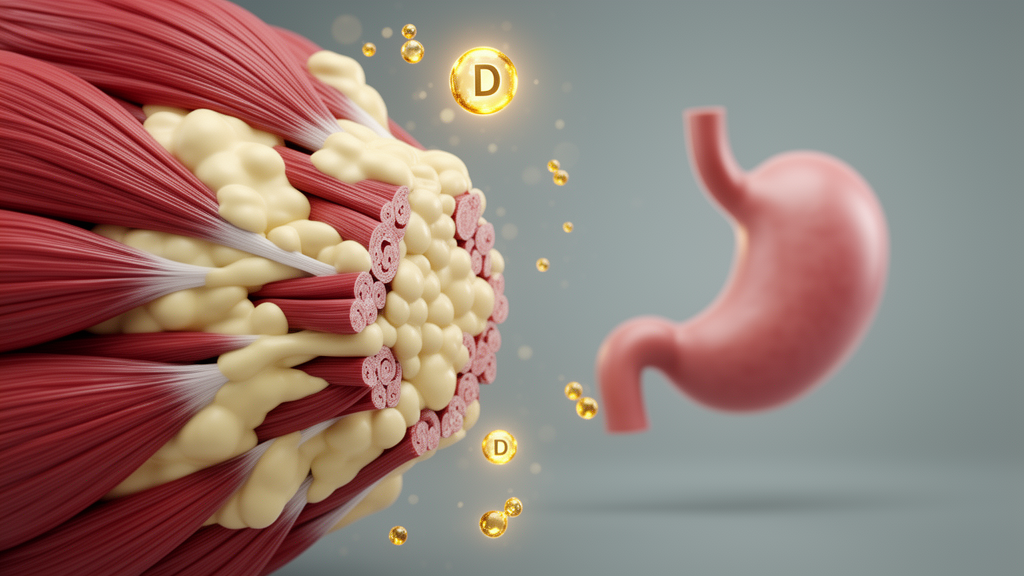
Most patients remain vitamin D deficient a year after bariatric surgery, and those with the lowest blood levels of the nutrient also carry more fat inside their spinal muscles and around their abdominal organs, according to a prospective cohort study published in BMC Medical Imaging. The research team measured serum 25-hydroxyvitamin D, the standard marker of vitamin D status, before surgery and again one year after the operation. Average levels rose from 11.92 to 21.24 nanograms per millilitre, a statistically significant increase.
Yet the improvement was not enough for most patients: 72.6 percent still fell below the threshold for vitamin D deficiency at the one-year mark. At baseline and at one year, they measured anthropometric values, biochemical markers and QCT-derived body composition variables, including fat infiltration within the erector spinae muscles that run along the spine, fat fraction in the psoas major muscle, and volumes of visceral adipose tissue, the fat stored deep inside the abdomen around internal organs. When patients were split into postoperatively deficient and normal vitamin D groups, clear differences emerged.
The deficient group had significantly higher erector spinae muscle fat, a higher erector spinae muscle fat fraction, a higher psoas major muscle fat fraction, and greater visceral adipose tissue volume and visceral adipose tissue index, all differences reaching statistical significance. In other words, patients whose vitamin D remained low carried more fat inside the muscles that stabilize the trunk and more fat around their abdominal organs. Correlation analysis reinforced the pattern.
Postoperative 25-hydroxyvitamin D levels were negatively correlated with erector spinae muscle fat, erector spinae muscle fat fraction, psoas major muscle fat fraction, visceral adipose tissue and the visceral adipose tissue index, with all associations remaining significant after adjustment for the false discovery rate. Lower vitamin D went hand in hand with greater fat deposition in both muscle and visceral compartments. Two further analyses tempered the interpretation.
When the researchers examined whether changes in vitamin D levels tracked with changes in body composition over the year, no such correlations remained significant. And preoperative vitamin D levels did not predict postoperative body composition parameters at all. The picture is therefore cross-sectional: at the one-year time point, patients with higher vitamin D had less muscle fat infiltration and less visceral fat, but the study cannot establish that raising vitamin D caused those differences, nor that preoperative status sets the trajectory.
A sensitivity analysis restricted to patients who underwent sleeve gastrectomy alone produced similar cross-sectional findings, indicating that the associations were not driven by a mixture of operation types. The authors conclude that vitamin D deficiency was prevalent after surgery and that higher postoperative 25-hydroxyvitamin D was associated with lower muscle fat infiltration and visceral adiposity. On that basis, they recommend monitoring both postoperative vitamin D levels and body composition to optimize long-term clinical outcomes.
Subject of Research: Associations of postoperative vitamin D with body composition changes after bariatric surgery: a prospective cohort study
Article Title: Associations of postoperative vitamin D with body composition changes after bariatric surgery: a prospective cohort study
Article References: Guan, W., Yuan, X., Hao, Z., Zhu, W., Yin, H., Li, J., Zhang, T., Li, W., Yu, F., Zhang, P., Wang, Z., & Zhang, P. (2026). Associations of postoperative vitamin D with body composition changes after bariatric surgery: a prospective cohort study. BMC Medical Imaging. https://doi.org/10.1186/s12880-026-02985-x
Image Credits: AI Generated
DOI: 10.1186/s12880-026-02985-x
Keywords: Associations, postoperative, vitamin, body, composition, changes, bariatric, surgery, prospective, cohort, scientific research
News Source: Ophelia Keating. (October 26, 2026). Low Vitamin D After Bariatric Surgery Tracks With Fat-Infiltrated Muscle. Scienmag.