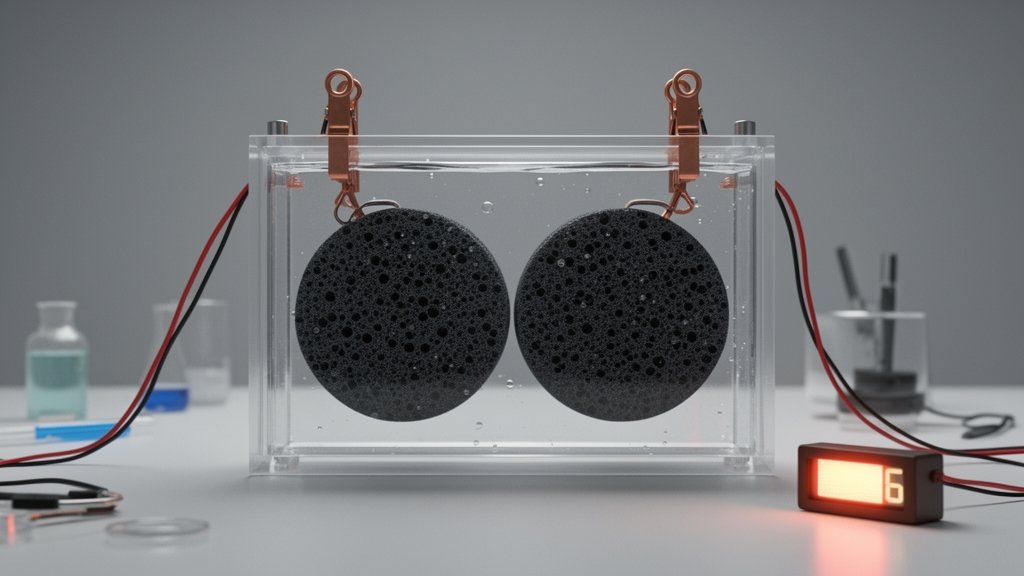
Researchers report a hybrid electrode material that combines graphitic carbon nitride, nitrogen-doped carbon quantum dots, and polypyrrole into a single nanocomposite for supercapacitor applications. The study, published in the Journal of Materials Science, describes the synthesis of the g-C3N4/N-CQDs/PPy nanocomposite and its evaluation as an electrode for electrochemical energy storage, a field the authors highlight as growing in importance as electricity demand rises and the finite availability and environmental effects of fossil fuels draw attention to storage technologies supporting renewable energy. Structural and morphological characterizations confirmed that the three components were successfully integrated into the nanocomposite.
The authors report that these characterizations verified the formation of the composite, providing the materials foundation for the electrochemical tests that followed. The electrochemical performance was evaluated in a three-electrode configuration using cyclic voltammetry, galvanostatic charge–discharge, and electrochemical impedance spectroscopy. These measurements formed the basis of the reported performance figures for the composite electrode.
The central practical demonstration came from assembling a symmetric supercapacitor, in which the same nanocomposite served as both electrode materials. The device delivered a specific capacitance of 197.5 farads per gram at a current density of 1 ampere per gram, and it achieved an energy density of 79 watt-hours per kilogram at a power density of 849 watts per kilogram. As a demonstration of practical use, the assembled device successfully illuminated a red LED for three minutes.
The authors present this as evidence of the material's potential for practical energy storage applications, although a single LED demonstration is a small-scale test and does not by itself establish commercial viability. The study's scope should be kept in view when reading the results. The measurements were carried out on laboratory-scale electrodes and a single assembled symmetric device, with performance figures reported at specific current and power densities rather than across all operating conditions.
Within those limits, the work adds a documented data point to the search for electrode materials for advanced supercapacitors. The synthesis route produced a composite whose structure was verified by characterization and whose device-level performance was quantified by the three electrochemical techniques. The findings sit within a broader effort to develop electrochemical energy storage technologies as renewable energy deployment accelerates.
Whether this particular nanocomposite advances beyond the laboratory will depend on results not reported here, but the study documents a specific, measured performance for a hybrid carbon nitride, carbon dot, and polypyrrole electrode, from material synthesis through device demonstration.
Subject of Research: Hybrid g-C3N4/N-CQDs/PPy nanocomposite electrode for symmetric supercapacitor applications
Article Title: Hybrid electrode of polymeric carbon nitride/fluorescent carbon quantum dots integrated with polypyrrole towards supercapacitor applications
Article References: Shanmugavel, A., Pastiur, N. P. L., Yadhukrishnan, K. V., Antoinette, M. M., Jose, J., & Jose, S. P. (2026). Hybrid electrode of polymeric carbon nitride/fluorescent carbon quantum dots integrated with polypyrrole towards supercapacitor applications. Journal of Materials Science. https://doi.org/10.1007/s10853-026-13911-5
Image Credits: AI Generated
DOI: 10.1007/s10853-026-13911-5
Keywords: supercapacitor, graphitic carbon nitride, carbon quantum dots, polypyrrole, nanocomposite, energy storage, electrode material, specific capacitance, energy density, symmetric supercapacitor, Hybrid, electrode
News Source: Faith Mcneil. (October 26, 2026). Carbon Nitride and Carbon Dot Hybrid Electrode Powers a Symmetric Supercapacitor. Scienmag.