Titanium is prized for its light weight, non-toxic character, corrosion resistance and strength, but extracting it from one of China’s largest titanium resources has long been a stubborn chemical puzzle. In the Panzhihua–Xichang region of Sichuan Province, more than 90 percent of the country’s titanium sits in vanadium-titanium magnetite ores of low grade, complex elemental composition and high impurity content. Blast furnace smelting of these ores yields molten iron as the main product and leaves behind a high-titanium blast furnace slag containing roughly 20 to 25 percent TiO2, a material historically classified as industrial waste despite holding a strategically valuable metal, creating both a significant waste of resources and serious ecological threats.
A promising route to reclaim that titanium begins with high-temperature carbonization reduction, which converts the slag into titanium-bearing carbonized slag. The titanium there is locked in titanium carbide, TiC, which reacts readily with chlorine at relatively low temperatures to form titanium tetrachloride, the key intermediate for producing titanium sponge and titanium dioxide. Yet the process carries a hidden complication: when chlorine attacks TiC, the carbon in the carbide does not simply vanish. It precipitates in situ as highly reactive solid carbon inside the reaction zone, and that fresh carbon opens an unintended chemical doorway for the impurity oxides surrounding the TiC particles.
Thermodynamic calculations using FactSage 8.1 show why this matters. Taking Ca2MgSi2O7 and Ca2Al2SiO7 as representative impurity phases, regarded as the primary phases formed during cooling and crystallization of high-titanium blast furnace slag, the researchers found that direct chlorination of these oxides has positive standard Gibbs energies across the 100 to 1000 degrees Celsius range investigated, meaning it should not proceed on its own. But once solid carbon enters the picture, the corresponding carbon-assisted chlorination reactions flip to negative Gibbs energies, becoming thermodynamically favorable. The carbon precipitated from TiC chlorination effectively licenses impurity oxides to react that would otherwise stay put.
The consequences are practical and troublesome. Chlorination of calcium and magnesium oxides produces CaCl2 and MgCl2, which can form low-melting eutectic mixtures; when local temperatures reach the melting point, a liquid phase appears and particles stick together or agglomerate, disrupting the normal fluidization in the reactor. Meanwhile, precipitated carbon and impurity chloride by-products can coat or encapsulate unreacted TiC cores in a passivation-like structure, raising the mass-transfer resistance that chlorine and gaseous products face as they diffuse in and out of particles. Both effects erode the efficiency and selectivity that the selective chlorination route depends on, so promoting TiC chlorination while suppressing solid carbon precipitation and induced impoxide chlorination is the key issue for efficient, stable, selective titanium extraction.
Mixed chlorine-oxygen atmospheres have attracted attention across extractive metallurgy for regulating selective separation in complex minerals. Previous studies reported that chlorine-oxygen mixtures can improve the selectivity of target metal chlorination in separating Cu, Ni, Zn and Pb from electroplating sludge and electric arc furnace dust; that an appropriate amount of oxygen promotes copper removal from copper-bearing slag, though excessive oxygen lowers the volatilization rate of CuCl; and that 15 percent oxygen raised the chlorination rates of Al2O3 and SiO2 in bauxite from 65.59 and 51.52 percent to 86.30 and 74.51 percent by releasing additional heat. Oxygen has also been shown to promote volatile chloride formation and shape etching profiles in Cl2/O2/Ar etching of molybdenum and cobalt thin films and of GaAs. But the impact of oxygen on TiC chlorination had received very limited attention, despite its importance for carbonized slag.
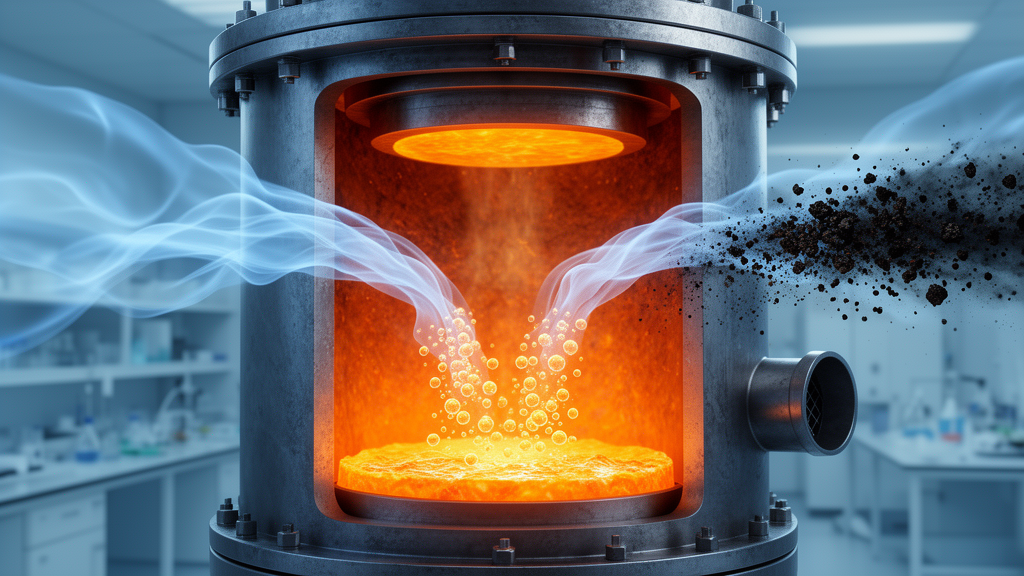
To address this gap, a research team tested a chlorine-oxygen synergistic chlorination strategy in a quartz tubular fluidized bed, comparing pure chlorine against a chlorine-oxygen mixture at 550 degrees Celsius with a fluidization gas velocity of 0.18 meters per second and a 35-minute reaction time after introducing the reactive gas. The factory-supplied carbonized slag, containing 14.97 percent TiC, 27.27 percent CaO, 7.26 percent MgO and 1.40 percent free carbon among other constituents, was screened to 160 to 200 mesh. In the pure chlorine system the feed gas was 60 percent Cl2 with argon balance; in the synergistic system chlorine was held at 60 percent while oxygen was introduced at a Cl2/O2 volume ratio of 6:1. That ratio was chosen because thermodynamic phase-equilibrium calculations showed it suppresses solid carbon without oxidizing TiC, whereas a more oxygen-rich 2:1 ratio produced a minor amount of unwanted TiO2. The team emphasized that the goal was not to determine an optimal Cl2/O2 ratio but to evaluate whether oxygen could alter the chlorination behavior and elucidate the synergistic mechanism.
The compositional results were striking. In the pure chlorine system, the chlorinated residue contained 3.27 percent CaCl2, 0.74 percent MgCl2 and 2.49 percent free carbon, with calculated chlorination rates of 6.06 percent for CaO and 4.34 percent for MgO. With oxygen added, those figures fell dramatically to 1.39 percent CaCl2, 0.07 percent MgCl2 and 1.11 percent free carbon, while the CaO and MgO chlorination rates dropped to 2.58 percent and 0.39 percent. At the same time, TiC chlorination efficiency rose from 76.95 percent to 80.76 percent, and TiO2 content in the residue increased only marginally, from 4.59 percent to 4.78 percent, indicating favorable reaction selectivity toward TiC chlorination rather than oxidation. In both systems the measured free carbon content fell below the theoretical value, but for different reasons: in pure chlorine the highly reactive precipitated carbon partially reacted with impurity oxides, while in the synergistic system the carbon in TiC formed gaseous carbon oxides that escaped the furnace directly.
Microscopy told the same story in two dimensions. In residues from pure chlorine treatment, scanning electron microscopy with energy-dispersive spectroscopy showed that most of the original tiny TiCxOy particles scattered in the gray impurity oxide matrix had vanished, their positions filled by black material that was 71.91 atomic percent carbon. Raman spectroscopy of those regions displayed characteristic peaks near 1354 and 1580 per centimeter, the D and G bands of disordered or defective graphite and of flawless graphite respectively, confirming in-situ solid carbon precipitation. Chlorine signals overlapped strongly with the carbon regions, consistent with dissociated Cl2 adsorbing on carbon surfaces to form CCl bonds, and also appeared at the carbon edges overlapping the oxide matrix, consistent with solid chlorides. Electron probe microanalysis further revealed that calcium and magnesium concentrated at the edges of these carbon-filled zones in a low-center, high-edge pattern, evidence that the precipitated carbon was actively driving impurity oxide chlorination at the particle boundaries.
Focused ion beam sectioning added the third dimension. The pure chlorine residue exhibited a dense longitudinal microstructure studded with bright agglomerates a few micrometers across, matching the size of the original TiCxOy particles and enriched in carbon at 65.90 atomic percent, while the non-bright regions consisted mainly of O, Ca, Si, Al and Mg from the gangue constituents. In the oxygen-assisted residue, by contrast, the reaction sites had become networks of micron-sized pores whose positions and sizes mirrored the original TiCxOy particles, formed in situ after their chlorination. Carbon and chlorine contents in those pore regions fell to 7.91 and 0.48 percent respectively, and calcium and magnesium showed no center-to-edge concentration gradients, only a more uniform distribution consistent with suppressed impurity chlorination and with the pore structure directly exposing the impurity oxide matrix inside.
The pore structure is more than a cosmetic difference. Because the carbon in TiC is diverted into gaseous carbon oxides that escape the furnace rather than accumulating as solid deposits, the reacting particles are left with open, porous interiors instead of carbon-clogged shells. That architecture lowers the internal diffusion resistance for chlorine reaching unreacted TiC and for gaseous products leaving, which helps explain the higher TiC chlorination rate achieved under the synergistic conditions. The authors frame the result as a shift in how oxygen is used in chlorination metallurgy: rather than merely raising the oxygen potential to speed up a target reaction, oxygen here acts as a regulator of the reaction pathway, redirecting the carbon in TiC at its source and cutting off the carbon-assisted chlorination of impurity oxides before it can begin. The work, conducted on factory-supplied carbonized slag at a single representative gas ratio and temperature, offers theoretical guidance and a process-optimization direction for selective, low-temperature fluidized chlorination of titanium-bearing carbonized slag, though determining an optimal operating ratio for industrial scale-up remains future work.
Subject of Research: Chlorine-oxygen synergistic chlorination of titanium-bearing carbonized slag for selective titanium extraction
Article Title: Study on the influence of chlorine-oxygen synergistic chlorination strategy on the constituent content and microstructure of the reaction residue of titanium-bearing carbonized slag
Article References: Yue, D., Wen, L., Wang, J., Ye, E., Zhang, S., & Qiu, G. (2026). Study on the influence of chlorine-oxygen synergistic chlorination strategy on the constituent content and microstructure of the reaction residue of titanium-bearing carbonized slag. Results in Engineering, 32, Article 113704. https://doi.org/10.1016/j.rineng.2026.113704
Image Credits: AI Generated
DOI: 10.1016/j.rineng.2026.113704
Keywords: titanium, chlorination, carbonized slag, TiC, fluidized bed, thermodynamics, microstructure, solid carbon, impurity chlorides, extractive metallurgy, TiCl4, Panzhihua
News Source: Denise Maddox. (October 25, 2026). Adding Oxygen to Chlorination Steers Titanium Recovery Away from Waste-Forming Side Reactions. Scienmag.