• HOME
  • NEWS
  • EXPLORE
    • CAREER
      • Companies
      • Jobs
    • EVENTS
    • iGEM
      • News
      • Team
    • PHOTOS
    • VIDEO
    • WIKI
  • BLOG
  • COMMUNITY
    • FACEBOOK
    • INSTAGRAM
    • TWITTER
Sunday, October 25, 2026
BIOENGINEER.ORG
No Result
View All Result
  • Login
  • HOME
  • NEWS
  • EXPLORE
    • CAREER
      • Companies
      • Jobs
        • Lecturer
        • PhD Studentship
        • Postdoc
        • Research Assistant
    • EVENTS
    • iGEM
      • News
      • Team
    • PHOTOS
    • VIDEO
    • WIKI
  • BLOG
  • COMMUNITY
    • FACEBOOK
    • INSTAGRAM
    • TWITTER
No Result
View All Result
Bioengineer.org
No Result
View All Result
Home NEWS Science News Technology

Printed liquid-metal electrodes track motion and heart signals

by
October 25, 2026
in Technology
Reading Time: 2 mins read
0
Printed liquid-metal electrodes track motion and heart signals

Printed liquid-metal electrodes track motion and heart signals

Share on FacebookShare on TwitterShare on LinkedinShare on RedditShare on Telegram

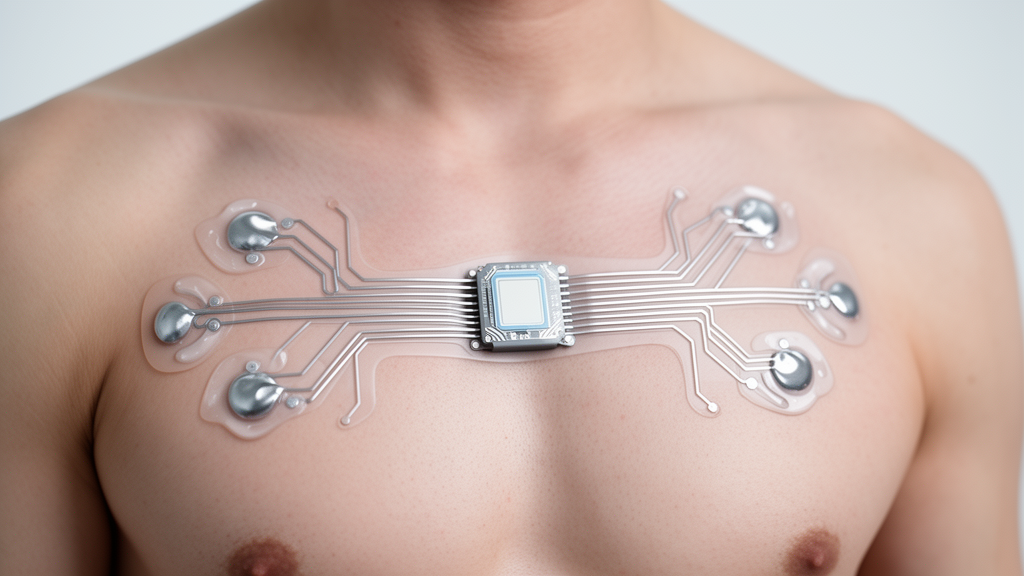
A printed flexible electrode combining the GaInSn liquid-metal alloy with copper powder achieved a reported signal-to-noise ratio of 19.5 dB while monitoring electrocardiograms during movement. This was a materials study, not a clinical trial, and the supplied evidence does not specify the number or characteristics of the human participants. The researchers developed the electrodes using a low-cost printing method that combines liquid metal with mixed metal particles.

Copper powder was incorporated into the GaInSn mixture, and the resulting electrodes were designed to adapt to deformation of the skin while remaining comfortable to wear. The study abstract reports that the flexible composite maintained good mechanical stability and a high signal-to-noise ratio. Mechanical testing assessed the stability of the electrode’s resistance response during repeated stretching.

At 10% strain, the fluctuation in the relative resistance change rate was 1.5% after 500 tensile cycles. This measurement indicates that the composite retained a comparatively consistent electromechanical response under the tested deformation conditions. The cycle test does not by itself establish lifetime durability, and the reported result applies specifically to the tested strain and loading protocol rather than to unrestricted use over an extended period.

Electrocardiogram monitoring was evaluated while the wearer sat still, squatted, stood and walked. The electrodes successfully monitored ECG status during these activities, showing that cardiac monitoring continued across several forms of body movement. Together, the results support the use of printed GaInSn–copper composites as adaptable electrodes for wearable sensing.

The measured 19.5 dB signal-to-noise ratio, the limited fluctuation after 500 stretching cycles and ECG monitoring during four activities form the principal experimental evidence. The available information does not establish diagnostic accuracy, equivalence to clinical ECG equipment, performance in a broad patient population or safety for long-term skin contact. Nor does it report results from cohort testing, comparisons with established electrodes, or assessments of factors such as sweating and prolonged unrestricted activity.

The work therefore demonstrates a promising materials platform under the reported laboratory conditions, while broader validation of sustained real-world use remains outside the evidence presented in the abstract.

Subject of Research: Printed GaInSn–copper flexible electrodes for wearable motion and electrocardiogram monitoring

Article Title: Liquid GaInSn alloy with copper powder composite flexible electrodes for monitoring body motion and electrocardiograms

Article References: Gao, J., Shao, N., Wei, L., Lin, J., Wang, H., Zhang, H., & Qin, H. (2026). Liquid GaInSn alloy with copper powder composite flexible electrodes for monitoring body motion and electrocardiograms. Journal of Materials Science, 61(40), 30904-30915. https://doi.org/10.1007/s10853-026-13622-x

Image Credits: AI Generated

DOI: 10.1007/s10853-026-13622-x

Keywords: GaInSn, liquid metal, copper composite, flexible electrodes, electrocardiography, wearable sensors, body-motion monitoring, printed electronics, Liquid, alloy, copper, powder

News Source: Denise Maddox. (October 25, 2026). Printed liquid-metal electrodes track motion and heart signals. Scienmag.


Tags: alloybody-motion monitoringcoppercopper compositeelectrocardiographyFlexible electrodesGaInSnliquidliquid metalPowderprinted electronicswearable sensors
Share12Tweet7Share2ShareShareShare1

Related Posts

Interpretable machine learning predicts strength of heat-storing microcapsule concrete in external lab tests

Interpretable machine learning predicts strength of heat-storing microcapsule concrete in external lab tests

October 25, 2026
Explainable AI system predicts IT outsourcing success before contracts are signed in Iraq

Explainable AI system predicts IT outsourcing success before contracts are signed in Iraq

October 25, 2026

Body tissue links miniature implants to wearable health devices

October 25, 2026

Shed receptor protein offers new clues to hyperemesis gravidarum

October 25, 2026

POPULAR NEWS

  • Kurarinol A inhibits activated stellate cells through MyD88 in preclinical study

    Kurarinol A inhibits activated stellate cells through MyD88 in preclinical study

    29 shares
    Share 12 Tweet 7
  • Expert analysis of LLM hantavirus outbreak responses finds 11.1% potentially misleading

    29 shares
    Share 12 Tweet 7
  • Printed liquid-metal electrodes track motion and heart signals

    29 shares
    Share 12 Tweet 7
  • Interpretable machine learning predicts strength of heat-storing microcapsule concrete in external lab tests

    29 shares
    Share 12 Tweet 7

About

We bring you the latest biotechnology news from best research centers and universities around the world. Check our website.

Follow us

Recent News

Kurarinol A inhibits activated stellate cells through MyD88 in preclinical study

Expert analysis of LLM hantavirus outbreak responses finds 11.1% potentially misleading

Printed liquid-metal electrodes track motion and heart signals

Subscribe to Blog via Email

Enter your email address to subscribe to this blog and receive notifications of new posts by email.

Join 85 other subscribers
  • Contact Us

Bioengineer.org © Copyright 2023 All Rights Reserved.

Welcome Back!

Login to your account below

Forgotten Password?

Retrieve your password

Please enter your username or email address to reset your password.

Log In
No Result
View All Result
  • Homepages
    • Home Page 1
    • Home Page 2
  • News
  • National
  • Business
  • Health
  • Lifestyle
  • Science

Bioengineer.org © Copyright 2023 All Rights Reserved.