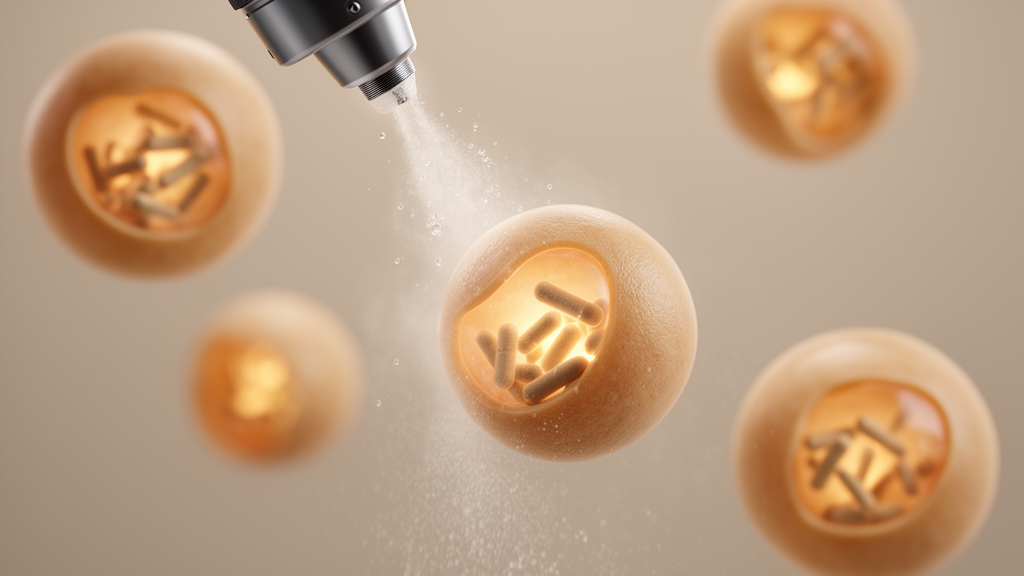
A laboratory study published in Food Science and Biotechnology on 25 October 2026 reports that Lactobacillus acidophilus can be encapsulated in microcapsules made from autolyzed yeast cells (AYC), with spray-drying survival rates ranging from 59.46 percent to 82.15 percent depending on the process settings used.
The researchers optimized the spray-drying process, testing how inlet temperature and solids concentration governed cell survival. The maximum recovery was achieved at an inlet temperature of 135 °C combined with a 10 percent solids concentration. The results show how directly process parameters translate into biological outcomes: the same bacterium, dried under different settings, emerged with markedly different survival.
The starkest contrast appeared during simulated digestion. Free, unencapsulated cells declined sharply from 9.30 ± 0.06 to 1.22 ± 0.07 log CFU/mL in gastric fluid and fell further to 0.52 ± 0.03 log CFU/mL in intestinal fluid, meaning nearly the entire population was lost in transit. Microcapsules produced under multi-response optimized conditions behaved very differently. They carried 7.24 ± 0.11 log CFU/mL immediately after drying, retained 5.25 ± 0.12 log CFU/mL after sequential intestinal transit, and held 5.51 ± 0.18 log CFU/mL following 90 days of refrigerated storage. The slightly higher count after storage than after digestion reflects the distinct tests performed, not a gain during storage.
Structural analysis helped characterize the protection. Scanning electron microscopy confirmed the formation of intact spherical microcapsules, while Fourier-transform infrared spectroscopy showed a marked increase in rigid β-sheet protein conformations within the wall material. The abstract reports the structural observations and the survival measurements separately rather than establishing a causal mechanism linking the protein conformational shift to cell protection.
The study is laboratory research based on in vitro digestion models, so the results describe performance in simulated gastric and intestinal fluids rather than confirmed benefits in humans. Even so, the reported numbers are notable for food applications: a carrier that maintains cell counts above 5 log CFU/mL through sequential digestive stress and preserves viability over a 90-day refrigerated shelf life addresses several bottlenecks at once.
The authors position AYC as a sustainable, high-performance carrier for delivering viable probiotics through gastrointestinal stress. Within the limits of the in vitro evidence, the study indicates that spray-drying conditions and wall material can be tuned together to keep L. acidophilus viable from the drying chamber through simulated digestion and storage.
Subject of Research: Spray-drying microencapsulation of Lactobacillus acidophilus in autolyzed yeast cell-based microcapsules
Article Title: Spray drying process optimization for encapsulation of Lactobacillus acidophilus in autolyzed yeast cell-based microcapsules: structural and functional evaluation
Article References: Atalar, I., Yılmaz, S., El-Obeid, T., Aksu, M. İ., Toker, Ö. S., İlter, Ş. O., Kurt, A., & Konar, N. (2026). Spray drying process optimization for encapsulation of Lactobacillus acidophilus in autolyzed yeast cell-based microcapsules: structural and functional evaluation. Food Science and Biotechnology. https://doi.org/10.1007/s10068-026-02351-1
Image Credits: AI Generated
DOI: 10.1007/s10068-026-02351-1
Keywords: probiotics, microencapsulation, spray drying, Lactobacillus acidophilus, autolyzed yeast, gastrointestinal survival, in vitro digestion, shelf life, food science, β-sheet proteins, Spray, drying
News Source: Drew Townsend. (October 25, 2026). Yeast-derived microcapsules shield probiotic bacteria through spray drying and digestion. Scienmag.