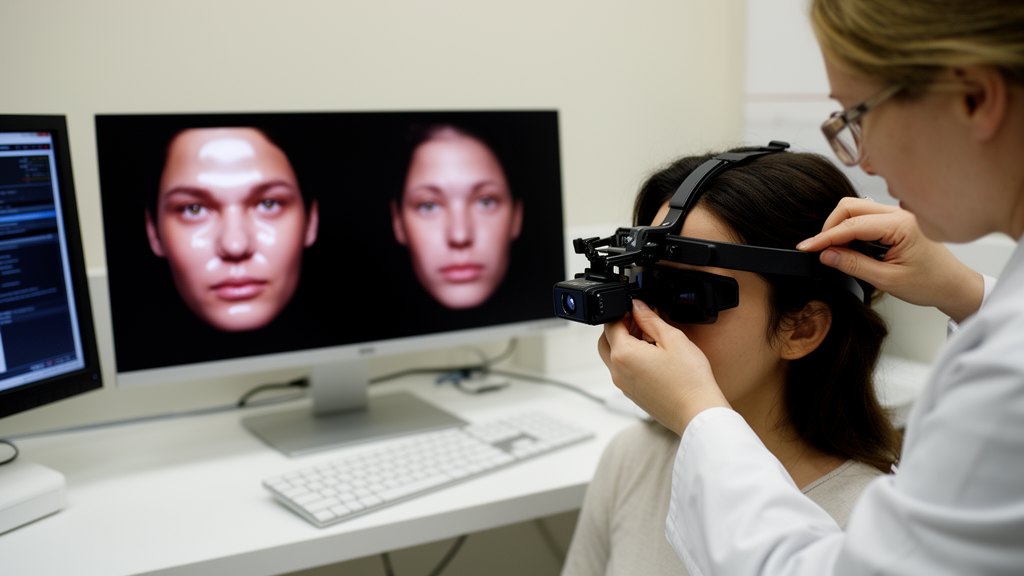
The same everyday-object images elicited different temporal patterns of pupil constriction and dilation depending on whether 24 participants judged their glossiness or their attractiveness, according to an experimental study from Toyohashi University of Technology. Higher glossiness ratings were associated with stronger pupil constriction in an early response window centered at approximately one second after stimulus onset. By contrast, higher attractiveness ratings tended to be associated with greater pupil dilation at later points. The findings indicate that measured pupillary responses can reflect the evaluation being performed as well as the visual characteristics of the objects themselves.
Associate Professor Hideki Tamura and colleagues from the university’s Vision and Action Laboratory, Visual Perception and Cognition Laboratory, and Cognitive Neurotechnology Unit conducted the experiment. The researchers examined two forms of evaluation: perceived glossiness, a visually grounded judgment about a surface property, and perceived attractiveness, a more affective impression. The same 60 images of everyday objects were used in both tasks. Participants rated every image separately on seven-point scales for how glossy and how attractive it appeared, allowing the researchers to compare the timing of pupillary responses while holding the visual stimuli constant.
Each image was presented for three seconds while the researchers recorded changes in pupil diameter. Because pupil size is highly sensitive to luminance, the team assessed image statistics, including mean luminance and variance, and controlled these characteristics across the stimulus set. In both judgment tasks, the pupil initially constricted after an image appeared and then gradually recovered. The relationship between the subjective ratings and the pupillary response nevertheless followed different temporal courses. Greater perceived glossiness was associated with greater constriction around one second after stimulus onset, whereas greater perceived attractiveness tended to be associated with more dilation later in the response. These observations represent measured associations between ratings and pupil behavior, not evidence that one type of evaluation directly caused a particular change in pupil size.
To characterize these differences, the researchers used temporal principal component analysis and generalized additive models. The analyses showed that the relationship between participants’ ratings and their pupillary responses varied systematically according to both the judgment task and the time since stimulus onset. The early constriction associated with glossiness ratings therefore differed from the later dilation pattern associated with attractiveness ratings. The results support the narrower conclusion that the temporal characteristics of pupillary responses may differ when observers evaluate the same objects in terms of a surface property versus an affective impression.
The experiment was limited to 24 participants, a set of 60 everyday-object images, and two forms of evaluation, so it does not establish a general mapping between pupil responses and all perceptual or affective judgments. Tamura said the results suggest that pupillary responses are influenced not only by the visual characteristics of objects but also by what observers are evaluating about those objects. Future research will examine whether evaluations of other material and surface properties, including transparency, roughness, and softness, are likewise reflected in distinguishable temporal patterns of pupillary response.
Subject of Research: Task-dependent pupillary responses during judgments of object glossiness and attractiveness
Article Title: Pupils respond not only to “what we see” but also to “how we evaluate it”
Article References: Pupils respond not only to “what we see” but also to “how we evaluate it”. Original publication (Bibliographic details unavailable.)
Image Credits: AI Generated
DOI: Not provided
Keywords: pupillary response, pupil dilation, pupil constriction, gloss perception, attractiveness judgment, visual perception, affective evaluation, temporal dynamics, eye tracking, object imagery, Pupils, respond
News Source: Denise Maddox. (October 25, 2026). Pupil timing differs in 24-person glossiness and attractiveness experiment. Scienmag.