Sugarcane fields in northeastern Brazil have become the testing ground for a simple but potentially far-reaching idea: instead of dripping water and fertilizer into the soil in one long daily session, deliver them in short, repeated pulses. In a field experiment at the Carpina Sugarcane Experimental Station, a research unit of the Federal Rural University of Pernambuco, researchers found that pulse subsurface drip fertigation combined with a nitrogen rate of about 189 kilograms per hectare produced the highest net photosynthesis the team measured in the crop. The study, published in Discover Plants, also identified a physiological ceiling: nitrogen rates above roughly 168 kilograms per hectare reduced the efficiency with which the plants fixed carbon and used water. The results suggest that the timing of water delivery can matter as much as the amount of fertilizer applied, and that the two factors interact in ways conventional management may be missing.
The stakes are considerable. Sugarcane underpins the production of sugar and ethanol across tropical and subtropical regions, and demand for both commodities continues to climb. Nitrogen is one of the primary nutrients driving plant growth, development and metabolic activity, while irrigation is essential for meeting the water demands of the crop in many production regions. Yet both resources are costly, and both are easily wasted. Excess nitrogen can be lost from the root zone, and over-irrigation squanders water and energy. Rational, combined management of irrigation and fertilization is therefore viewed as a key tool for reducing the effects of water scarcity while raising the production potential of sugarcane fields. The Brazilian team set out to test whether the way water is delivered, not just how much, changes how the crop responds to nitrogen.
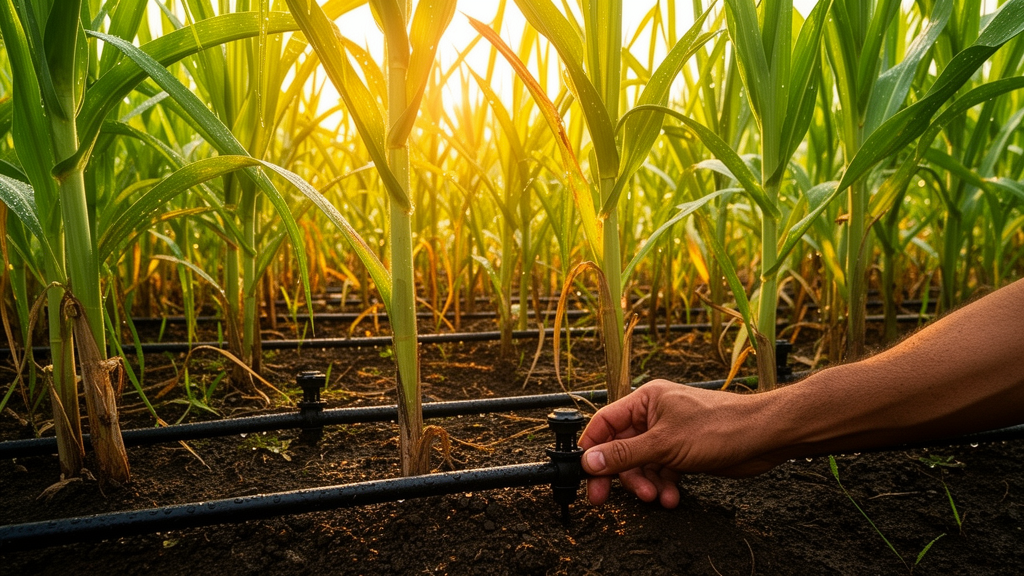
Pulse drip irrigation works by breaking the daily irrigation depth into a succession of cycles. Each cycle has two distinct phases: an irrigation phase, in which the soil is moistened, followed by a resting phase, which allows the water to redistribute through the soil profile before the next cycle begins. In this experiment, the crop received four daily pulses with 40-minute rest intervals between them, with the duration of each pulse adjusted daily to match the calculated water requirement. Previous studies in other crops have linked this approach to water and energy savings, maintained soil moisture, higher yields and improved nutrient absorption. Earlier work on sugarcane under pulse subsurface drip irrigation had already reported significant gains in physiological performance, but studies pairing pulse delivery with nitrogen rates were scarce.
The experiment ran between December 2021 and October 2022 in the humid tropical Zona da Mata region of Pernambuco, on a sandy loam Ultisol. The team used a randomized block design in a five-by-two factorial scheme: five nitrogen doses delivered by fertigation (80, 120, 160, 240 and 320 kilograms per hectare) crossed with two irrigation application types, pulse and continuous, with four replicates each, totaling 40 plots. The crop was cultivar RB041443, and urea served as the nitrogen source, with fertigation beginning 70 days after harvesting and the nitrogen fractionated into seven fortnightly applications between March and September. Phosphorus was applied conventionally, potassium went through the drip lines, and a micronutrient mix was sprayed twice during the cycle.
The water balance over the cycle tells its own story. Accumulated rainfall reached 1,129 millimeters, nearly matching the reference evapotranspiration of 1,139 millimeters, while crop evapotranspiration totaled 1,039 millimeters. As a result, the gross irrigation depth applied was only 166 millimeters, since rainfall between February and August covered most of the crop’s needs. Gas exchange was measured at 240 and 300 days after harvesting with a portable infrared gas analyzer, on the middle third of the leaf plus three and the top visible dewlap leaf, between 11 a.m. and 1 p.m., when solar radiation and evapotranspiration demand were intense. To promote sucrose deposition and maturation, irrigation was deliberately suspended at 270 days after harvesting, and the crop was harvested at 310 days.
The photosynthesis results were striking. Under pulse irrigation at 240 days after harvesting, net photosynthesis peaked at 16.05 micromoles of carbon dioxide per square meter per second at the estimated nitrogen dose of 189.4 kilograms per hectare, an increase of 82.38 percent compared with the lowest dose of 80 kilograms per hectare, which yielded 8.8 micromoles. Under continuous irrigation, by contrast, the optimum dose was 135 kilograms per hectare, and it produced only 8.9 micromoles, a gain of just 2.29 percent over the lowest dose. At the intermediate doses of 120 and 160 kilograms per hectare, pulse-irrigated plants outperformed continuously irrigated ones by 53.4 and 117 percent respectively. At the second reading, 300 days after harvesting, the estimated optimum dose was 176.1 kilograms per hectare, producing 19.8 micromoles, 22.9 percent above the 16.1 micromoles recorded at 80 kilograms per hectare.
Transpiration and stomatal conductance followed similar patterns. At 240 days after harvesting, transpiration peaked at 3.7 millimoles of water per square meter per second at 165 kilograms of nitrogen per hectare, a modest 5.7 percent increase over the 3.5 millimoles recorded at the lowest dose. Stomatal conductance reached its maximum of 0.063 moles of water per square meter per second at 150 kilograms of nitrogen per hectare at the first reading, a gain of 16.6 percent over the 0.054 moles measured at 80 kilograms per hectare. At 300 days after harvesting, the same optimum dose of 150 kilograms per hectare produced a maximum conductance of 0.132 moles, 12.8 percent above the 0.117 moles at the lowest dose. The researchers attribute these stomatal responses to nitrogen’s role in synthesizing photosynthetic pigments and enzymes, which supports stomatal regulation and facilitates carbon dioxide assimilation.
The efficiency metrics revealed where the physiological ceiling lies. Instantaneous water use efficiency, the ratio of photosynthesis to transpiration, peaked at 4.09 micromoles of carbon dioxide per millimole of water at 185 kilograms of nitrogen per hectare at 240 days after harvesting, exceeding both the lowest dose by 15.5 percent and the highest dose of 320 kilograms per hectare by 28.6 percent. At 300 days, the maximum was 5.09 micromoles at the same dose, 9.4 percent above the lowest. Intrinsic water use efficiency, the ratio of photosynthesis to stomatal conductance, reached 165.1 micromoles per millimole at 168.4 kilograms of nitrogen per hectare, 14.6 percent above the lowest dose. Instantaneous carboxylation efficiency climbed to 0.135 moles per square meter per second at 191.6 kilograms of nitrogen per hectare, a dramatic 121.3 percent increase over the 0.061 moles at 80 kilograms per hectare, but declined at higher rates.
Across both readings, pulse irrigation consistently outperformed continuous delivery. At 240 days after harvesting, pulse irrigation raised transpiration, stomatal conductance, intrinsic water use efficiency and carboxylation efficiency by 19.05, 22.41, 10.52 and 56.16 percent respectively compared with continuous irrigation. At 300 days, the gains for those variables were 15.07, 30.63, 6.49 and 136.12 percent, while net photosynthesis, internal carbon dioxide concentration and instantaneous water use efficiency, which showed no pulse advantage at the first reading, rose by 16.56, 35.0 and 9.8 percent. Leaf temperature and internal carbon dioxide concentration were largely unaffected by the treatments at the first reading. The team explains the mechanism as improved synchronization between water and nutrient availability in the root zone: fractionating the irrigation depth maintains a more stable soil water potential, keeping nitrogen readily available for root uptake and sustaining chlorophyll synthesis, RuBisCO activity and ATP production needed for carbon assimilation.
The practical implications are twofold. First, integrating pulse irrigation with balanced nitrogen management appears to enhance photosynthetic efficiency, stomatal regulation and water use efficiency, converting water and nitrogen into biomass more effectively while reducing losses through leaching. In the same experimental conditions, related work has shown that pulse irrigation increased stalk dry biomass and yield compared with continuous irrigation, and the physiological gains documented here are consistent with those agronomic outcomes. Second, the diminishing returns above roughly 168 kilograms of nitrogen per hectare warn against over-fertilization, since excess nutrient reduced carboxylation efficiency and water use rather than improving them. The authors caution that pulse irrigation demands greater investment in automation, regular maintenance and trained personnel, so its economic feasibility must be evaluated against local production conditions. Nitrogen doses between 150 and 190 kilograms per hectare optimized the physiological responses in this study, offering a benchmark for growers weighing fertigation strategies against water scarcity.
Subject of Research: Effects of nitrogen rates and pulsed versus continuous subsurface drip fertigation on leaf gas exchange in sugarcane
Article Title: Effects of nitrogen rates and pulsed versus continuous subsurface drip irrigation on gas exchange in sugarcane
Article References: de Vasconcelos, M. C., da Silva, G. F., da Silva, K. E., da Silva, M. M., Oliveira Filho, R. A., dos Santos, M. A. L., & da Silva, A. O. (2026). Effects of nitrogen rates and pulsed versus continuous subsurface drip irrigation on gas exchange in sugarcane. Discover Plants, 3(1), Article 483. https://doi.org/10.1007/s44372-026-00976-4
Image Credits: AI Generated
DOI: 10.1007/s44372-026-00976-4
Keywords: sugarcane, pulse irrigation, subsurface drip, nitrogen fertigation, gas exchange, photosynthesis, water use efficiency, carboxylation efficiency, stomatal conductance, Brazil, crop physiology, precision agriculture
News Source: Alan Morgan. (October 25, 2026). Pulsed Drip Irrigation and Moderate Nitrogen Boost Photosynthesis in Sugarcane. Scienmag.