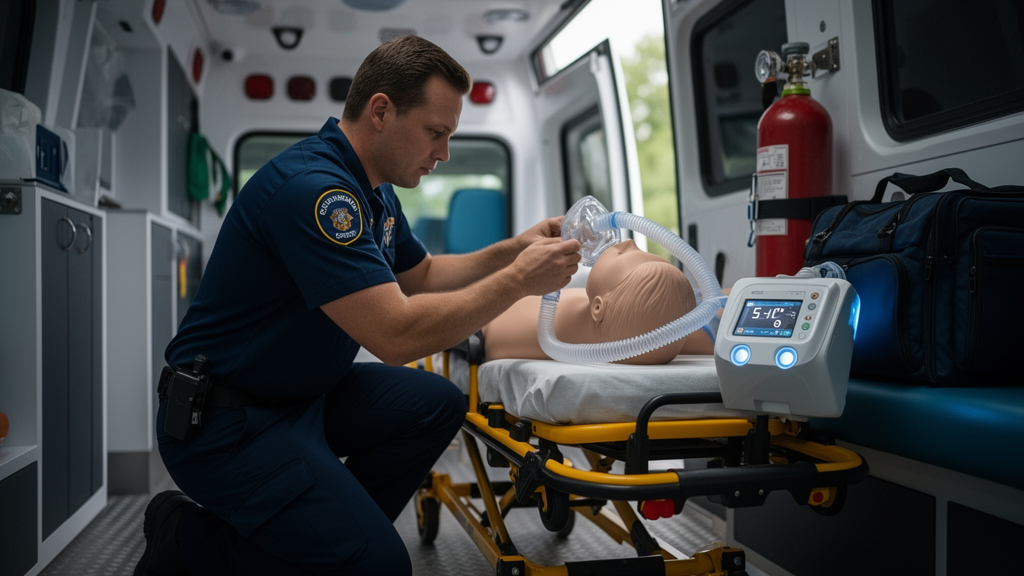
A portable, ready-to-use continuous positive airway pressure (CPAP) device designed to bring respiratory support to patients with acute respiratory failure before they reach a hospital has passed its first preclinical performance evaluation. The study, published in Biomedical Engineering Letters, describes how a team of engineers and clinicians combined bench experiments with two complementary computer modelling approaches to verify that their prototype can deliver a therapeutically useful pressure without pushing airway pressure into dangerous territory, and that exhaled carbon dioxide is efficiently cleared from the mask circuit between breaths.
Acute respiratory failure is a life-threatening condition in which the respiratory system can no longer maintain adequate gas exchange. Timely initiation of respiratory support is a key determinant of patient outcomes, because delays in treatment are correlated with an increased risk of progression to invasive ventilation and death. Accumulating evidence from observational studies and systematic reviews indicates that early non-invasive ventilation via CPAP, possibly initiated in the prehospital setting, is associated with a reduced risk of endotracheal intubation, lower in-hospital mortality and shorter intensive care unit stays compared with standard care. A recent multidisciplinary consensus paper went further, recommending that treatment begin within ten minutes of presentation and that non-invasive ventilation be preferred over simple oxygen therapy when acute respiratory distress is present, even before a diagnosis is clear.
Yet the widespread use of out-of-hospital CPAP remains limited by the devices themselves. Prehospital systems such as the Boussignac CPAP are pneumatically driven and require connection to a high-flow oxygen source, with delivered pressure depending on the supplied gas flow. Hospital-grade ventilators demand significant expertise for setup and adjustment and depend on external power or oxygen. Even home CPAP machines for sleep apnoea require users to select target pressures or predefined support profiles, which undermines their usefulness in urgent scenarios handled by first responders with no medical training. The new device was conceived specifically to close this gap: a compact, battery-powered, fully standalone unit that requires no external oxygen, no manual parameter setting and no technical expertise.
The operating principle is deliberately simple. A 12-volt DC brushless centrifugal blower, driven at a fixed, design-set rotational speed through pulse-width modulation, draws ambient air through an anti-particulate filter and pushes it into an air-distribution chamber, which decelerates and expands the high-velocity jet leaving the blower to promote more uniform flow and pressure at the patient interface. From there, air is delivered through a standard oronasal mask. Two fixed mechanical PEEP valves, one rated at 5 centimetres of water and one at 10, regulate the pressure reaching the airways, while an anti-asphyxia valve guarantees unobstructed inspiration even if the blower fails. The design goal was a positive end-expiratory pressure of at least 5 cmH2O for therapeutic benefit, with pressure never exceeding 10 cmH2O to avoid lung overdistention in an unmonitored setting.
The dual-valve arrangement is central to both the efficacy and the safety logic of the system, with built-in redundancy. The 5 cmH2O valve acts primarily as a pressure stabiliser, operating mostly within its low-resistance regime and venting excess flow to the atmosphere during transient phases of the respiratory cycle. Under normal operating conditions the 10 cmH2O valve constantly sits below its opening pressure, within its high-resistance regime, and intervenes only in the case of unexpected excessive pressure load, acting as a second safety element. The team deliberately chose fixed-point valves over adjustable ones because they offer higher precision, greater operational repeatability and improved safety, since the operator cannot alter the preset values. This choice differentiates the proposed system from currently available prehospital CPAP devices, which do not address the specific use case of a standalone, battery-powered unit requiring no external oxygen or pneumatic source and no manual setting of ventilatory parameters.
To characterise the prototype, the researchers first measured the pressure-flow behaviour of each component in isolation. The filter-blower-chamber sub-assembly was tested across blower duty cycles from 40 to 70 percent, with an adjustable resistance modulating outflow from free flow to zero in steps of roughly 20 litres per minute, using a biomedical gas flow analyser. The two PEEP valves were separately characterised with incremental flows from 0 to 150 litres per minute. These measurements, with root-mean-square errors between 0.28 and 2.42 cmH2O depending on the component, became the input parameters for the modelling work, ensuring that the simulations were grounded in the behaviour of the real hardware rather than in assumptions.
The first modelling layer was a lumped-parameter model built in OpenModelica, representing the blower assembly as a non-ideal pressure generator, the valves as variable resistive elements and the patient as an oscillating flow source, all coupled through conservation of air mass at the mask interface. Patient breathing was simulated using profiles from an active lung simulator configured to replicate a healthy subject at rest and during moderate and intense exercise, as well as obstructive and restrictive conditions: chronic obstructive pulmonary disease, acute respiratory distress syndrome and asthma, each at mild, moderate and severe levels. The single respiratory cycles were extracted with a custom MATLAB script and smoothed by spline interpolation, with an average reconstruction error of 1.23 litres per minute.
Simulations run at three duty-cycle levels, 45, 55 and 65 percent of maximum power, showed that the device held its pressure targets across every scenario. Positive end-expiratory pressure consistently exceeded the 5 cmH2O target, ranging from a low of 6.10 cmH2O in the mild asthma condition at 45 percent duty cycle to a high of 6.76 cmH2O in mild COPD at 65 percent. The highest maximum pressure observed was 7.39 cmH2O, recorded under the mild ARDS profile at 65 percent duty cycle, comfortably below the 10 cmH2O safety ceiling. Notably, PEEP rose with the device setting but was largely unaffected by disease severity or exercise intensity, while maximum pressure actually decreased as disease severity increased, because patients with worse respiratory mechanics impose greater instantaneous flow demands that shift the blower’s operating point toward lower pressure generation.
This behaviour revealed a form of passive self-adaptation that the authors consider central to the design. The system does not deliver a static pressure; it continuously adjusts its operation to the patient’s breathing pattern through the intrinsic flow-pressure characteristics of the blower and its fluid-dynamic interaction with the airways, without sensors, feedback control or operator tuning. The simulations also guided the choice of a single fixed operating point. Although the target pressure could be achieved even at 45 percent duty cycle under ideal conditions, the team selected 55 percent as a conservative setting that preserves a safety margin for power fluctuations, reduced battery capacity and the mask leakage and fit variability expected in real-world use, while optimising battery life for emergency deployment.
The second modelling layer addressed a safety concern that lumped-parameter models cannot resolve: the risk that exhaled carbon dioxide accumulates in the mask and is rebreathed. A three-dimensional computational fluid dynamics model of the device, discretised with roughly 1.3 million tetrahedral elements and solved with unsteady Reynolds-averaged Navier-Stokes equations using the realizable k-epsilon turbulence model in ANSYS Fluent, tracked the washout of a passive scalar representing exhaled CO2. The residual concentration decayed in an approximately negative-exponential pattern mirroring the expiratory flow: falling to 64 percent within 0.7 seconds of the onset of expiration, to 5 percent by 2.4 seconds, and leaving only about 2.3 percent of CO2-saturated air inside the device when the next inspiration began. Under the simulated conditions, the risk of hypercapnia from rebreathing appears negligible.
The authors are careful to frame these as preliminary, preclinical findings. The model assumed leak-free operation, whereas real mask fit and component connections can leak in ways that are difficult to predict; preliminary simulations exploring leakage flows up to 120 litres per minute suggested that the 55 percent setting would still maintain the target pressure, but dedicated bench testing with controlled leaks is planned. The breathing profiles came from simulator software libraries rather than in vivo measurements, and may not capture the full spectrum of real presentations, such as the rapid shallow breathing of severe COPD exacerbations. Patient comfort and tolerability were not assessed. The device is also explicitly not intended to replace expert care: it delivers low-level, temporary CPAP rather than pressure support, so patients with severe hypercapnic failure and exhausted respiratory muscles still require prompt professional assessment and possible escalation to bilevel ventilation.
The intended use cases span home, workplace and street emergencies handled by lay bystanders, nursing and elder care facilities, ambulances lacking the equipment or expertise to initiate non-invasive ventilation, and non-intensive hospital wards awaiting the medical emergency team. Supporting the model’s reliability, a companion usability study from the same group, in which multiple users applied the device to a manikin connected to an active lung simulator, found differences of only 1.1 to 1.3 cmH2O between the computed and experimentally delivered PEEP values across simulated pathological scenarios. Clinical studies are ongoing to validate the device’s real-world performance in scenarios where expert medical support is not immediately available.
Subject of Research: Design and preliminary performance evaluation of a portable CPAP device for prehospital treatment of acute respiratory failure
Article Title: Design assessment and preliminary performance evaluation of a novel device for non-invasive emergency treatment of acute respiratory failure
Article References: Ciceri Negri, F., Salurso, E., Giardina, G., Consolo, F., Landoni, G., Redaelli, A. C. L., & Fiore, G. B. (2026). Design assessment and preliminary performance evaluation of a novel device for non-invasive emergency treatment of acute respiratory failure. Biomedical Engineering Letters. https://doi.org/10.1007/s13534-026-00619-3
Image Credits: AI Generated
DOI: 10.1007/s13534-026-00619-3
Keywords: acute respiratory failure, CPAP, non-invasive ventilation, prehospital care, PEEP valves, lumped-parameter model, computational fluid dynamics, CO2 rebreathing, emergency medicine, biomedical engineering, respiratory support, medical device design
News Source: Denise Maddox. (October 25, 2026). Ready-to-use CPAP device shows safe pressure profile in prehospital respiratory failure simulations. Scienmag.