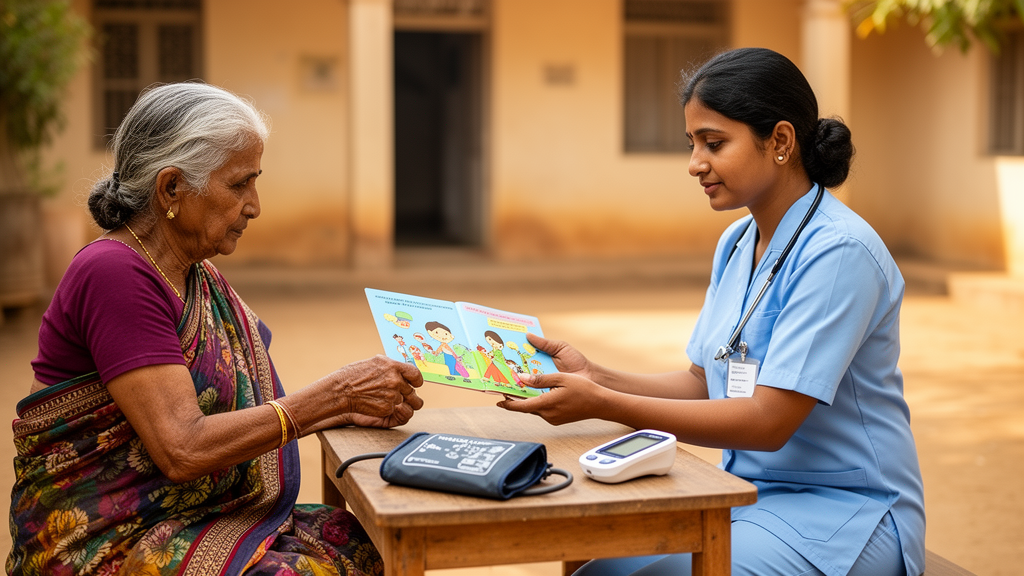
A sweeping scoping review of randomised controlled trials has found that behavioural interventions for managing diabetes and hypertension across South Asia are heavily concentrated in just two countries and rely overwhelmingly on patient-level education and counselling, while evidence on whether these programmes are actually adopted by organisations, sustained over time, or embedded into health systems remains strikingly thin. The review, published in BMC Public Health, mapped 88 randomised controlled trials to characterise how healthy-behaviour interventions targeting the two conditions have been designed, delivered and evaluated in the region.
Non-communicable diseases such as diabetes and hypertension place a major public health burden on South Asia, yet existing syntheses of behavioural interventions have been constrained by outdated evidence, limited geographic coverage and a narrow analytical scope. To address this gap, the research team systematically searched PubMed, Embase.com and the Web of Science Core Collection from their inception dates up to 20 August 2026. Of 7,645 records identified, 4,915 remained after duplicate removal and were screened, ultimately yielding 88 studies for inclusion in the review.
The geographic picture that emerged was markedly uneven. India accounted for 47 of the 88 included studies, or 53.4 percent, and Pakistan contributed a further 19 studies, or 21.6 percent, meaning roughly three-quarters of the regional evidence base came from these two countries alone. In terms of clinical focus, 57 studies, or 64.8 percent, targeted diabetes, 27 studies, or 30.7 percent, addressed hypertension, and only four studies covered both conditions simultaneously.
When the researchers characterised what the interventions actually did, a consistent pattern surfaced. Most programmes, 60 of the 88 studies or 68.2 percent, addressed multiple behavioural or self-management targets rather than a single behaviour. Education or counselling featured in 78 studies, or 88.6 percent, face-to-face delivery was used in 73 studies, or 83.0 percent, and 59 studies, or 67.0 percent, incorporated repeated follow-up or ongoing support for participants.
To move beyond simple descriptions of intervention content, the team mapped the underlying behavioural mechanisms using established behaviour-change frameworks. Capability was identified as a mechanism in 86 studies, or 97.7 percent, Motivation in 56 studies, or 63.6 percent, and Opportunity in 51 studies, or 58.0 percent. The researchers noted that these categories were not mutually exclusive, so a single trial could contribute to more than one mechanism. The dominance of Capability suggests that most interventions concentrated on equipping patients with the skills and knowledge to manage their condition, rather than reshaping the environments or social structures that shape behaviour.
The review also assessed how well implementation had been documented across the trials, and here the imbalances were pronounced. Information on intervention implementation was reported in 81 studies, or 92.0 percent, but reach, meaning the extent to which the target population was actually exposed to the intervention, was documented in only 47 studies, or 53.4 percent. Adoption by organisations or settings was reported in just 11 studies, or 12.5 percent, and maintenance, whether effects and delivery persisted over time, appeared in only two studies, a mere 2.3 percent of the evidence base.
Health-system integration showed an even steeper gradient. All 88 studies demonstrated individual- or family-level actions, reflecting the patient-centred nature of the field. Only 29 studies, or 33.0 percent, included organisational or community-level actions, and a single study, or 1.1 percent, incorporated any health-system or policy-level action. The authors characterised this as evidence that behavioural support in the region has remained largely confined to the level of the individual patient and their household, with little connection to broader chronic-care structures.
The mapping drew on established intervention-description, behaviour-change, implementation and chronic-care frameworks, allowing the team to characterise intervention targets, delivery approaches, behavioural mechanisms, implementation dimensions, outcomes and health-system integration in a standardised way across the 88 trials. This framework-based approach is what enabled the review to expose not only what interventions contain, but which parts of the implementation and health-system picture have gone largely unmeasured in the published literature.
The authors concluded that behavioural interventions for hypertension and diabetes in South Asia are geographically concentrated in India and Pakistan and focus predominantly on patient-level education and self-management support, while evidence on reach and representativeness, organisational adoption, maintenance and health-system integration remains limited. They recommended that future research evaluate the integration, sustainability and scalability of behavioural support within routine chronic-care settings. As a scoping review, the study maps the shape of the existing trial evidence rather than pooling effectiveness estimates, and its conclusions about gaps in the literature reflect what the included trials did and did not report.
Subject of Research: Behavioural interventions for hypertension and diabetes management in South Asia
Article Title: Interventions promoting healthy behaviours for hypertension and diabetes management in South Asia: a scoping review
Article References: Arifuzzaman, Rajagopal, A., Nisar, M., Moni, M. A., Mridha, M. K., & Khan, A. (2026). Interventions promoting healthy behaviours for hypertension and diabetes management in South Asia: a scoping review. BMC Public Health. https://doi.org/10.1186/s12889-026-30011-w
Image Credits: AI Generated
DOI: 10.1186/s12889-026-30011-w
Keywords: scoping review, South Asia, diabetes, hypertension, behaviour change, randomised controlled trials, self-management, health-system integration, implementation science, non-communicable diseases, BMC Public Health, Interventions
News Source: Courtney Benton. (October 25, 2026). Behavioural programmes for diabetes and hypertension in South Asia skew toward education, review finds. Scienmag.